A decade that changed the terms of discussion
Discussing board games in the 1990s does not require treating the decade as an absolute beginning. Board, card, token and dice games have a far longer history, and popular accounts often trace that history to ancient forms of play. Yet the evidence available for this dossier does identify a shift in perspective: from the 1990s onward, the industry is described as undergoing an especially significant transformation, linked to popularisation and a broader range of releases.
That wording matters because it avoids two common simplifications. One would be to assume that there had been no innovation, authors, publishers or adult audiences before the decade. The other would be to treat every game published since then as one homogeneous block. What can cautiously be sustained is narrower: board games gained visibility as a distinct form of entertainment and as objects around which design, industry, narrative, materiality and consumption could be discussed.
A broader offer does not mean one way of playing
The expansion of available games is the structural point running through the supplied sources. Shangrila places the greatest transformation of the industry in the 1990s, connecting it with popularisation and an increase in the offer. Its approach does not reduce the phenomenon to a single rule system or editorial nationality: it proposes studying games from historical origins to contemporary industry, considering mechanics, represented worlds and the physical dimension of objects.
This makes it possible to read the change as an expansion of possibilities. A richer catalogue can accommodate family games, strategy titles, negotiation experiences, thematic proposals and designs with differing levels of complexity. It does not, by itself, establish how every household played or which titles sold most in each country; those questions would require distribution, sales and reception data absent from the supplied evidence. It does explain why discussion of the medium became more varied.
Eurogame as a sign of its time
The sources name Settlers of Catan, Carcassonne and Ticket to Ride when describing the popularisation of so-called eurogames. Corvus Belli also describes the release of Catan, designed by Klaus Teuber, as a fundamental milestone for the industry. These statements are best read as markers of sector memory: the three titles recur as reference points in accounts of the hobby’s changing scale.
The word eurogame, however, does not settle a fixed definition by itself. Shangrila’s text notes that “modern board games” is itself a contested expression. Editorially, that caution is productive. Rather than turning the label into a rigid boundary, it can be understood as shared vocabulary for discussing part of the production that gained prominence in those decades. Labels organise conversations, but they can also conceal differences among authors, rules, markets and communities.
Catan as an example, not a total explanation
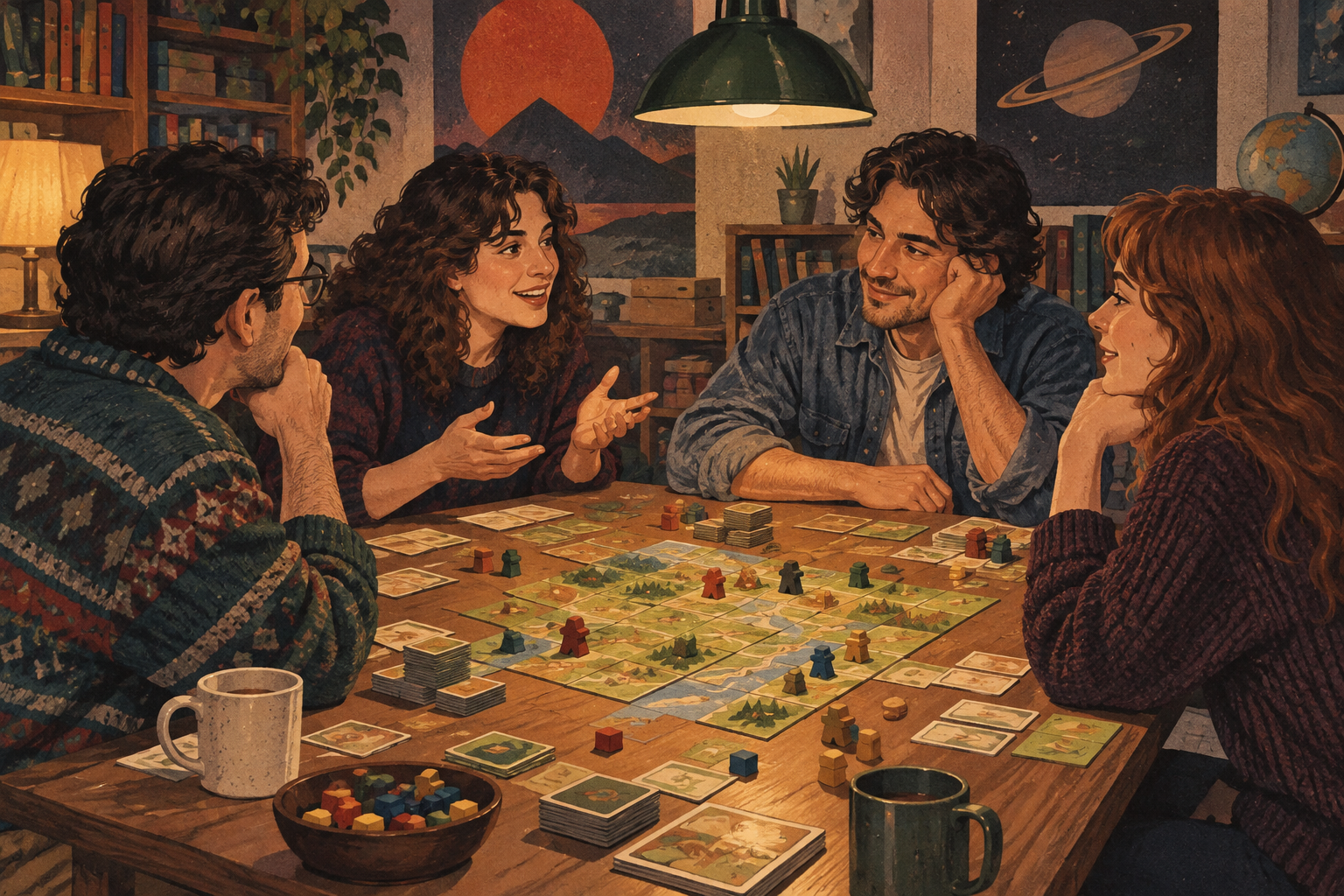
Settlers of Catan is an appropriate visual and editorial subject because it is explicitly named in several pieces of evidence. Its recurring presence shows that the game has become a reference for explaining a wider transformation. Using it as an emblem does not mean claiming that it alone caused the sector’s evolution. The industry is a network of design, publishing, distribution, criticism, shops, fairs and play habits; the available material does not allow the weight of each element to be measured.
The example is valuable for another reason. Catan can open larger questions: what makes a game recognisable, how recommendations circulate, and why a domestic object can become a meeting point for people with different experiences. Corvus Belli’s overview also points toward this movement, describing an increasing separation of board games from the toy category and an orientation toward varied audiences, including adults and dedicated players.
Fairs, festivals and public visibility
The 1990s account is not only about boxes and rulebooks. Shangrila connects the popularisation of eurogames with festivals such as Internationale Spieltage in Essen. This matters because it places play in public meeting spaces, where publishers, authors, players and curious visitors may encounter new releases and demonstrations.
The supplied evidence mentions an attendance figure for Essen in a specific context, but offers neither a historical series nor enough independent documentation to make it a general measure of growth. It is therefore better not to use it as quantitative proof. What can be verified here is the symbolic role of fairs in the sector’s story: they make an activity visible beyond individual purchases and help create a shared language of new releases, genres and expectations.
From domestic object to object of study
One of the most suggestive consequences of this change is that board games cease to be only a pastime discussed through personal memories. Encrucijadas del juego de mesa proposes historical, cultural and industrial approaches. Its description includes narratives and metaphors, mechanics, simulated contexts, materiality and transformation into digital formats. This is a broad agenda: it asks not only whether a game is entertaining, but what it represents, what relationships it organises and how it exists as a product.
That view does not require claiming that every game has identical cultural importance. More modestly, it asks that games be taken seriously as designed artefacts. A board distributes spaces; rules enable and limit choices; pieces give physical presence to an abstraction; a box promises an experience before it is opened. Analysing such layers connects design with everyday life without confusing interpretation with documented fact.
Limits of the available evidence
This article does not seek to establish an exhaustive eurogame chronology or assign release dates, sales figures, awards or licences. The supplied sources are mainly popular and editorial texts, and some use broad formulations. They are useful for identifying narratives and recurring references, but they do not replace publisher archives, dated catalogues, market statistics or peer-reviewed historical research.
The conclusion must therefore remain proportionate. In the available evidence, the 1990s appear as a decade of expansion and reconfiguration for board games: the offer grew, certain reference titles became visible, and vocabulary for debating design, audiences and industry became established. Catan, Carcassonne and Ticket to Ride help identify that narrative, but do not exhaust it.
An open legacy
The legacy of this turn is not one formula for making games. It is the possibility of reading the board game at once as entertainment, cultural product, material design and social space. That plurality explains why a history of board games must look beyond nostalgia and quick classifications. It also requires documentary discipline: recognising the medium’s cultural importance does not authorise filling gaps in the evidence.
Seen through the assembled sources, the 1990s neither close an earlier history nor determine everything that followed. They mark, rather, a point from which speaking about board games more clearly meant speaking about an ecosystem: titles, players, authors, publishers, fairs, criticism and physical objects whose meanings continue to change whenever someone unfolds a board.
Documentary gallery


- Decade
- 1990s
- Region
- Global
- Level
- Enthusiast
- Entities
- No linked entities
Sources and references
- Encrucijadas del juego de mesa. Historia, cultura e industria – Shangrilashangrilaediciones.com · 2026-09-21
- Juegos de mesa: Evolución Históricacorvusbelli.com · 2026-09-21
- La historia mundial, contada con juegos de mesa: del Paleolítico a la Era Espacialwww.xataka.com · 2026-09-21
- textos en red - shangrila-blog: II. ENCRUCIJADAS DEL JUEGO DE MESA. HISTORIA, CULTURA E INDUSTRIA", Jan Gonzalo Iglesia (ccord.), Valencia: Shangrila, 2024.www.shangrila-blog.com · 2026-09-21
- La muy, muy larga pero imprescindible historia de los juegos de mesawww.xataka.com · 2026-09-21