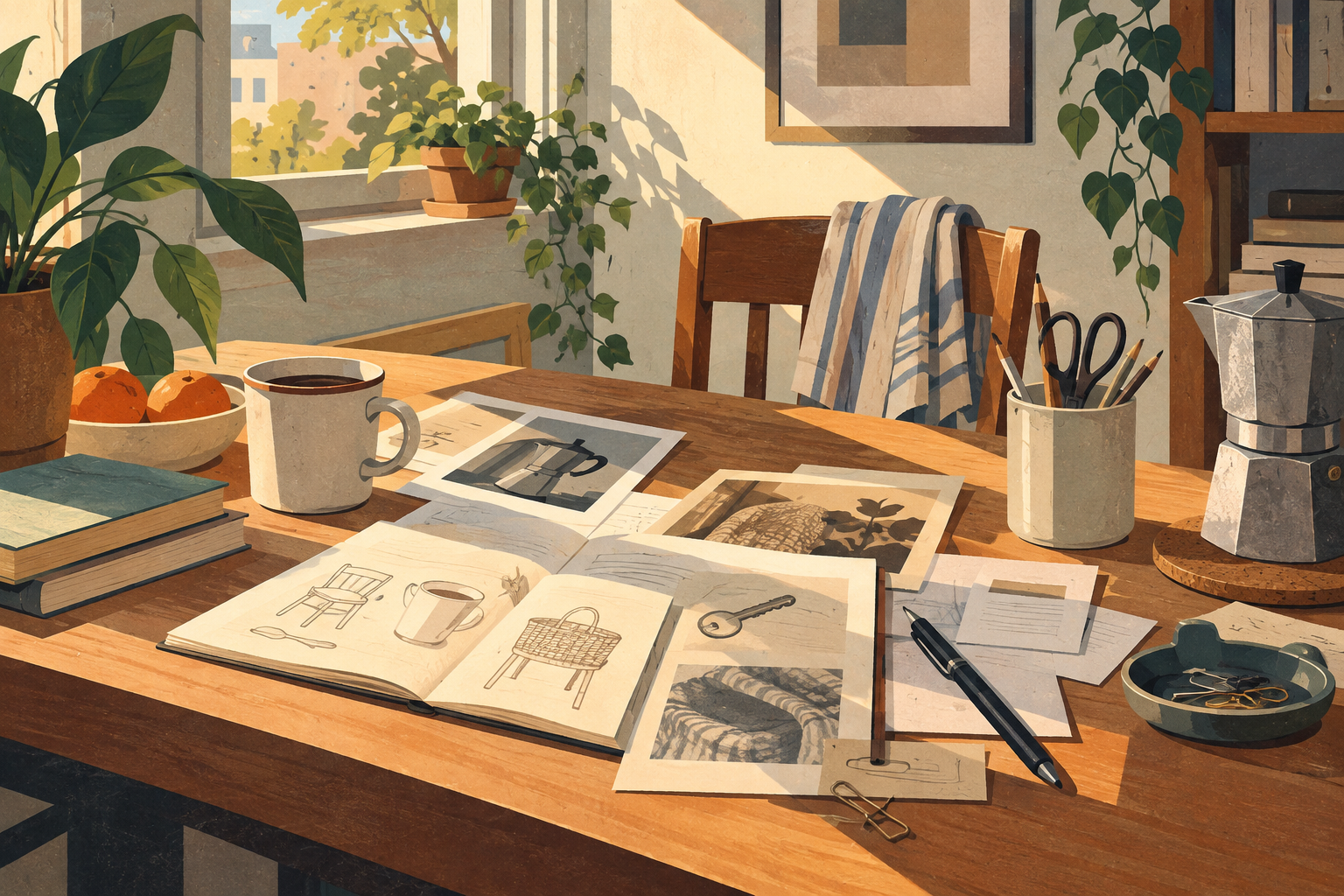
The ordinary changes too
History is often arranged around wars, governments, innovations, or crises. That approach helps explain major decisions and institutions, yet it leaves an open question: how did those processes translate into daily gestures, spaces, and obligations? The history of everyday life addresses precisely that territory. It does not treat the everyday as a set of domestic curiosities or as picturesque scenery for larger events. It approaches it as a historical sphere: a lived reality, socially constructed and subject to change.
The formulation found in Redalyc is particularly useful: everyday life stands at the centre of each person’s history and can be altered by the social context. The apparent simplicity of that claim requires caution. A frequent practice is not necessarily identical for everyone; an ordinary object does not by itself reveal who could buy it, repair it, or do without it. Studying daily life therefore means moving from nostalgia for “things from the past” to verifiable questions about access, use, rules, and inequality.
Beyond major events
The value of this perspective is not that it reduces the importance of politics, economics, or industry. On the contrary, it makes their effects visible at close range. The introduction available through Project MUSE notes that fields seemingly distant from daily life—trade, industry, administration, defence, or foreign relations—can provide evidence about practices and values. Import statistics may indicate the circulation of valued goods; factory and workshop regulations can offer a view of labour discipline; government archives may preserve traces of migration, conflict, and local events.
This is an important methodological lesson. Everyday life does not appear only in diaries or family photographs. It can also be reconstructed from documents created for other purposes: administrative records, court files, internal rules, service contracts, or financial transactions. None of them speaks for itself. A regulation describes expected conduct; it does not automatically prove compliance. A court file usually records conflict, not an uneventful routine. Its value emerges when it is compared with other evidence and placed in context.
Private sources are valuable, but insufficient
Memoirs, letters, autobiographies, and family archives seem to give direct access to intimacy. Project MUSE warns, however, that such testimony is scarce and cannot be fully trusted on its own. It contains choices, silences, and intentions. A letter writer may protect an image, omit hardship, or write for a particular recipient; a family album’s keeper decides which moments deserve preservation. This mediation does not invalidate the source. It requires us to read it as situated evidence.
Combination is essential. A memoir may suggest how a working day was experienced; business documents or regulations can help establish its schedules and rules; consumption records, where available, allow questions about material access. No layer replaces another. The strongest result is not a closed scene, but an explanation that separates what is documented, what is likely, and what cannot yet be known.
Objects, practices, and relationships
Objects belong to everyday life, but they do not define it completely. A utensil, garment, publication, or food item gains meaning within a network of practices: who makes it, who buys it, where it is kept, how it is used, how long it lasts, and which relationships it organizes. The research on artefacts cited by Dialnet refers to the continuous creation of everyday life and to the different social roles played by individuals. This shifts attention from an isolated item to its functional and social setting.
An everyday history of objects must therefore resist automatic explanations. The existence of a product does not prove widespread adoption. An image of use does not ensure that it depicts a majority custom. Even the word “everyday” can conceal decisive differences of class, age, gender, occupation, territory, or migratory situation. The productive question is not merely “what was there?” but “for whom, under what conditions, and with what alternatives?”
Scales: home, work, neighbourhood, and city
Context is not decorative. Project MUSE stresses that it is indispensable for supporting hypotheses and explaining local or regional situations: industrial zones, working-class districts, farming villages, and labour or religious corporations do not produce equivalent experiences. The same economic shift may change time, travel, housing, or consumption differently according to place and social position.
The Letras Libres review of Historia de la vida cotidiana en México. Siglo XX demonstrates the potential of this concrete scale by highlighting information about workers, industries, wages, products, organization, and industrial discipline, as well as access to private space among a growing urban working class. It does not authorize an extension of that experience to every territory or the entire century. It does show how social and material data can be connected to private life. Everyday life becomes historical when it is related to structures and differences, rather than presented as a uniform postcard.
Against the illusion of an unchanging routine
The JSTOR introduction notes that people tend to think they know the everyday and assume that needs and routines are unchanging, even though they constantly change. This warning is essential for any retro approach. Familiarity can mislead: recognizing a gesture or object is not the same as understanding its historical place. Shopping, work, care, leisure, and communication depend on rules, availability, infrastructures, and relationships that may change profoundly even when a surface gesture remains.
It also prevents another error: turning the past into a linear lesson in improvement or loss. Changes in daily life create possibilities, constraints, and unequal distributions. Without specific evidence, it is not appropriate to declare an era simpler, more authentic, or more comfortable. Responsible editorial work should describe demonstrable change, identify its limits, and leave open the questions that sources do not answer.
A demanding way to look closely
The history of everyday life expands the historical field because it takes seriously what often seems too normal to require explanation. Its contribution is not nostalgia for routines, but the ability to question them. Administrative archives, labour documentation, private sources, court records, and social research can reveal different aspects of the same experience when critically compared.
The limit of this approach is also its strength: it does not allow scattered clues to become total certainty. It demands attribution, context, and recognition of documentary absences. Looking at everyday life in this way does not reduce history to the small scale. Rather, it shows that large transformations acquire concrete form only when they affect the time, objects, spaces, and relationships through which people sustain their lives each day.
- Decade
- Before 1950
- Region
- Global
- Level
- Introduction
- Entities
- No linked entities
Sources and references
- Project MUSE - Introducción a la historia de la vida cotidianamuse.jhu.edu · 2026-09-19
- La vida cotidiana como espacio de construcción socialwww.redalyc.org · 2026-09-19
- Introducción a la historia de la vida cotidiana on JSTORwww.jstor.org · 2026-09-19
- Los artefactos como objetos de conocimiento en ...dialnet.unirioja.es · 2026-09-19
- Historia de la vida cotidiana en México. Siglo XX | Letras Libresletraslibres.com · 2026-09-19