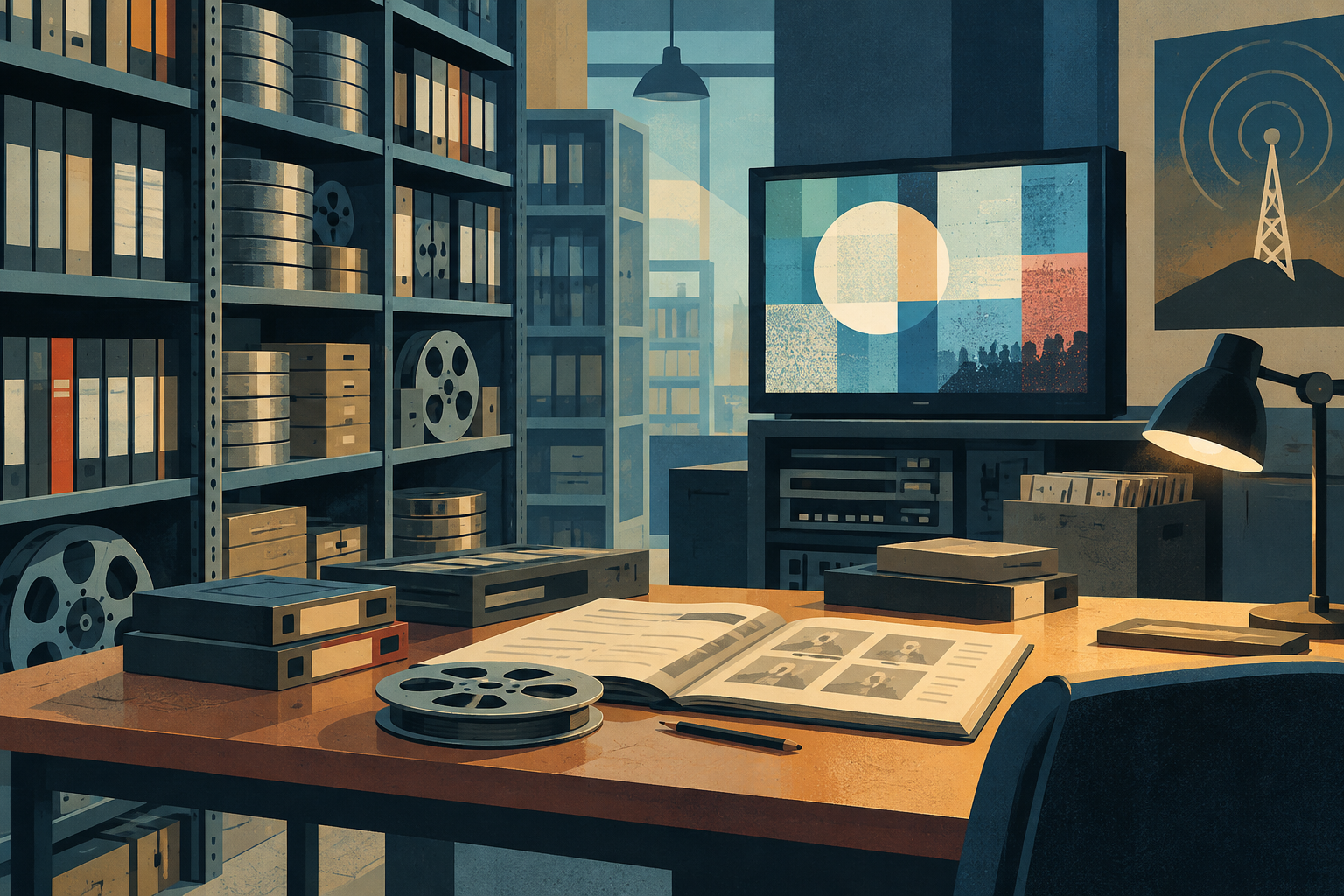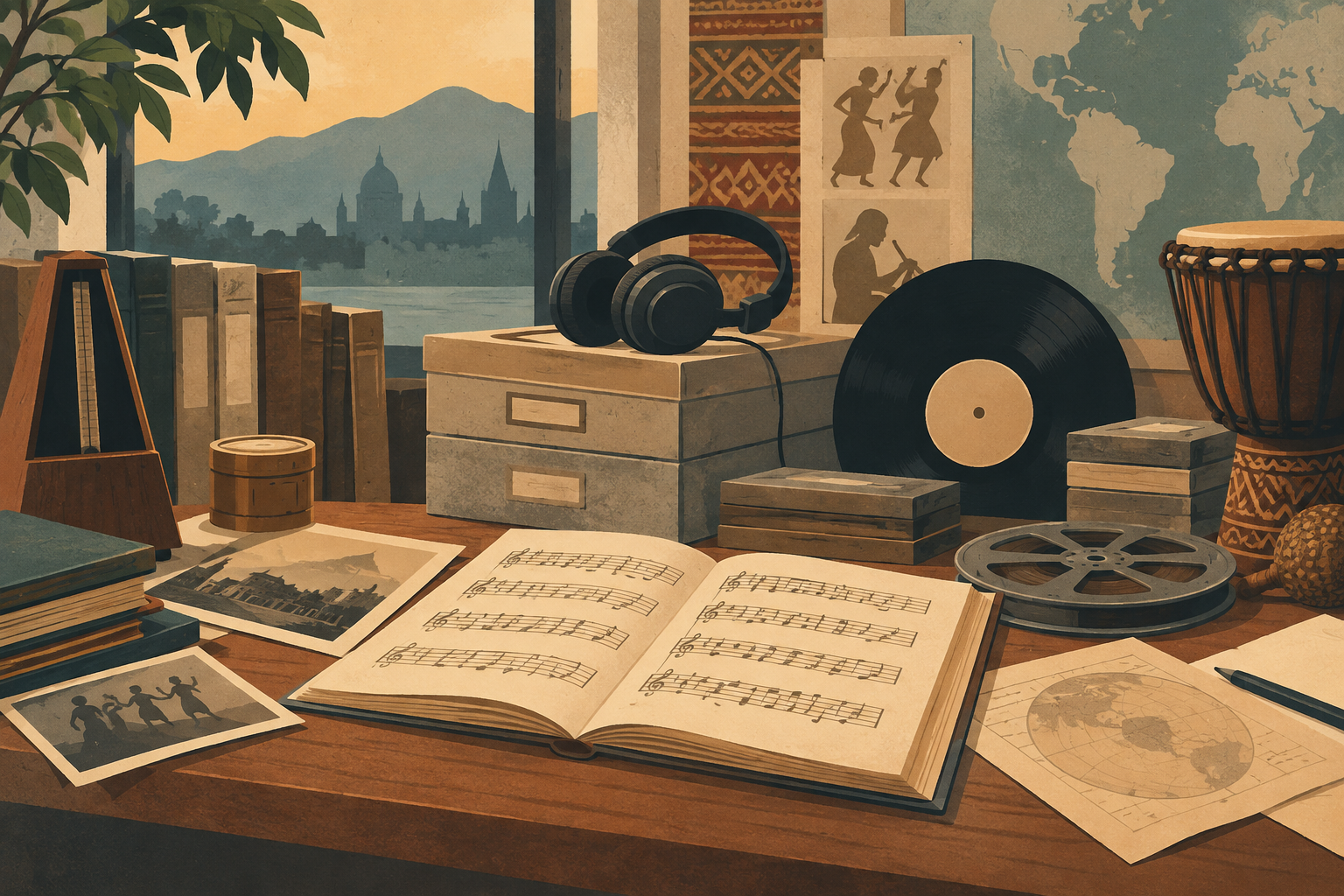
Music seems to disappear the moment it stops playing. Yet it leaves traces: scores, manuscripts, archival documents and, in some collections, sound and audiovisual materials. Those traces are not the complete musical experience. They do, however, make it possible to study how music was written, organized, transmitted and situated in different contexts. Treating these documents as heritage takes more than storing them: their context must be preserved, and their capacity to tell us things — as well as their limits — made clear.
There is no single kind of musical document
A music archive may bring together different kinds of material. Research on documentary collections distinguishes, among other things, books and notated music, and notes that sound and audiovisual documents form a broad field requiring its own approach. The distinction matters: a score is not a recording, and neither one alone represents the whole of musical practice.
Written documents record works, notation or institutional histories, but do not necessarily preserve every detail of a performance. Sound recordings can bring us closer to an audible realization, yet they do not replace information about who took part, the circumstances of production or how the music was received. Heritage research therefore begins by identifying the kind of source at hand and the questions it can answer.
Context is not an optional extra
Musical heritage has been approached through perspectives that connect musicology, ethnomusicology and social conditions. This convergence challenges a rigid separation between written music and oral tradition, or between historical study and attention to living practices. It does not make every source interchangeable. It means that a fuller investigation may need to relate documents, sounds and social practices without erasing their differences.
A manuscript or score may offer evidence about a work and its documentary preservation; on its own, it cannot fully describe how the music was performed or what it meant to a community. Likewise, an orally transmitted tradition is not adequately represented simply by filing away a text. Context helps shape questions; it does not license us to fill gaps with claims the sources cannot support.
Archives, libraries and documentation centres
Preservation does not depend on a single type of institution. In Spain, a recent review identifies the National Library of Spain, the Basque Archive of Music and the Andalusian Musical Documentation Center, among other institutions, as contributors to safeguarding musical heritage. The range of custodians shows that heritage is distributed across collections and organizations with different roles.
The Musical Archive of the National Museum of Performing Arts offers a specific example. According to the museum, much of its holdings comes from the Museum-Archive of the Teatro Real, created by its director Luis París in 1919 from musical holdings organized between 1850 and 1952. The archive is divided into broad sections for Spanish and international music. Described materials include manuscripts and composers’ legacies, as well as a piano piece by Camille Saint-Saëns signed and dated 1897. These details describe one collection; they should not be mistaken for a comprehensive picture of all music archives.
Preservation also means making material intelligible
The existence of a document does not guarantee that it can be understood without information about its provenance, arrangement and use. The management of old, modern and digital music collections matters precisely because these documents bear witness to culture and to the historical relationship between music and society. Cataloguing, describing and connecting materials can make a collection more than a group of objects in storage: it can become a usable source for research and public understanding.
This work calls for care. An archive may preserve only part of a career, and holdings may be dispersed. A survey of music archives, for example, notes that a composer’s materials can be divided among several institutions. In such cases, physical preservation and the intellectual reconstruction of relationships between documents are connected, but not identical, problems. A catalogue helps locate and contextualize material; it does not automatically turn a fragmented collection into a complete record.
What the sources do not establish
The evidence available here supports the importance of archives, libraries, collections and musical documents, and provides some institutional examples. It does not permit a global inventory, a comprehensive comparison of preservation policies or a judgment about which institution cares for its holdings best. Nor does it provide enough technical detail to prescribe conservation procedures for every medium.
Those boundaries matter. Music can be written, recorded, audiovisual and intangible heritage, but it is not documented in the same way in every case. Some sources place music in social and cultural contexts; others describe institutions or types of document. Each illuminates one aspect, not the whole.
A memory built between sources
Preserving music means preserving the conditions for studying it again: identifiable documents, described collections and links to the contexts in which materials were created or used. Archives cannot, by themselves, retain the full experience of listening to or making music. Their value lies in offering traces that can be read rigorously and related to other evidence.
Musical memory therefore does not reside in a single object. It is built between scores, recordings, archives and practices; between institutions that care for materials and people who interpret them. Recognizing that plurality avoids reducing music history to a succession of works and lets us see it also as a history of documents, communities and forms of transmission.
- Decade
- 2000s
- Region
- Global
- Level
- Enthusiast
- Entities
- Museum
Sources and references
- Estudio y análisis de los museos de música en Europadiposit.ub.edu · 2026-09-25
- Acervos de Documentos musicales - Bibliopos: Biblioteca de recursos para Bibliotecarios y Opositoreswww.bibliopos.es · 2026-09-25
- El patrimonio musical en la convergencia entre musicología y ...revistas.ucm.es · 2026-09-25
- Año 10, No. 10, 2014 bibliotecas anales de investigacióndialnet.unirioja.es · 2026-09-25
- 48 artículoswww.iaph.es · 2026-09-25
- (PDF) Los archivos musicales: estado de la cuestiónwww.academia.edu · 2026-09-25
- Archivo Musical - Museo Nacional de Artes Escénicas: Almagro, Ciudad Realmuseodeartesescenicas.inaem.gob.es · 2026-09-25