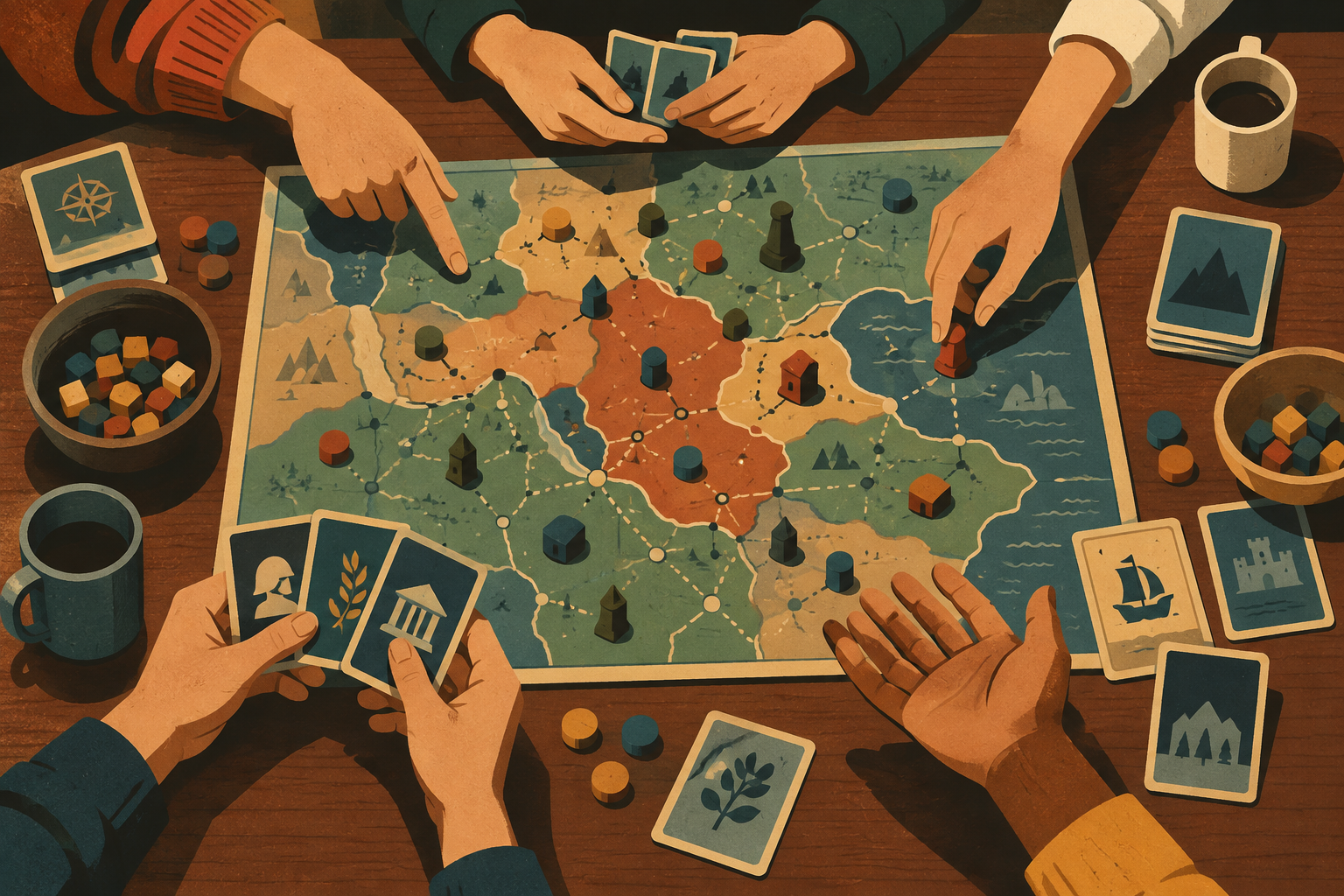
A historical board game can put an entire period on the table, but it cannot include everything. The board crops a space, the rules decide which actions count, and a play session turns those decisions into an experience. Playing the past is therefore not the same as consulting a neutral document. Research on historical simulation games points to precisely this issue: their systems construct and reinforce a vision of the past. Players may be free to act, but only within the possibilities permitted by the rules. That tension offers a useful way to approach these games without mistaking one for a complete history lesson.
Rules tell a story too
In a simulation, the board’s imagery is only part of what matters. What each player can do, which resources become important and which consequences are treated as possible all shape the experience. A rule is not decoration outside the story; it structures play and determines which parts of the context receive attention. The freedom to change events can be compelling, but it always operates within options designed in advance.
That does not automatically make a game a mistaken interpretation. It does invite questions about what the game simplifies, leaves out and foregrounds. Research on historical simulation provides a framework for asking those questions. It does not justify assuming that all titles work alike, or that one mechanic by itself proves a particular ideological position.
The Spanish case, approached cautiously
An academic book chapter examines Spanish Civil War board games as public history and proposes approaching them through data science. Its title identifies the subject and broad method, but the evidence available here does not describe its findings. The cautious conclusion is that such games can be studied as part of public discussion about the past—not that we can attribute undocumented conclusions to the chapter.
That distinction matters when a game represents historical conflict. Its system may make some actors, decisions or processes more prominent than others. Analysing it does not require deciding in advance whether the game is accurate. It requires describing what it proposes and comparing that proposal with appropriate historical sources. A session can raise questions; it cannot settle them by itself.
Playing to learn is not learning everything
Research on applying board games to history teaching shows that the relationship between games and the classroom is a subject of study. But an academic article’s title is not enough to establish specific results or to claim that any game improves learning. The potential of an activity should be distinguished from evidence that a particular application achieves a particular educational goal.
In a learning setting, a game can help participants examine how decisions work within a system and discuss the system’s limits. The conversation afterwards matters: which aspects of history appear, which have no place, and which decisions are available to the players? These questions treat the rules as material for analysis rather than as a transparent account of the past.
A medium made of choices
The history of board games is not limited to titles that simulate historical events. A general account of the sector mentions a new wave of game creation centred in Germany from the late 1970s, and identifies the release of Catan in 1995 as a milestone. These are clues to changes in game creation and circulation; on their own, they do not demonstrate a uniform transformation in how history was represented.
Other formats turn historical events into material for ordering or recall. A review of Timeline describes cards associated with events and notes that its selection mixes familiar milestones with less familiar ones. In that format, the past appears as a set of facts for players to relate. This differs from a simulation in which the system lets players make decisions and change the course of a session.
What the box cannot verify
The available sources support a broad point: historical games can be studied as interpretations, as objects of public history, and as potential teaching resources. They do not let us reconstruct the detailed rules or results of every title mentioned, or verify the historical accuracy of any particular game here. Nor can a commercial or general-interest account stand in for academic consensus.
The most productive reading begins with specifics—rules, components, choices and omissions—and separates documented facts from a player’s inferences. A box offers a playable model, not the whole past. Recognising that limit does not diminish the game; it makes clearer which version of history it proposes and which questions remain when play ends.
- Decade
- 2000s
- Region
- Spain
- Level
- Enthusiast
- Entities
- No linked entities
Sources and references
- Evolución de los juegos de mesazacatrus.es · 2026-09-25
- Timeline, un juego de mesa para amantes de la Historiawww.sacodedados.es · 2026-09-25
- Historia de los Juegos de Mesawww.jugamostodos.org · 2026-09-25
- ¿Qué historia jugamos? Una aproximación al estudio de los juegos de mesa de simulación históricadoi.org · 2026-09-25
- La aplicación de los juegos de mesa en la enseñanza de la Historiadoi.org · 2026-09-25
- Los juegos de mesa de la guerra civil española como historia pública: una aproximación desde la ciencia de datosdoi.org · 2026-09-25