A decorative object never arrives alone
A piece of furniture, a lamp, tableware or a decorative textile may seem self-contained: it can be viewed, identified and placed in a gallery. Museum conservation starts from a broader premise. An object has physical integrity, but it also conveys historical and artistic information. Spain’s National Museum of Decorative Arts presents both dimensions as inseparable aims of collection conservation.
That approach is useful when discussing decoration beyond surface nostalgia. An object may be compelling because of its form, colour or domestic use, yet a museum also needs to know what it is, how it was made, what changes it has undergone and which records accompany it. Without that context, its cultural reading is necessarily diminished.
Conservation is not simply restoration
Preventive conservation seeks to establish conditions that reduce or delay deterioration before direct intervention is required. The Museum International issue devoted to the subject describes it as a professional ethic and as a systematic process of maintenance and improvement. It is not a one-off action or a final solution; it is ongoing institutional work.
This distinction matters. The Castilla-La Mancha cultural portal explains conservation-restoration as a discipline that assesses, establishes and carries out measures intended to stabilise and slow the deterioration of cultural heritage. Yet not every act of conservation means repairing a visible surface. Reviewing, documenting, storing and enabling safe handling are protective actions too.
For decorative arts, where materials, scales and former functions vary greatly, this distinction prevents conservation from becoming a pursuit of objects that look “like new”. The supplied evidence does not provide a universal procedure for every material, nor can it replace specialist judgement. It does indicate that preservation considers a collection’s history, composition, age and cultural attribution.
Storage is part of the narrative
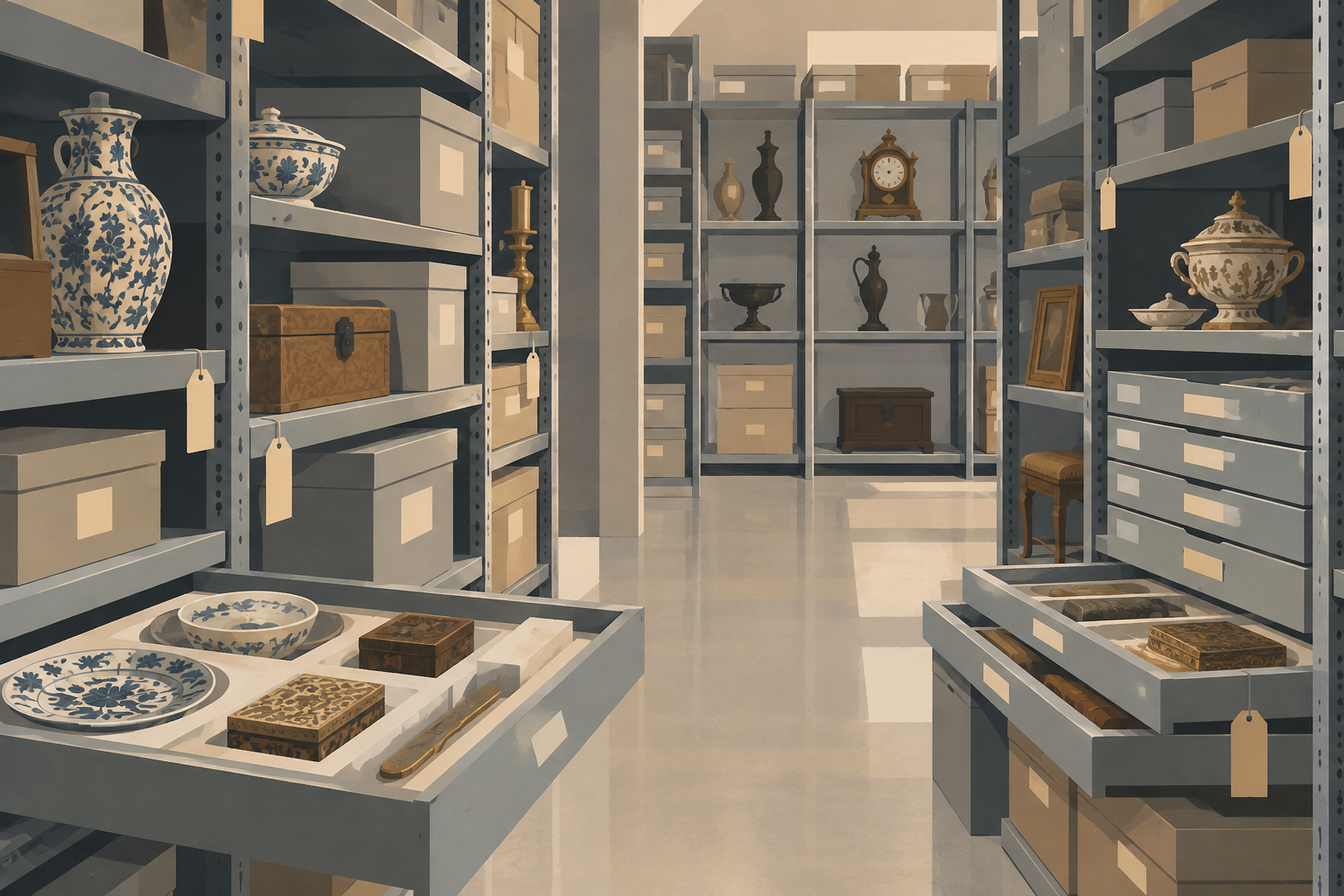
Storage is often imagined as the reverse side of display. In practice, it is one of the places where a collection’s material and documentary continuity is decided. The National Museum of Decorative Arts reports work on reviewing collections and optimising storage spaces to address collection growth while improving conservation conditions and accessibility.
Accessibility is not merely logistical. If an object can be located and moved safely, it can also be studied, checked and documented with better safeguards. The museum notes that large, heavy pieces should be placed in low areas that do not require ladders, while smaller, fragile ones may need special supports, pull-out trays or boxes.
These are not universal household instructions. They are institutional criteria connected to particular collections and qualified staff. Their editorial value lies in showing that a collection’s physical order is also a form of knowledge: it enables finding, comparing and reviewing objects without needlessly increasing risk.
Documentation means observing through time
Documentation makes a decorative object more than a visual presence. The National Museum of Decorative Arts explains that condition reports are accompanied by photographs to identify changes or new alterations and, where possible, by alteration maps. It also notes that analytical techniques can inform understanding of materials, construction techniques, alterations and additions.
An object’s condition is therefore not exhausted by a single impression. A photograph, a description and a report make successive observations comparable. They do not alone guarantee complete interpretation, but they provide a basis for noticing change and making informed decisions.
Facts and interpretation must remain distinct. A record may describe an observed alteration; identifying its cause or deciding on a response requires knowledge, analysis and context. The museum stresses the need for continuous review and documentation in order to ensure conservation. The key is not simply to accumulate documents or images, but to keep records connected to the object and its trajectory.
Documentary context is heritage too
Archival guidance from Navarra stresses that archives hold the documentation of objects, that this context is inseparable from them and that it should remain within the institution. This is crucial for decoration: an object may retain its appearance while losing an important part of its meaning if separated from records that help explain its provenance, relationship to other objects or place within a collection.
Museum documentation may have diverse media, contents, origins and cultural values. An archive is therefore not only old written material. Photographs, reports, catalogue records and other documents can all belong to an object’s institutional life.
That link between object and context sets useful limits on retrospective imagination. Decoration invites reconstructions of interiors and uses, but a museum should not present as certainty what its documentation does not establish. Archives do not remove every gap; they make gaps visible and support more honest interpretation.
Material memory kept open
Preventive conservation does not turn collections into static things. Its purpose is to let them remain accessible, researchable and communicable. The Ministry of Culture explicitly connects conservation and accessibility, while museum-archive texts connect documentation with the capacity to tell stories and share knowledge.
For readers interested in design, collecting or material culture, that changes the question. Rather than asking only whether an object is “well preserved”, it is worth asking which information has been preserved with it, how it can be consulted and which aspects of its history remain unknown.
This is not a domestic technique or an invitation to intervene on objects. It is a way of looking. Decorative-arts conservation brings together material, space, record and time. An object that is well cared for is not merely one that physically reaches the future; it is one whose history can still be investigated without erasing the traces of its passage.
- Decade
- 1990s
- Region
- Spain
- Level
- Enthusiast
- Entities
- Museum
Sources and references
- Conservación - Museo Nacional de Artes Decorativas | Ministerio de Culturawww.cultura.gob.es · 2026-09-20
- Museum Internacional No 201 (Vol LI, n° 1, 1999) Conservación preventivawww.ibermuseos.org · 2026-09-20
- instrucciones para la gestión y organización de archivos ...www.navarra.es · 2026-09-20
- LA CONSERVACION PREVENTIVA EN LOS MUSEOS Teoría y prácticawww.museosdetenerife.org · 2026-09-20
- Estudio y documentación - Museo Nacional de Artes Decorativas | Ministerio de Culturawww.cultura.gob.es · 2026-09-20
- La importancia de la conservación y restauración del patrimonio cultural. ¿Qué es la restauración? | Portal de Cultura de Castilla-La Manchacultura.castillalamancha.es · 2026-09-20