A familiar period, uneven evidence
The years from 1970 to 2009 are often described as a time of rapid transformation in visual culture. Responsible research, however, does not begin by repeating that formula. It begins by asking what the available sources can actually support. The material consulted brings together a popular timeline, bibliographic catalogues and heritage-institution pages. It is useful for examining how photography is preserved, described and studied; it is not enough, on its own, to reconstruct a comprehensive history of cameras, video formats, markets or domestic practices.
Caution matters especially when photography and video are discussed together. One popular source lists 1970 as the year of a “first electronic video camera.” In the supplied material, that statement has no manufacturer, model, place or technical documentation. It can therefore be reported as a claim appearing in a timeline, but not turned into a settled milestone or assigned specific consequences.
Starting with the archive
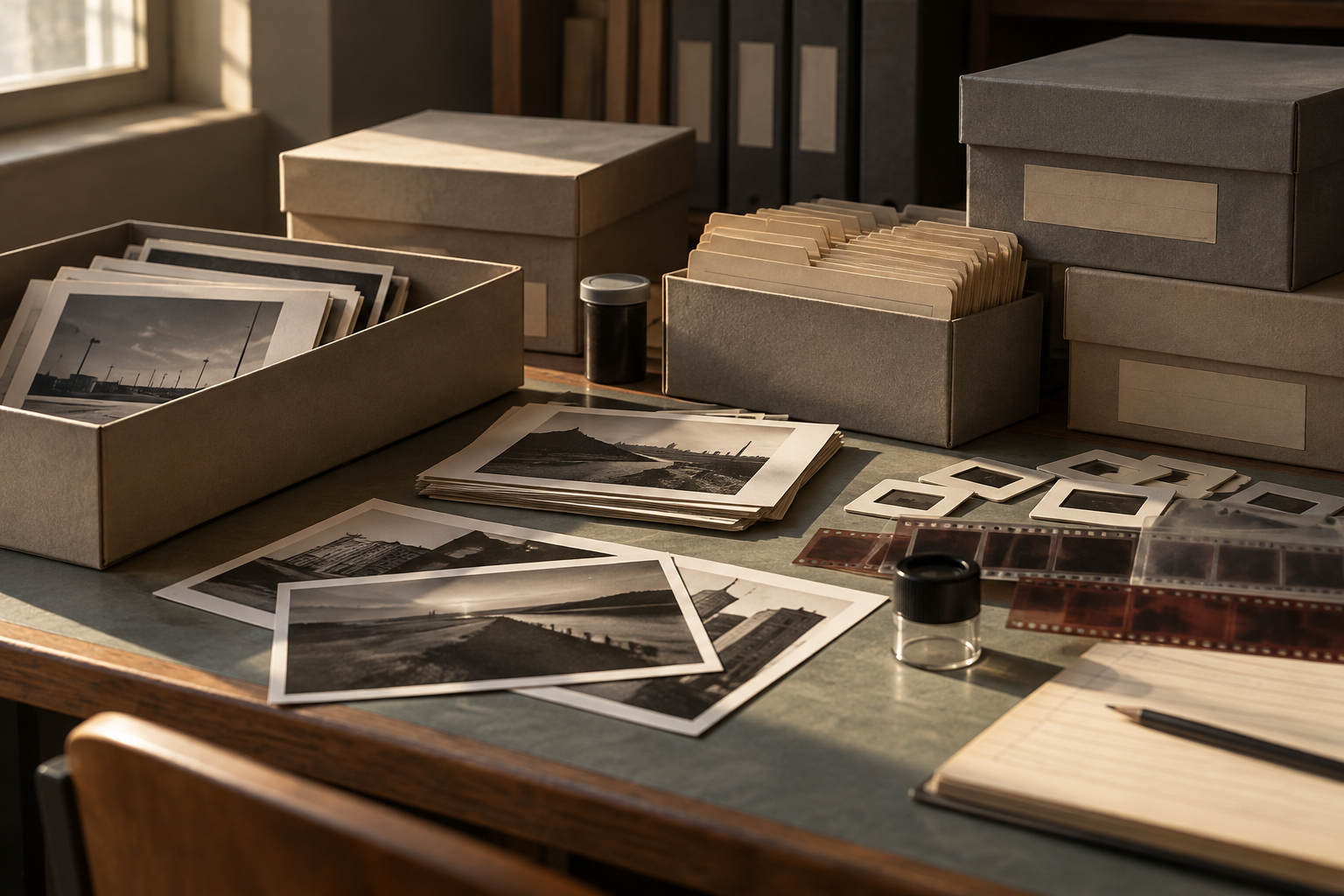
The Spanish institutions in the evidence suggest another route: approaching images as preserved records. The Photographic Archive of the Spanish Cultural Heritage Institute describes holdings linked to photographers, agencies and bodies of views concerning heritage, industry, art and other subjects. It dates the Agencia Pando archive from 1940 to 1993 and Otto Wunderlich’s work to the 1970s. Those dates do not describe all Spanish photographic production, but they do define concrete holdings that cross the decade’s threshold.
This approach shifts attention from the device to the documentary trace. A photograph enters an archive not merely as an image, but with authorship, medium, probable date, provenance, series and uses that require description. The archive itself notes that its holdings continue to grow through acquisitions and documentation created during interventions. History is therefore not a fixed list of inventions; it also changes as materials are incorporated and organised.
Collections, media and limits
The National Museum of Anthropology describes holdings of positives and negatives in varied techniques and formats, including glass plates, albumen prints, stereoscopic photographs, cartes de visite and postcards. For the period nearest this article, it mentions around 1,700 slides from the travels of ethnologist Karl Sieghard Seipoldy in the 1960s and 1970s. This is specific evidence of slides within one collection, not proof that they were the dominant medium everywhere.
That distinction prevents a common mistake: treating the contents of an archive as a general statistic. Collections have acquisition criteria, institutional histories and gaps. They are evidence for what they hold and prompts for asking what is absent; they are not automatically a census of all visual production.
From technical history to cultural history
Spain’s National Library describes photography’s timeline as marked by technical and format milestones that specialists constantly study. That wording matters because it does not reduce change to one cause. Technique and format organise the possibilities for making, circulating and preserving images, but do not by themselves explain social meaning.
A Ministry of Culture bibliography records an exhibition titled Four Directions: Contemporary Spanish Photography, 1970–1990. Its inclusion confirms that the interval has been framed curatorially and historiographically. The supplied evidence does not permit a summary of its artists, tendencies or arguments. It does, however, remind us that photography in those decades can be read as an artistic practice as well as a document or a technology.
Photography, museums and visibility
Dialnet records a book on photography and museums in Spain and Latin America. Its contents include a study of photography’s entry into art circuits in Venezuela between 1970 and 1990. The reference broadens the map: institutional visibility was neither uniform nor exclusively Spanish. It also explains why it is better to speak of circuits, collections and contexts in the plural.
In the Canary Islands, the Virtual Library of Bibliographic Heritage states that a historical photography archive began in 1999 after the acquisition of a collection of more than 18,000 images, while FEDAC maintains an archive of more than 140,000 photographs. Here, 1999 is not a camera innovation. It is a decision about custody, acquisition and access—another kind of milestone, less spectacular but crucial for research.
What remains verifiable
The evidence supports four limited conclusions: some holdings reach into the 1970s; institutions describe photographs in a range of media; 1970–1990 has been the subject of exhibitions and scholarship; and archives can begin or change through later acquisitions, as in the Canary Islands in 1999. It also permits a qualified note that a popular timeline places a first electronic video camera in 1970.
It does not identify that camera’s model, establish a complete sequence of audiovisual innovations from 1970 to 2009, or measure technological adoption. The conclusion is not that the period lacks a history. It is that sound history should expose its evidence. Rather than automatically narrating continuous revolution, archives demand a more exact task: identify the object or image under study, who preserved it, how it was described, and precisely which claim it can support.
- Decade
- 1970s
- Region
- Spain
- Level
- Enthusiast
- Entities
- Museum
Sources and references
- Fototeca - Instituto del Patrimonio Cultural de España | Ministerio de Culturaipce.cultura.gob.es · 2026-09-20
- Fotografía | Biblioteca Nacional de Españawww.bne.es · 2026-09-20
- LA FOTOGRAFÍA: ARTE Y TESTIMONIOwww.cultura.gob.es · 2026-09-20
- 400 hitos en la historia de la fotografía | Oscar en Fotososcarenfotos.com · 2026-09-20
- Colecciones de materiales gráficos - MUSEO NACIONAL DE ANTROPOLOGÍA | Ministerio de Culturawww.cultura.gob.es · 2026-09-20
- Fotografía y Museo: de los orígenes a la conquista de un espacio de visibilidad en España y América Latina (siglos XIX-XXI) - Dialnetdialnet.unirioja.es · 2026-09-20
- Biblioteca Virtual del Patrimonio Bibliográfico > Fototeca > Fototeca > Presentaciónbvpb.mcu.es · 2026-09-20


