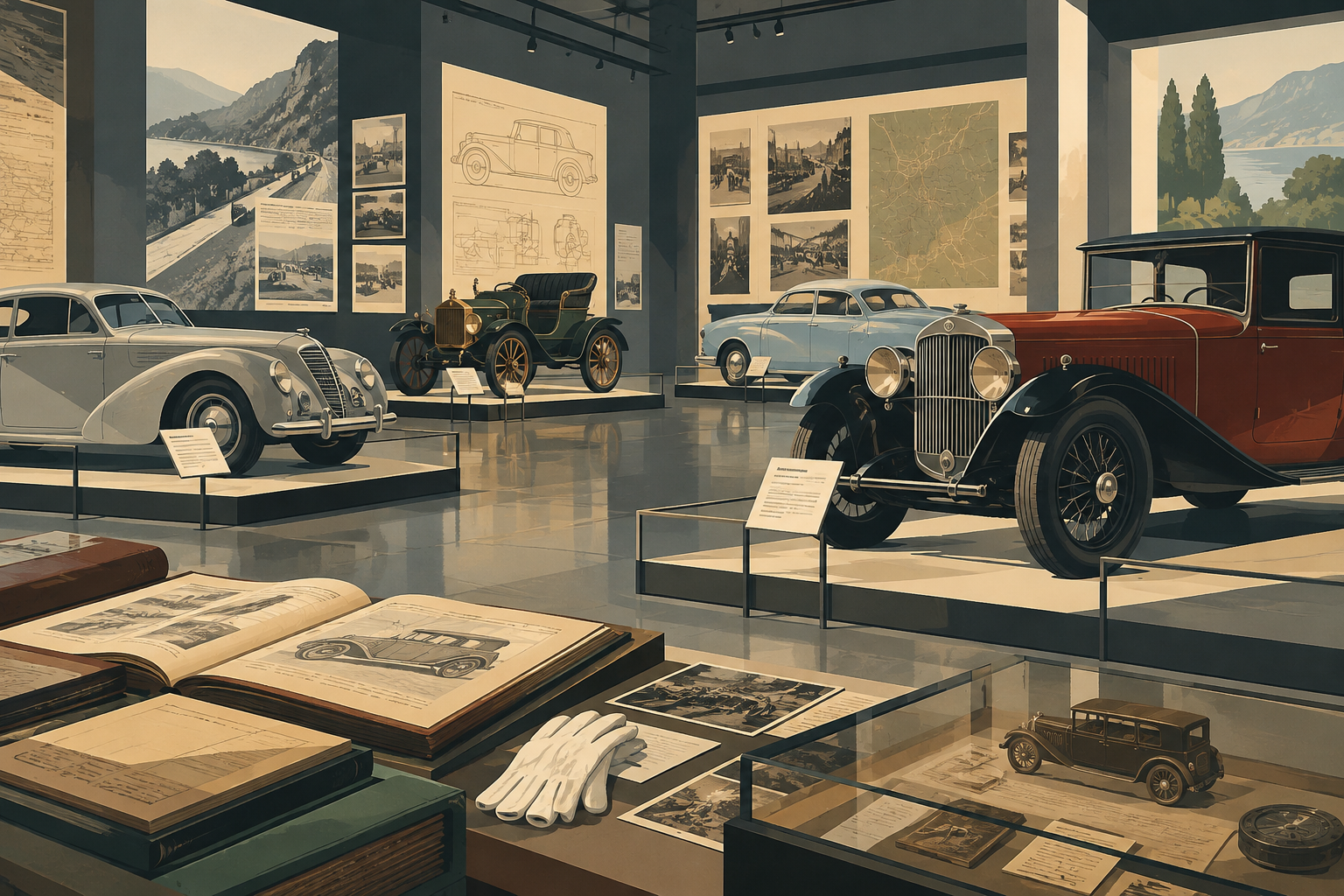
A vehicle is not an isolated object
A historic automobile may draw attention through its silhouette, visible mechanics or the memories it evokes. Once it enters a public collection, however, it becomes more than a vehicle: it becomes a material document. Its paint, components, earlier repairs and accompanying information can support research into design, industry, mobility and social habits. That premise connects several motor collections in Spain and Italy, despite their different institutional models.
The Museo Nazionale dell’Automobile in Turin, MAUTO, provides a clear historical scale. Its earliest core was linked to Carlo Biscaretti di Ruffia, who began collecting cars, chassis and engines in 1933. The museum opened to the public in 1939 in rooms beneath the Municipal Stadium stands. It then held 181 objects dated from 1854 to 1939, although space prevented all of them from being displayed. The museum’s stated mix of cars, engines and chassis matters: automotive history requires preserving systems, not only complete bodies.
Collecting is also selecting
Every collection is a selection. MAUTO states that its display relates vehicles to historical moments, cultural and social movements, technological achievements and scientific discoveries. This matters because a car does not gain significance solely from rarity or operability. It also gains meaning from the questions it can raise about its period.
This approach avoids a simple linear story in which every object is merely a step towards today’s car. In a museum, an engine can address production techniques; a chassis can address construction and materials; a manual can address training and maintenance; a motorcycle can address professional or everyday uses. The quality of interpretation depends on documented links and clear explanation, not on assigning each object a story unsupported by the available evidence.
The military case: vehicles and documentation
The Automotive Museum Collection in Torrejón de Ardoz offers another route in. Spain’s Defence Cultural Heritage service traces its origins to the holdings of the former Spanish Army Automobile School, created in 1931. Those holdings included cars, motorcycles and numerous manuals, as well as other materials. The present collection contains vehicles, engines and components that make it possible to follow more than a century of military vehicle development.
Here, the technical archive is inseparable from the object. Manuals are not merely display accessories: they indicate how a machine was taught, maintained and understood in a particular institutional setting. A gearbox or engine can likewise reveal what remains unseen when a visitor encounters only a body shell. The institution says the museum was inaugurated in 2007 and received visiting hours in 2013; these dates distinguish the age of its holdings from the recent public history of their display.
Preservation does not mean making everything immaculate
Preservation involves a continuing tension between legibility, material stability and appearance. MAUTO says that its Conservation and Restoration Centre combines traditional vintage-car techniques with advanced methods used for artworks, and works through prevention and conservation to protect vehicle authenticity. The wording is important: authenticity is not simply a shiny surface or the indiscriminate replacement of traces of use.
The Museo del Motor on the Costa Blanca expresses a compatible public-facing idea: traces of a vehicle’s earlier life may remain when they do not endanger structure, operation or preservation. This should be treated as a cautious principle rather than an automatic rule. Without documentation for an individual object, nobody can decide from outside which marks are original, which alterations are old, or which measures a particular vehicle needs. Responsible restoration requires diagnosis, records and explicit criteria.
Museums for reading the twentieth century
MAHI, the Museum of Motoring and History in A Coruña, defines its purpose as presenting motoring and the twentieth century through major historical, cultural, economic, technological and social milestones. FEVA records the same pedagogical and plural ambition. The focus therefore moves away from admiration for a marque or model and towards the relationship between mobility and everyday life.
That has an editorial consequence. A motor museum visit need not mean accumulating model names. It can mean observing how narratives are constructed: what is contextualised, what documentation accompanies the objects, which mechanical elements are visible, and which absences remain. Visitors need no specialist knowledge to ask these questions; they need labels, routes and sources that distinguish fact, interpretation and evocation.
Limits and legacy
The available sources describe institutional missions, origins and broad collecting lines. They do not suffice to reconstruct the provenance, conservation condition or biography of every vehicle. Nor do they permit treating all museums as though they had identical resources, criteria or collections. This is a necessary limit, not a gap to be filled with nostalgia.
What can be verified supports a firm conclusion. Motor heritage includes cars and motorcycles, but also engines, chassis, components, manuals, facilities and specialist knowledge. Its preservation becomes richer when the object retains its connection to those contexts. Looking at a museum car therefore means looking at a piece of design and technology, but also at a fragment of cultural archive.
- Decade
- Before 1950
- Region
- Spain
- Level
- Enthusiast
- Entities
- Museum
Sources and references
- El MAUTO - MAUTOwww.museoauto.com · 2026-09-22
- Folleto de la Colección Museográfica del Automóvilpatrimoniocultural.defensa.gob.es · 2026-09-22
- MAHI, Museo de Automoción e Historia - Fundación Jorge Jovewww.fundacionjorgejove.com · 2026-09-22
- Museo del Motor - Costa Blancawww.museodelmotor.com · 2026-09-22
- Colecciones del Automóvil | Patrimonio Cultural de Defensapatrimoniocultural.defensa.gob.es · 2026-09-22
- Portada de la Colección museográfica del Automóvil | Patrimonio Cultural de Defensapatrimoniocultural.defensa.gob.es · 2026-09-22
- Museo de Automoción e Historia de La Coruña. La Coruña | Museos | Fevawww.feva.es · 2026-09-22