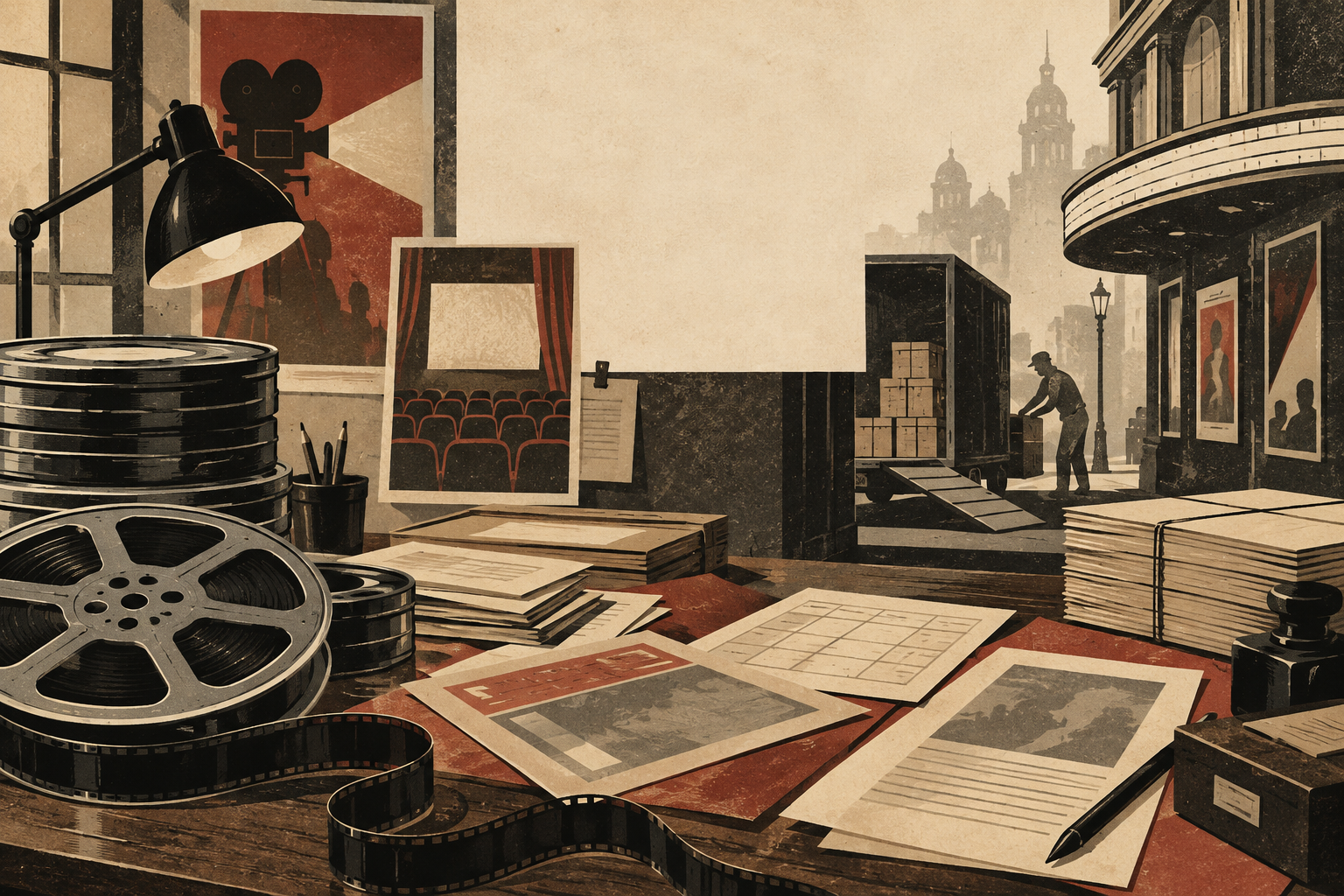
A Film Did Not Reach the Screen by Itself
Once a work had completed editing, its public journey was not over. Between the producer and the cinema stood the distributor: an independent company acquiring exhibition rights for theatres and receiving, according to Archivo Cine’s description, a percentage of a film’s revenue from the producer. This apparently administrative operation shows why cinema cannot be understood only as a sequence of premieres or a history of auteurs. It was also a network of negotiation, circulation of copies, commercial information, and relations with exhibitors.
That network matters when considering the formation of the Spanish film market. Distribution selected which titles could be offered, under which conditions, and with which promotional materials. This does not mean that distributors alone determined public taste: the available evidence cannot measure such influence in every city or reconstruct every company’s decisions. It does, however, identify distribution as a decisive mediation between a completed film and its effective presence before audiences.
A Sector Consolidating Around 1905
Archivo Cine places the consolidation of Spain’s distribution sector approximately from 1905 onward. Its explanation brings together several changes: the restructuring of exhibition through industrial development, the construction of early coliseums and permanent buildings devoted to cinema, broader catalogues, and the gradual increase in film length.
The approximate nature of that date matters. It was neither a single founding act nor the instant birth of a uniform industry. It is a reference point for a transformation: as the supply of films expanded and screenings occupied more stable venues, organizing access to titles became a distinct task. The distributor thus emerged as a specific part of a chain that did not end with either production or projection.
Foreign companies also belonged to this context. A study available through Dialnet states that Lumière, Pathé, Méliès, and Gaumont opened branches in Spain, whose commercial management was handled by Spanish businesspeople because of their knowledge of the market and local negotiating customs. This does not justify reducing the market to those firms, but it does show that international circulation depended on local establishments, intermediaries, and situated knowledge.
Catalogues, Competition, and Quotas
Distribution worked with an available repertoire rather than one isolated film. Archivo Cine notes that foreign product was more attractive to Spanish audiences and that distributors devoted greater effort to its exploitation. The same source records that the First Spanish Congress of Cinematography in 1928 raised a distribution quota of one Spanish film for every twenty-five foreign films.
That statement requires careful reading. It documents a proposal or demand at a congress; by itself, it does not prove that the ratio was implemented or establish general release statistics. Its historical value lies in revealing a concern: the imbalance between domestic production and a foreign supply perceived as dominant. The quota debate shows that distribution was not simply film transport; it was one of the arenas in which access to cinema screens was contested.
Distribution was also tied to publicity. Archivo Cine defines a poster as a large handwritten or printed sheet placed in public spaces to announce a film. It describes advertising guides, or pressbooks, as paper materials used by distributors to provide information on films to critics and cinema business owners. These documents did not replace the film, but they record how it was meant to be presented, explained, and made visible.
From Promotional Paper to Historical Document
Posters and pressbooks reveal a material side of the circuit. They were working and communication tools before becoming sources for researchers, collectors, and institutions. Archivo Cine notes that film magazines, from the early twentieth century, provided comments, reviews, and criticism alongside reports on productions, releases, and biographical profiles. This printed ecosystem connected industrial information, publicity, and public discussion.
Not everything preserved fully represents the market or every spectator’s experience. A poster may document a campaign without proving its reach; a pressbook may reveal a distributor’s strategy without showing how a title was received. For that reason, such material is best read alongside company holdings, institutional records, and historical studies rather than treated as isolated proof of success or popularity.
Archives Preserve the Chain, Not Only Films
Filmoteca Española describes its personal and company archives as indispensable testimony for historical analysis of Spanish cinema. Spain’s Ministry of Culture states that more than one hundred holdings have been preserved through purchase, donation, deposit, or loan, including material from production and distribution companies. Another institutional description mentions records from the Official School of Cinematography, the Institute for Cinematographic Research and Experience, the NO-DO Historical Archive, and more than one hundred personal and corporate holdings.
The importance of these collections goes beyond preserving a finished work. They may make it possible to study correspondence, decisions, promotional material, and institutional paths linked to film activity. The supplied summaries do not establish which documents each holding contains or which gaps remain. Even so, the existence of distributor archives corrects a view focused exclusively on directors, performers, or celebrated titles.
A Legacy of Mediation
Distribution history clarifies a simple fact: a film had to circulate before it could become a public event. In Spain, consolidation around 1905, the commercial presence of foreign firms, the 1928 quota debate, and the production of promotional material outline a field where economics, culture, and documentation met.
The limits of the available evidence are plain. It cannot reconstruct the accounts of specific companies, measure audiences, establish release calendars, or assign commercial outcomes. It does support a more cautious and useful conclusion: distributors were active agents in film life, and the papers they produced are part of cinema’s memory. Looking at these intermediaries does not diminish films themselves; it better explains the conditions that enabled some of them to reach theatres and enter cultural history.
- Decade
- Before 1950
- Region
- Spain
- Level
- Enthusiast
- Entities
- No linked entities
Sources and references
- EMPRESAS DE DISTRIBUCIONarchivocine.com · 2026-09-21
- Archivos personales y de empresas - Filmoteca Española | Ministerio de Culturawww.cultura.gob.es · 2026-09-21
- Archivo - Filmoteca Española | Ministerio de Culturawww.cultura.gob.es · 2026-09-21
- REVISTAS de cinearchivocine.com · 2026-09-21
- Revista Arte y Patrimonio • núm. 1 • año 2016, ISSN: 2530-0814, pp. 33-50. 33dialnet.unirioja.es · 2026-09-21
- Archivo Cine - Carteles Cine - Historia Oscararchivocine.com · 2026-09-21