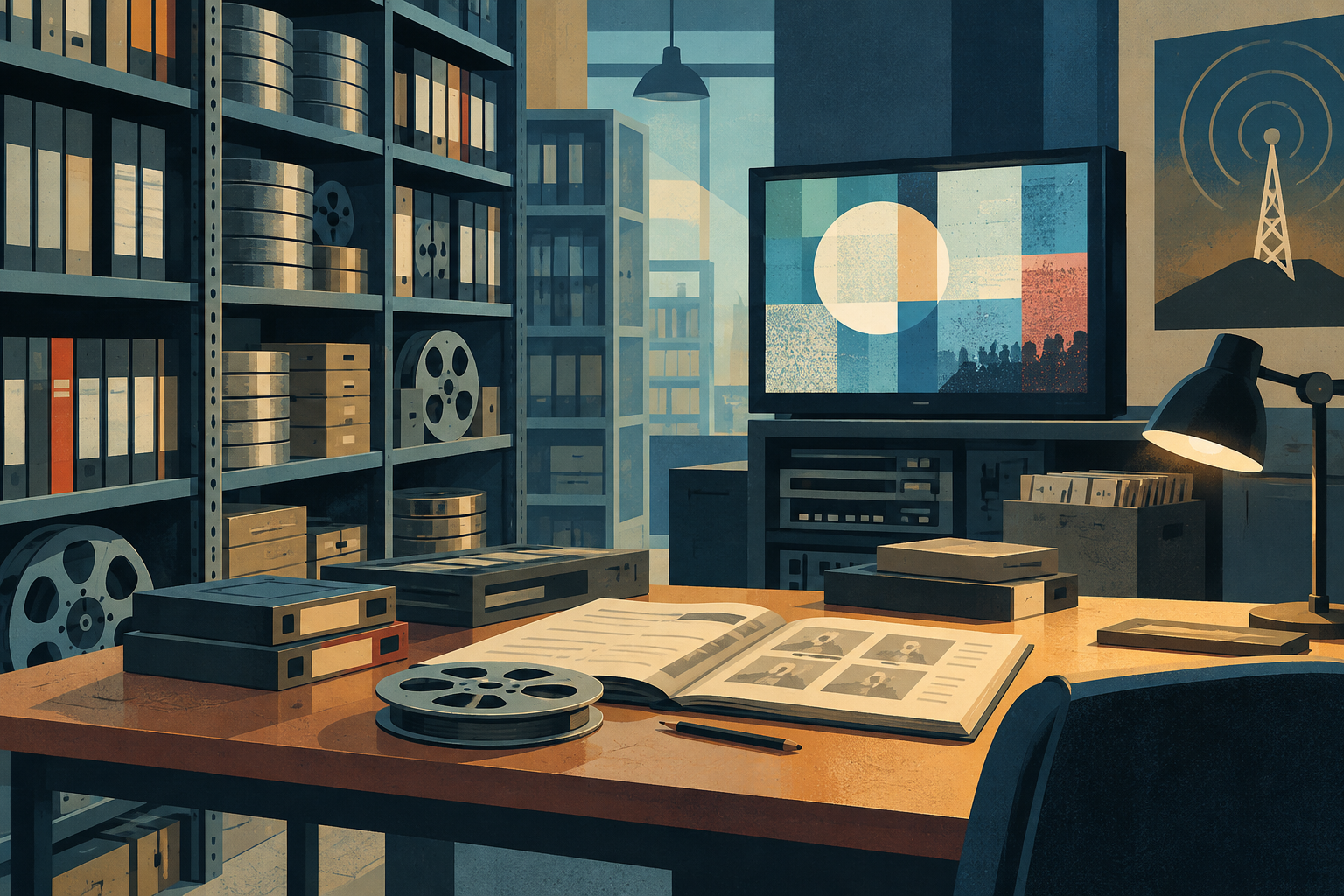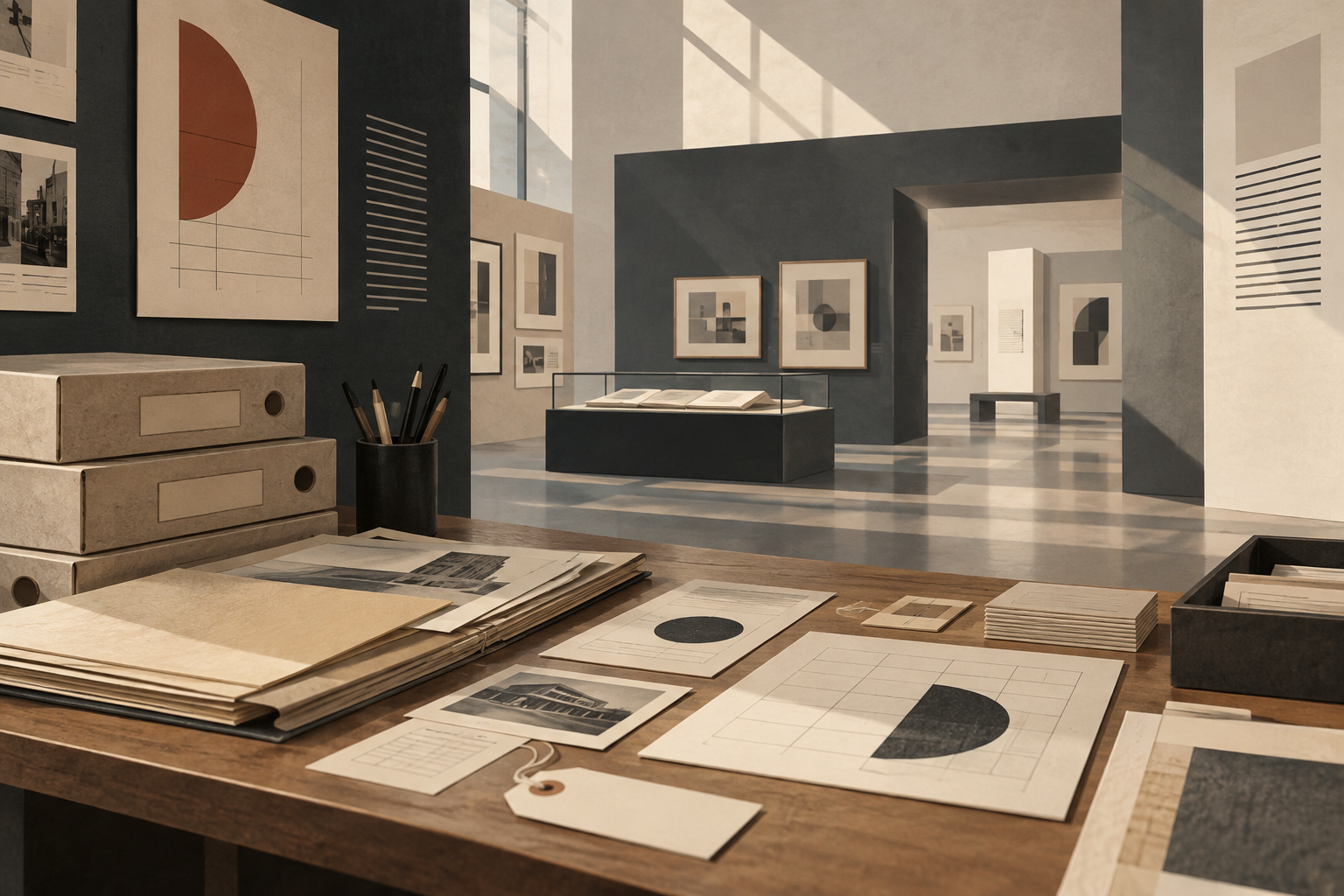
A document does not arrive at a museum alone
A poster, installation photograph, invitation, advertisement or internal production sheet may seem secondary beside an artwork or collection object. Yet the materials consulted for this article suggest another reading: such documents make it possible to reconstruct the conditions in which an institution produced, displayed, explained and circulated culture. An archive is not simply a store of papers; it is an infrastructure for connecting objects, decisions, audiences and narratives.
The Censo-Guía entry for MUAC’s Arkheia Documentation Centre describes an orientation toward documentary preservation, knowledge production and dissemination, linked to art in Mexico from the second half of the twentieth century onward. The same entry cites documents on a university media library dated 2004 and on a documentation centre from around 2006. They do not, by themselves, establish a complete history of design or advertising, but they do show that institutional documentation can retain traces of needs, structures and access devices.
Preservation means keeping relationships intact
Records management becomes meaningful when it maintains the relationship between a record and its origin. Navarra’s instructions for archive management and organisation state that every museum should identify the documentary types it produces and have tools such as a classification scheme, a metadata framework for production context, and a retention and preservation table. This is administrative language, but its cultural consequence is decisive: without context, a promotional image may remain only an attractive surface, and a graphic item may lose the reason it existed.
The same text stresses that documentation about objects is inseparable from their context. For design and advertising, this requires asking what is actually known: who issued a piece, for which activity, on which medium it circulated, which version survives, and how it relates to an exhibition, collection or programme. When those facts are unavailable, responsible presentation should not fill the gaps with nostalgia or automatic attribution.
Graphics communicate the institution too
The study on museum graphic design published in i2 Investigación e Innovación en Arquitectura y Territorio defines graphic design as part of museums’ visual context and connects it with promotion and advertising. It does not treat graphics as decoration. Typographic choices, wayfinding, text hierarchy and orientation media affect the message visitors receive.
This makes it possible to examine museum advertising more precisely. An advertisement does more than announce an activity: it frames a promised experience, chooses what becomes visible and proposes an image of the institution. At the same time, gallery graphics extend that mediation inside the building. The continuity—or friction—between poster, website, signage and label helps explain how a public identity is constructed. This is editorial interpretation, not a fixed property of every design, and it must therefore be checked against the specific documents in each archive.
Advertising as heritage and narrative
The Museo de la Historia de la Publicidad presents itself as a journey through decades and formats—print, radio, television, outdoor, digital and popular culture—and states aims of preserving advertising heritage and supporting education. Its own description illustrates an important shift: advertising can be historically contextualised as an object of study, rather than treated only as a current commercial tool.
Turning it into heritage, however, requires avoiding two shortcuts. The first is reducing every campaign to a memorable look while overlooking formats, conditions of circulation or social context. The second is mistaking a curatorial narrative for definitive historical proof. An exhibition selects and arranges; it does not exhaust all possible material. As EVE Museos + Innovación notes, museography orders objects and content to convey narratives and establish relationships. That narrative capacity is valuable, but it also makes selection criteria worth disclosing.
Access: from inventory to public conversation
Access is not a stage that follows preservation. SEDIC’s text on the archives of state museums highlights the need for cooperation, coordination, preservation and public access to documentary heritage. At Arkheia, the existence of Excel catalogues for each collection and discussion of a database system also reveal a less visible aspect of archives: access depends on description, classification and consultation tools, not only on safeguarding materials.
For an editorial project focused on design, the practical lesson is straightforward. Publish only what can be identified cautiously, separate the document from current interpretation, describe gaps and retain provenance references. An image without a confirmed date or authorship can still be useful, but it should be presented accordingly. Cultural interest does not license the completion of what is unknown.
Conclusion
Design and advertising acquire historical depth when read alongside archives that record their production, circulation and institutional reception. Preservation protects materials; description supports their traceability; information design makes them findable; and museography places them in a narrative for contemporary audiences. None of these layers is neutral. That is why the best public interpretation does not promise certainty where documents are absent: it explains what is supported, what context can be reconstructed and which questions remain open.
- Decade
- 2000s
- Region
- Other regions
- Level
- Technical
- Entities
- No linked entities
Sources and references
- Censo-Guía de Archivos de España e Iberoaméricacensoarchivos.cultura.gob.es · 2026-09-17
- Clip de SEDIC, Revista de la Sociedad Española de Documentación eedicionsedic.es · 2026-09-17
- Museo de la Historia de la Publicidad — Descubriendo la huella de la Publicidadmuseohistoriapublicidad.org · 2026-09-17
- instrucciones para la gestión y organización de archivos ...www.navarra.es · 2026-09-17
- Diseño Museográfico y Semiótica – EVE Museos + Innovaciónevemuseografia.com · 2026-09-17
- Diseño gráfico del museo como estímulo creativo en educación patrimonial | i2 Investigación e Innovación en Arquitectura y Territorioi2.ua.es · 2026-09-17