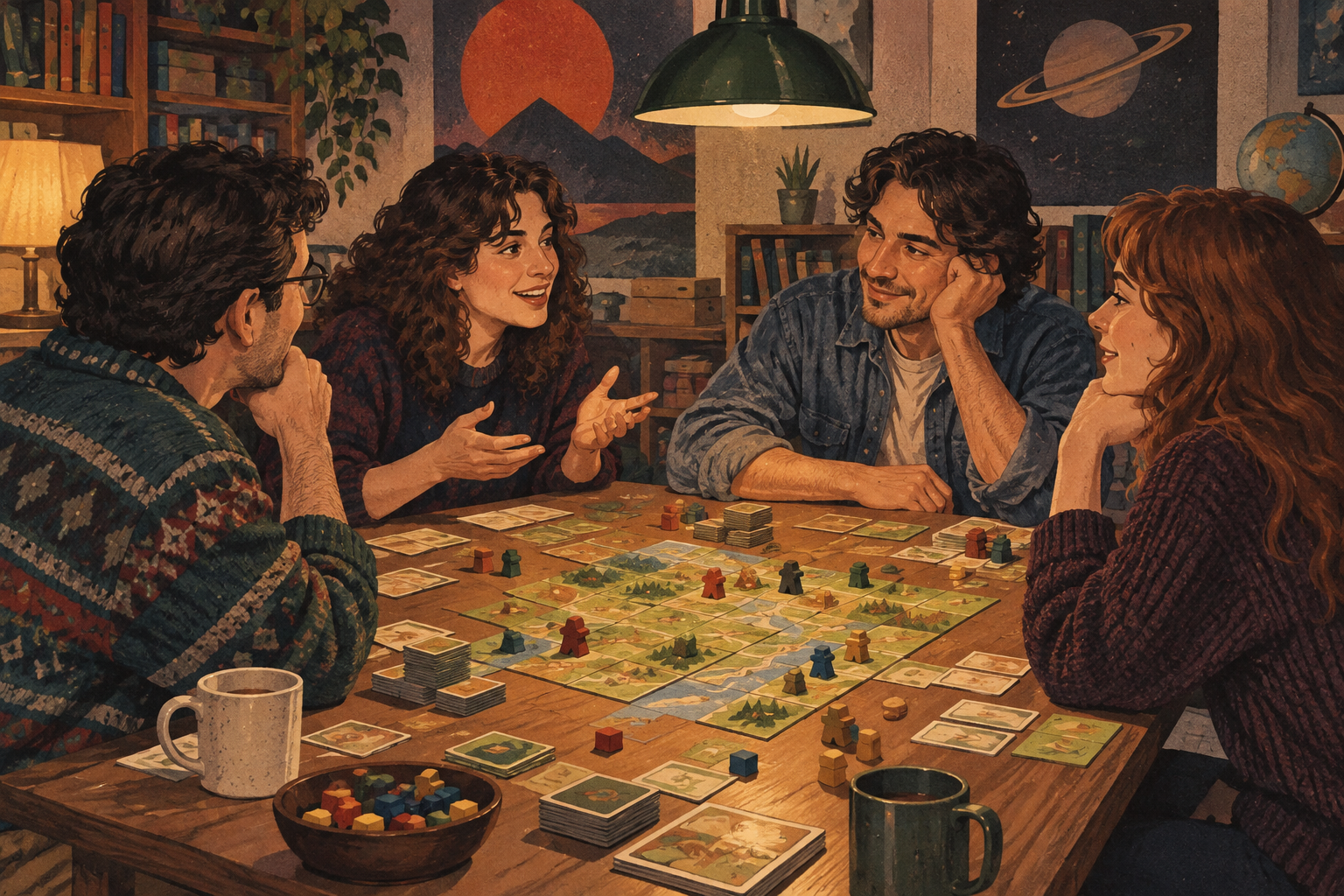
Modern board games cannot be understood solely through their rules or the age of the people who play them. Publication, authorship, and the kind of experience created around the table also matter. The available sources show a significant transition: alongside the longstanding view of games as children’s entertainment, a European creative current emerged from the late 1970s and became associated with social games, eurogames, and designer games. Popular titles from the 1990s and 2000s suggest the range this landscape reached, though they cannot, by themselves, explain its entire history.
A pastime beyond the childhood label
The history published by Jugamos Todos notes that board-game marketing was closely linked to the toy industry and that games were long regarded mainly as children’s pastimes. That association helps explain why the change involved more than new mechanics: it also meant widening the imagined player base and reconsidering the place of games in social life.
This observation should not be turned into a uniform chronology. The source describes a general tendency; it does not claim that every earlier game was intended for children or that perceptions changed overnight. It is more accurate to describe a gradual shift in how this hobby was presented and valued.
The European turn from the late 1970s
The same source places a new wave of creativity, centred in Germany, from the late 1970s. It connects that wave with a European school now described using terms such as eurogames, social games, and designer games, and notes its international repercussions. The supplied information does not identify one mechanism as the cause, so the shift cannot responsibly be reduced to a single design formula.
What matters is the emergence of a shared cultural identity. These labels suggest that a game could be considered not merely a product for passing time, but a recognisable work whose approach could bring several people together. That is an editorial interpretation compatible with the source, not a comprehensive definition of every European-style game.
A map of titles, not a complete history
Zacatrus lists Uno (1992), The Settlers of Catan (1995), Jungle Speed (2002), Dixit (2008), and Dobble (2009) among well-known titles from the more recent period. The list suggests that popular offerings included different kinds of play and that board gaming’s development cannot be reduced to a single experience.
A list of titles, however, does not by itself establish sales, social impact, or a direct connection between each game and the European movement. These examples should not be treated as an inevitable sequence or as interchangeable representatives of one school. Their narrower value is as reference points for the variety audiences could encounter between 1992 and 2009.
Spain: publishing, outreach, and memory
The source on games in Spain provides another perspective. It reports that Dalmau Carles Pla published La reconquista in 1970 and later Las Grandes Batallas del Mediterráneo, alongside educational games and games based on television programmes. It also recalls the production of war games with miniatures and illustrations in earlier decades. This evidence makes it unwise to portray Spanish creation as a late consequence of one foreign trend.
At the same time, the supplied text is a historical overview, not a complete history of the industry. It identifies publishing activity and thematic variety, but does not allow comparisons of print runs, audiences, or business continuity. The Spanish story should be told with that limitation in mind.
When a game interprets history
The academic record for research on historical simulation games raises a useful question: what kind of history does each game system make possible? The supplied abstract says that rules limit players’ room for action and that games construct and reinforce views of the past. Another academic record concerns the use of board games in teaching history.
The material provided is not enough to summarise those studies’ complete methods or findings. It does support a broader caution: playing a historical game does not automatically mean learning a neutral version of history. A board selects events and possibilities; the play experience, the representation of the past, and documented historical knowledge should therefore be distinguished.
An open history, and its limits
The sources also record titles from the 2000s and contemporary reviews, including one of Timeline, described as a card game about ordering historical events. That review notes its combination of familiar and less familiar events. This is a specific observation about its challenge, not proof of educational outcomes or comprehensive historical accuracy.
Taken together, the period suggests a change in status more than an absolute break: board games retained their entertainment function while acquiring new ways to be discussed through design, authorship, sociability, and historical interpretation. The European wave of the late 1970s, Spanish publishing activity, and the variety of later titles are documented clues to that transformation. What the supplied evidence cannot establish—comparable sales, the full evolution of audiences, or precise causal links—should remain open rather than being filled in with an overly neat history.
Documentary gallery


- Decade
- 1990s
- Region
- Europe
- Level
- Enthusiast
- Entities
- Settlers of Catan
Sources and references
- Evolución de los juegos de mesazacatrus.es · 2026-09-24
- Timeline, un juego de mesa para amantes de la Historiawww.sacodedados.es · 2026-09-24
- Historia de los Juegos de Mesawww.jugamostodos.org · 2026-09-24
- ¿Qué historia jugamos? Una aproximación al estudio de los juegos de mesa de simulación históricadoi.org · 2026-09-24
- La aplicación de los juegos de mesa en la enseñanza de la Historiadoi.org · 2026-09-24