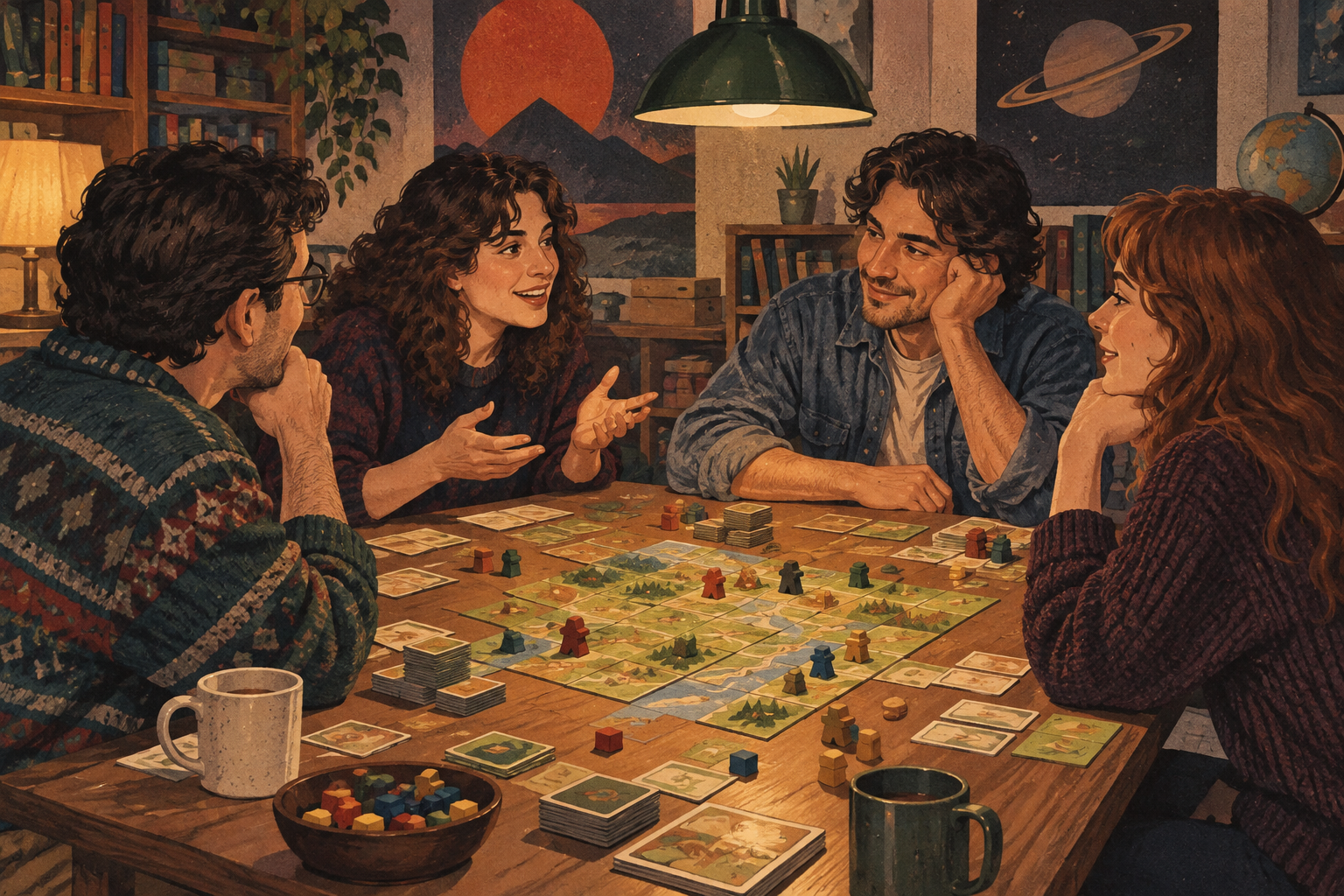
The recent history of board games cannot be reduced to a succession of hits or a single date of origin. The available sources point instead to changes in orientation and scale: games marketed specifically to adults appeared in the 1970s; a creative wave centred in Germany took shape from the end of that decade; and the industry underwent a marked transformation in the 1990s, with greater popularity and a wider range of products. This sequence helps explain why board games came to be associated with more than children’s pastimes, although the sources consulted cannot measure how much each audience changed, or how quickly.
A shifting boundary between audiences
A history of board games published by Jugamos Todos describes how marketing was long linked to toys and how many games were regarded as children’s pastimes. The same source places some explicitly adult-oriented releases in the 1970s and mentions Othello. This matters not because it proves adults did not play earlier, but because it indicates a change in how certain products were presented and classified.
The distinction is commercial and editorial as well as playful. A game may appeal to different groups, but presenting it for a particular audience can make visible a leisure practice that does not fit the image of a children’s toy box. The sources provide no campaigns, sales figures or player testimony with which to reconstruct how this strategy was received. It is therefore more accurate to speak of an explicit product positioning than of a universal change in households.
Master Mind as a reference, not a complete explanation
The history compiled by Jugamos Todos includes Master Mind among the significant twentieth-century games and dates it to 1970; it attributes its creation to Mordecai Meirowitz, whom it identifies as an Israeli computer programmer. This note places a specific title in the period, but does not by itself prove that the game founded a school or represented every trend of the decade.
As an object of analysis, Master Mind invites us to separate three questions: when it appeared, who created it, and what place it occupies in a broader history. The source offers brief answers to the first two; the available excerpt does not provide enough information to discuss its rules, editions, sales or reception in detail. The responsible approach is to treat it as a documented example of the variety of designs considered significant by that source, without embellishing its history with information absent from the material consulted.
A new wave centred in Germany
Jugamos Todos places the start of a new wave of board-game creation in the late 1970s, with its centre in Germany. It adds that this current grew into an important economic sector with international repercussions, and notes that its proposals are described with terms such as European school, eurogames, social games or designer games. This account describes a trend, not a closed category with undisputed boundaries.
That starting point is useful for interpreting the later expansion of the field: the sources are not discussing isolated titles alone, but a current connected to creation, industry and international circulation. However, the supplied material does not identify designers, publishers, mechanisms or distribution routes that would explain how the expansion happened. Nor does it justify assigning uniform mechanical characteristics to every game covered by those labels. The most cautious interpretation is that the vocabulary reflects an effort to define an increasingly recognisable body of work.
The 1990s: more choice, no single proven cause
Shangrila’s book on the history, culture and industry of board games argues that the industry’s greatest transformation took place from the 1990s onwards, with increased popularity and a larger offering. This is a broad claim, useful for describing a change in scale, but the supplied excerpt does not include statistical series, catalogue counts or national comparisons. It is therefore impossible to quantify growth here or establish one cause.
That observation can be read alongside the creative wave described by Jugamos Todos. An earlier movement and a later expansion in supply are not incompatible; they may form part of a longer evolution. But these sources do not prove a causal relationship. The expansion may have had multiple drivers, and the material provided does not allow us to choose among them. This caution prevents a suggestive chronology from becoming a complete economic explanation.
Familiar titles and the limits of the selection
A Zacatrus entry lists Uno (1992), The Settlers of Catan (1995), Jungle Speed (2002), Dixit (2008) and Dobble (2009) among well-known games around the turn of the century. The list provides recognisable reference points, but it is neither exhaustive nor an explanation of why each game became known. The entry also includes Virus, dated 2015, outside the period covered here; we therefore do not use it to describe 1970–2009.
The mention of Catan makes clear that popular accounts of the sector often connect the changes of the 1990s with highly identifiable titles. Still, the list does not prove that these games shared a design, audience or commercial trajectory. Nor is it enough to establish a definitive canon. It works better as a selection of names presented by the article as familiar than as evidence of sales, impact or historical primacy.
An open-ended conclusion
The picture that emerges is gradual: leisure classifications that still associated many games with childhood; examples of adult-oriented products in the 1970s; a creative wave centred in Germany from the end of that decade; and an industry that, according to Shangrila, became more popular and broadened its offering during the 1990s. The titles cited by Zacatrus show that the story can be followed through to the end of the period, but they do not complete it.
The most defensible legacy is not a straight line of progress, but the consolidation of board games as a field with a changing vocabulary, industry and audience. The limits remain clear: the available material provides no comparable sales data, testimony, print runs or country-by-country reception. A fuller history would require that evidence. What can be said from the material here is that change was gradual and that its milestones operate at different levels: product, creative current and industry.
Documentary gallery


- Decade
- 1990s
- Region
- Europe
- Level
- Enthusiast
- Entities
- No linked entities
Sources and references
- Evolución de los juegos de mesazacatrus.es · 2026-09-23
- Juegos de mesa - Zacatrus - Historiazacatrus.es · 2026-09-23
- Historia de los Juegos de Mesawww.jugamostodos.org · 2026-09-23
- Juegos aquí, antes y ahorajugamostodos.org · 2026-09-23
- Encrucijadas del juego de mesa. Historia, cultura e industria – Shangrilashangrilaediciones.com · 2026-09-23