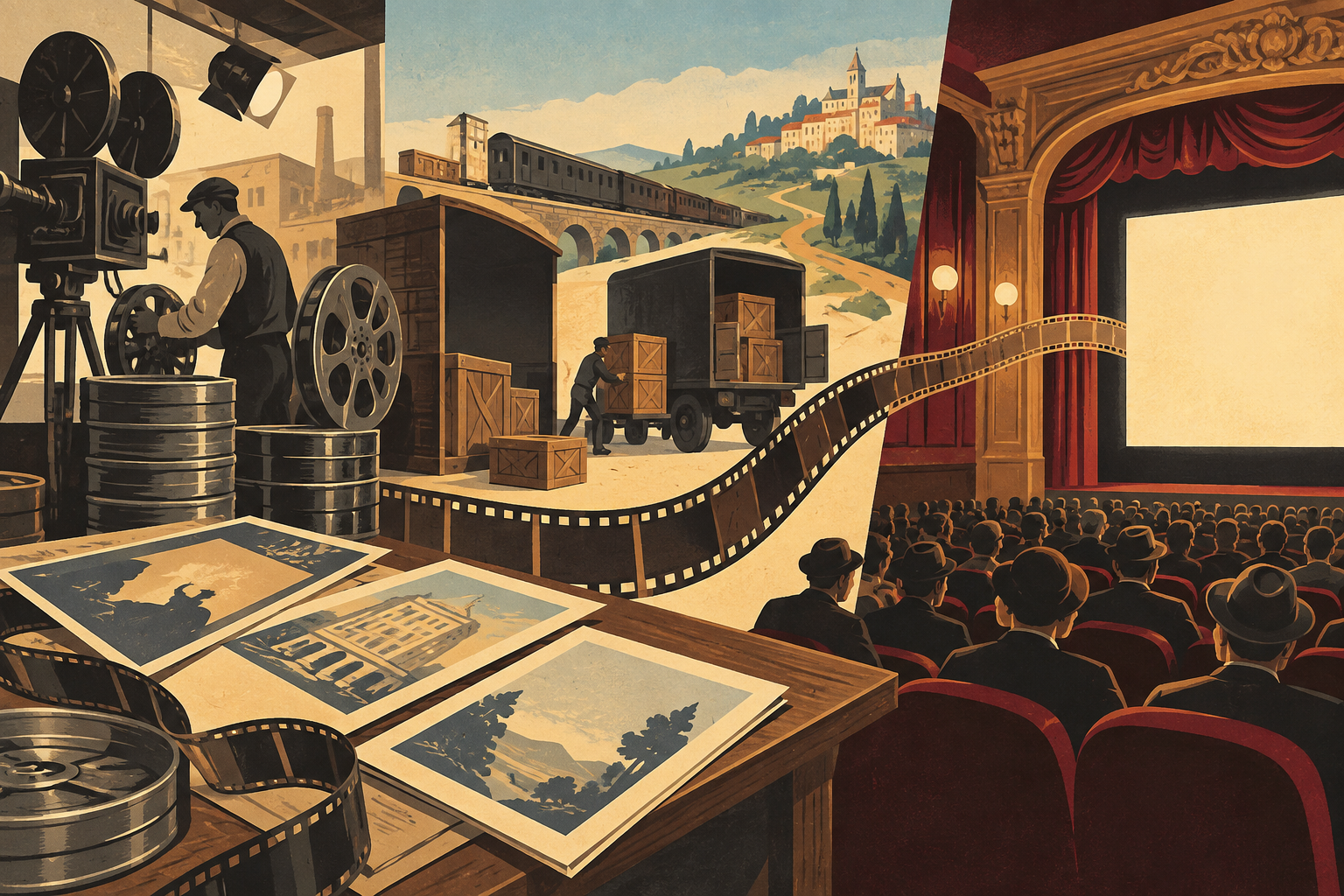
The link between production and the screen
A film did not reach cinemas on its own. Between the people who made it and the venues that screened it stood distribution: a business activity that organized access to exhibition rights and connected film catalogues with places where audiences could see them. Archivo Cine’s account of the sector describes that relationship concretely: a producer ceded the distributor a share of the revenue, while the distributor negotiated the rights needed for a film to be shown in cinemas.
This definition helps distinguish three related, but not identical, activities. Production means making a film; distribution means enabling its commercial circulation; exhibition means presenting it to audiences. The distinction does not, by itself, tell us how tasks were divided within each company or contract. The sources consulted do not provide complete accounts or a systematic catalogue of agreements. They do, however, show that distribution was an essential part of the circuit and that its development also depended on cinemas and the availability of films.
A change of scale in the early twentieth century
Archivo Cine places the approximate consolidation of Spain’s distribution sector around 1905. It connects the process to several changes occurring together: the reorganization of the cinema sector, the construction of the first stable buildings devoted to film, the expansion of film catalogues and the gradual increase in film length. The source therefore describes a transformation of the circuit, not a precisely dated birth.
That qualification matters. “Around 1905” is an approximate marker for a process, not the founding date of every company or the absolute beginning of distribution. The suggested relationship between stable cinemas, larger catalogues and distribution helps explain why the business could gain importance as film found more permanent exhibition venues. The information available here does not, however, measure the pace of that expansion or compare it from one city to another.
Foreign companies and local management
A study of the Spanish film market between 1925 and 1950 reports that French companies including Lumière, Pathé, Méliès and Gaumont opened branches in Spain. According to the study’s abstract, Spanish businesspeople handled commercial management, with their knowledge of the market and local negotiating practices regarded as an advantage.
This points to a structure in which international circulation and local intermediation could coexist. The presence of foreign companies does not mean that every operation was identical or that all branches had the same organization. Nor does it establish, by itself, what share of the market they controlled. What it does support is a more complex picture than a direct transaction between a foreign film and a cinema: companies, branches and commercial agents mediated between catalogues and markets.
Tensions between domestic and foreign supply
Archivo Cine records that the First Spanish Cinematography Congress of 1928 called for a distribution quota requiring one Spanish film for every twenty-five foreign films. The source relates the request to a perception that foreign films were more attractive to Spanish audiences and to the effort distributors, according to that account, devoted to exploiting them.
The figure identifies a specific demand; it does not automatically describe what every cinema actually screened. A proposed quota indicates concern about the relative presence of Spanish films. It does not prove that the rule was adopted, enforced or representative of a national statistical ratio. Distinguishing a concern, a proposed policy and commercial practice is essential: the debate documents an industry issue, but cannot by itself reconstruct the programme of films shown.
What archives and publications preserve
The history of the business is not reconstructed from films alone. Filmoteca Española preserves more than one hundred personal and company archives, acquired through purchase, donation, deposit or loan. The institution emphasizes their value as evidence for analysing Spanish film history. Its collections include production and distribution company archives, alongside materials from film organizations and personal collections.
Specialist publications offer another kind of trace. Archivo Cine describes film magazines as places where comments and reviews appeared alongside news about companies, performers, productions and releases, as well as biographical profiles. For research into distribution, such material can help trace how films were promoted and how the business was discussed. The source’s summary, however, names no specific magazines and supplies no sample from which to infer a shared editorial position.
What can be said—and what remains open
These sources support a cautious outline: distribution connected production with exhibition; its consolidation in Spain is placed approximately around 1905, alongside changes in cinemas and catalogues; French companies established branches and used local commercial management; and a quota favouring Spanish films was proposed in 1928. Archives and film publications offer routes to expand this history.
This selection cannot establish how many companies operated, what revenues they earned, which films circulated most successfully or whether the proposed quota was implemented. Nor is it sufficient to describe regional differences or reconstruct individual contracts. The strongest conclusion is narrower: distribution was a decisive mechanism for turning film production into exhibition, and the debates around it reveal both the commercial dimension of cinema and concern over the presence of Spanish films.
- Decade
- Before 1950
- Region
- Spain
- Level
- Introduction
- Entities
- No linked entities
Sources and references
- Archivos personales y de empresas - Filmoteca Española | Ministerio de Culturawww.cultura.gob.es · 2026-09-24
- EMPRESAS DE DISTRIBUCIONarchivocine.com · 2026-09-24
- Archivo - Filmoteca Española | Ministerio de Culturawww.cultura.gob.es · 2026-09-24
- REVISTAS de cinearchivocine.com · 2026-09-24
- Revista Arte y Patrimonio • núm. 1 • año 2016, ISSN: 2530-0814, pp. 33-50. 33dialnet.unirioja.es · 2026-09-24
- Archivo Cine - Carteles Cine - Historia Oscararchivocine.com · 2026-09-24