A period that cannot be reduced to a single nostalgia
Discussing Spanish television from the 1970s to the 2000s requires avoiding a convenient idea: that the past was uniform and can be summed up through a few programmes or one kind of set. The supplied sources support a narrower, and therefore more useful, claim. Across those decades television remained a highly continuous domestic presence, while its technology, production practices and the ways audiences could access broadcasts changed substantially.
El Mundo’s project on forty years of television in Spain structures its account around the 1970s, 1980s, 1990s and 2000s. That division does not prove that every decade had a sealed identity, but it does remind us that television viewing changed alongside social circumstances and available programming. Its approach places television within everyday shifts in consumption, public expectations and ways of watching. This is not the history of an isolated device; it is the history of a shared practice.
The screen as a domestic place
At home, television organised time and space. Watching a programme meant gathering around a screen and following a sequence fixed by broadcast scheduling. That linear condition matters because it helps explain television’s cultural force: the same programming could become a reference point for audiences receiving it at the same time, even when they did not interpret it in the same way.
This should not be turned into a universal statement about every Spanish household. The available sources provide neither audience figures nor receiver prices nor a detailed sociology of homes. They do, however, establish a framework: historical reconstructions present television as linked to Spanish social life and to the memory of several generations. RTVE’s current archive, also arranged by decades, preserves traces of that programming and makes its variety visible: news, fiction, variety shows, children’s programming and other forms.
Colour as a technical and perceptual change
The ETSIT Museum at the Universitat Politècnica de València identifies the arrival of colour as a major milestone in television’s development because it made images more closely resemble reality. The wording matters. Colour should not be treated merely as decoration added to the screen. It changed the viewer’s relation to the image by expanding visual information in sets, costumes, landscapes and broadcasts.
Colour, however, does not exhaust technical change. Television depends on a chain of production, transmission, reception and preservation. Reducing its history to improvements in the domestic receiver would erase the work of studios, cameras, recording systems and archives. An academic study from the University of Seville, covering 1956–2006, presents Spanish television as a broad historiographical field open to further questions. That invitation is useful: it is not enough to remember what was watched; we must ask how it was made, circulated, preserved and made available again.
Decades, genres and memory
A decade-based organisation is useful when it is treated as a tool rather than a rigid boundary. RTVE notes that Galas del sábado was a variety programme broadcast between 1968 and 1970, directed by Fernando García de la Vega and presented by Joaquín Prat and Laura Valenzuela. The fact shows that conventional chronological limits barely contain the real continuity of programmes: a broadcast may begin in one decade, continue into another and later survive as memory or document.
RTVE also describes a children’s programme hosted by the famous television clowns during the 1970s, with later editions until 1995. Without drawing unsupported conclusions about its quantitative impact, this example illustrates two basic features: formats could have long lives, and children’s programming belongs to the general history of the medium rather than to a footnote.
Television memory often selects scenes, theme tunes and familiar faces. Historical work needs a different operation. It must consider both remembered content and material that later became less visible, while separating personal emotion from documentary evidence. The archive does not remove nostalgia, but it offers a way to test it.
From broadcast document to searchable archive
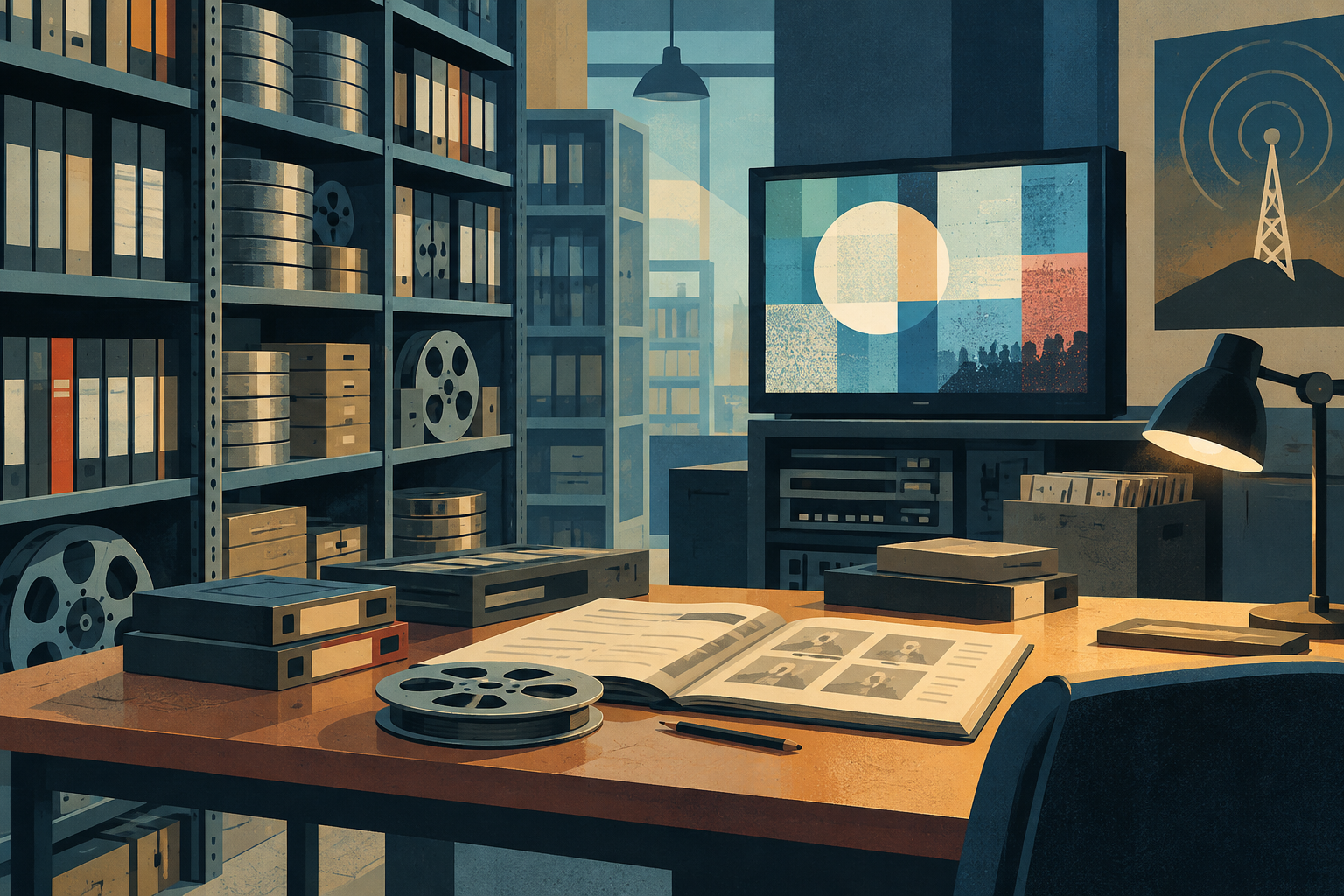
From today’s perspective, one of the most important changes is that part of television’s past can be consulted outside its original broadcast slot. RTVE presents its television archive as available on RTVE Play, through streaming and free of charge according to its own page description. This availability changes the relation to material: viewers no longer depend exclusively on the schedule to approach certain older programmes.
It would be excessive to say that a digital archive returns the whole television past exactly as it was lived. Online consultation cannot reproduce the set, the living room, family conversation or anticipation surrounding a particular transmission. Nor does it ensure that every programme made or broadcast is accessible. What it does offer is a different kind of contact: it makes it possible to locate, revisit and compare a preserved selection, while recognising audiovisual material as heritage.
Research on RTVE’s audiovisual archive published by a Complutense University of Madrid journal confirms the relevance of broadcast programmes as objects of historical study. Television does not merely narrate an era; its own surviving materials become sources for studying how that era was represented.
Limits of this overview
This article does not seek to establish a complete chronology of Spanish television or assign specific programmes audience figures, social influence or technical innovation not documented by the supplied evidence. It also does not identify a single date for the adoption of colour, the arrival of each channel or later technological transitions. Those questions need specific, corroborated sources.
That limit is not an editorial weakness. It helps define what can be verified. The available evidence supports stating that colour was a significant technical milestone; that the 1970s through the 2000s are a common framework for interpreting television change; that programmes and formats crossed decade boundaries; and that RTVE’s archive now provides access to part of that heritage. Beyond that, further research is required.
Conclusion: looking again is not going backwards
From the 1970s to the 2000s, Spanish television can be understood as a domestic cultural infrastructure that evolved while retaining a central place in everyday experience. The move to colour changed the visual quality of the image; the range of genres demonstrates that there was no single television; and digital archives introduce a new relationship with material once tied to a particular time and screen.
The most productive way to approach this period is not to search for one uniform golden age. It is to examine its documents closely, acknowledge the limits of what is known, and treat preserved broadcasts as part of a living audiovisual heritage.
Documentary gallery


- Decade
- 2000s
- Region
- Spain
- Level
- Introduction
- Entities
- Museum
Sources and references
- Historia y evolución de 40 años de televisión en España | EL MUNDOlab.elmundo.es · 2026-09-21
- medio siglo de televisión en españa (1956-2006).idus.us.es · 2026-09-21
- Televisión – Museo ETSITmuseotelecomvlc.webs.upv.es · 2026-09-21
- El archivo audiovisual de RTVE. Programas emitidos entre ...revistas.ucm.es · 2026-09-21
- Archivo Histórico - Programa de adquisiciones en RTVE Playrtve.es · 2026-09-21
- Archivo de Televisión Española | Ver en RTVE Playrtve.es · 2026-09-21