A history visible by decade
Television does not change overnight. Its history is made up of overlapping technologies, institutions, programmes and audience habits. The available sources make it possible to follow part of that journey in Spain from the 1970s to the early twenty-first century, without reducing it to a succession of devices or a list of memories.
EL MUNDO’s retrospective arranges the evolution of Spanish television by decade—the 1970s, 1980s, 1990s and 2000s—and relates it to social change during the democratic period. This is a useful way to navigate the subject, though historical reading should remember that a decade is not a precise dividing line: technologies and customs coexist and change unevenly.
From event to habit
Research on television in Spain from 1956 to 2006 places this period within a longer trajectory. The important point is not that television suddenly replaced other media or forms of entertainment, but that it became a cultural institution whose reach depended on programming, infrastructure and social context.
That is why it is useful to ask not only what was broadcast, but also how broadcasts were organised, who produced them and which materials were preserved. RTVE’s historical archive, which includes programmes, series, films and news content, demonstrates why broadcasts matter as records of the medium as well as content that can be watched again.
The technology behind the screen
The arrival of colour is among the technical milestones highlighted by the ETSIT Museum. Yet the experience of a broadcast depends on more than what viewers see on a television set. Production, transmission and storage form a chain, and technical changes can affect how content is made and retrieved.
The history of cable television in Spain from 1970 to 1995 offers another route into the development of distribution. The available source addresses that period, but the supplied material does not give local dates, operators or reach. The reference should not therefore be turned into a more precise chronology without consulting the full text.
From videotape to the computer archive
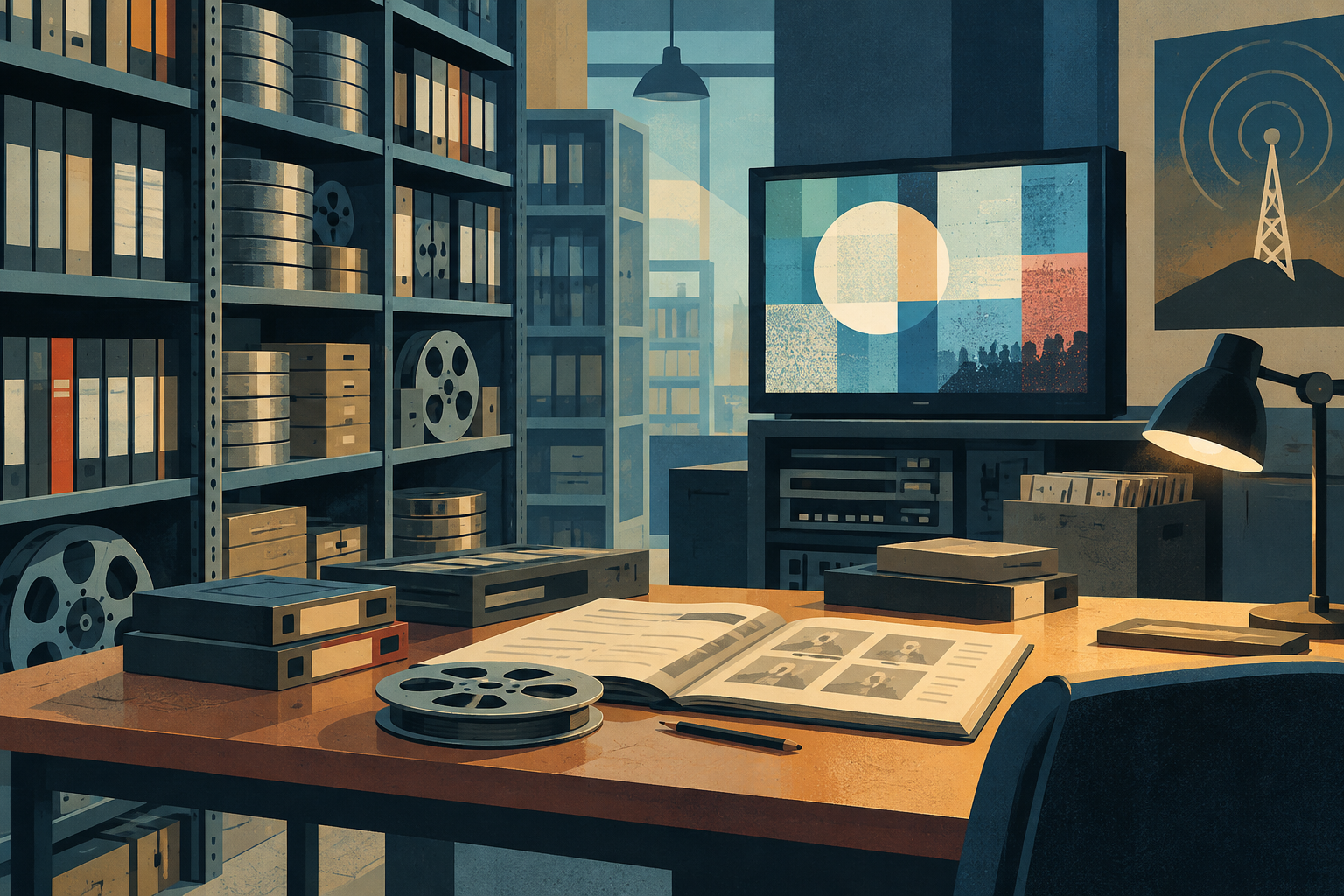
A general account of television’s evolution describes the move from storage systems such as videotape recorders to video servers and archives stored on hard drives and data tapes. It also describes an arrangement in levels: frequently used material available online, other material held in near-line storage, and a deep archive that requires manual retrieval.
That change matters to cultural history. A programme does not necessarily disappear when its broadcast ends: it can be preserved, catalogued and made available for later use. At the same time, finding it depends on archival systems and information attached to each file. Preservation is not automatic; it requires infrastructure, organisation and decisions about which materials to keep accessible.
What can be said, and what remains open
The sources gathered here support a broad outline: Spanish television can be studied by decade, through technical change, distribution and the development of archives. They also justify treating preservation as part of the medium’s history, rather than as a secondary task.
The supplied excerpts are not sufficient, however, to establish a complete chronology of programmes, audiences, regulatory changes or technical rollouts. Nor do they allow each transformation to be attributed to a single cause. It is better to distinguish explicit information from general interpretation: television underwent changes in programming and technology, while archival institutions took on a decisive role in keeping that past available for consultation.
The legacy of a screen that is also an archive
Looking at Spanish television from the 1970s to the 2000s means looking at two connected histories. One concerns what was broadcast and how the medium entered social life; the other concerns the technologies and archives that made it possible to preserve and retrieve those broadcasts. The first explains television’s cultural presence. The second helps us understand which parts of that experience can be researched today.
RTVE’s archive and the cited historical studies provide verifiable starting points, not a complete picture of every broadcast or audience. Their value lies in making it possible to compare television memory with preserved material and documented analysis. The screen was a place of everyday consumption; over time, it also became a historical source that must be preserved and read carefully.
Documentary gallery


- Decade
- 2000s
- Region
- Spain
- Level
- Introduction
- Entities
- Museum, Televisión
Sources and references
- Historia y evolución de 40 años de televisión en España | EL MUNDOlab.elmundo.es · 2026-09-24
- medio siglo de televisión en españa (1956-2006).idus.us.es · 2026-09-24
- Historia de la televisión - Wikipedia, la enciclopedia librees.wikipedia.org · 2026-09-24
- Televisión – Museo ETSITmuseotelecomvlc.webs.upv.es · 2026-09-24
- Archivo de Televisión Española | Ver en RTVE Playrtve.es · 2026-09-24
- Historia de la televisión por cable en España. 1970-1995 (I)forohistorico.coit.es · 2026-09-24