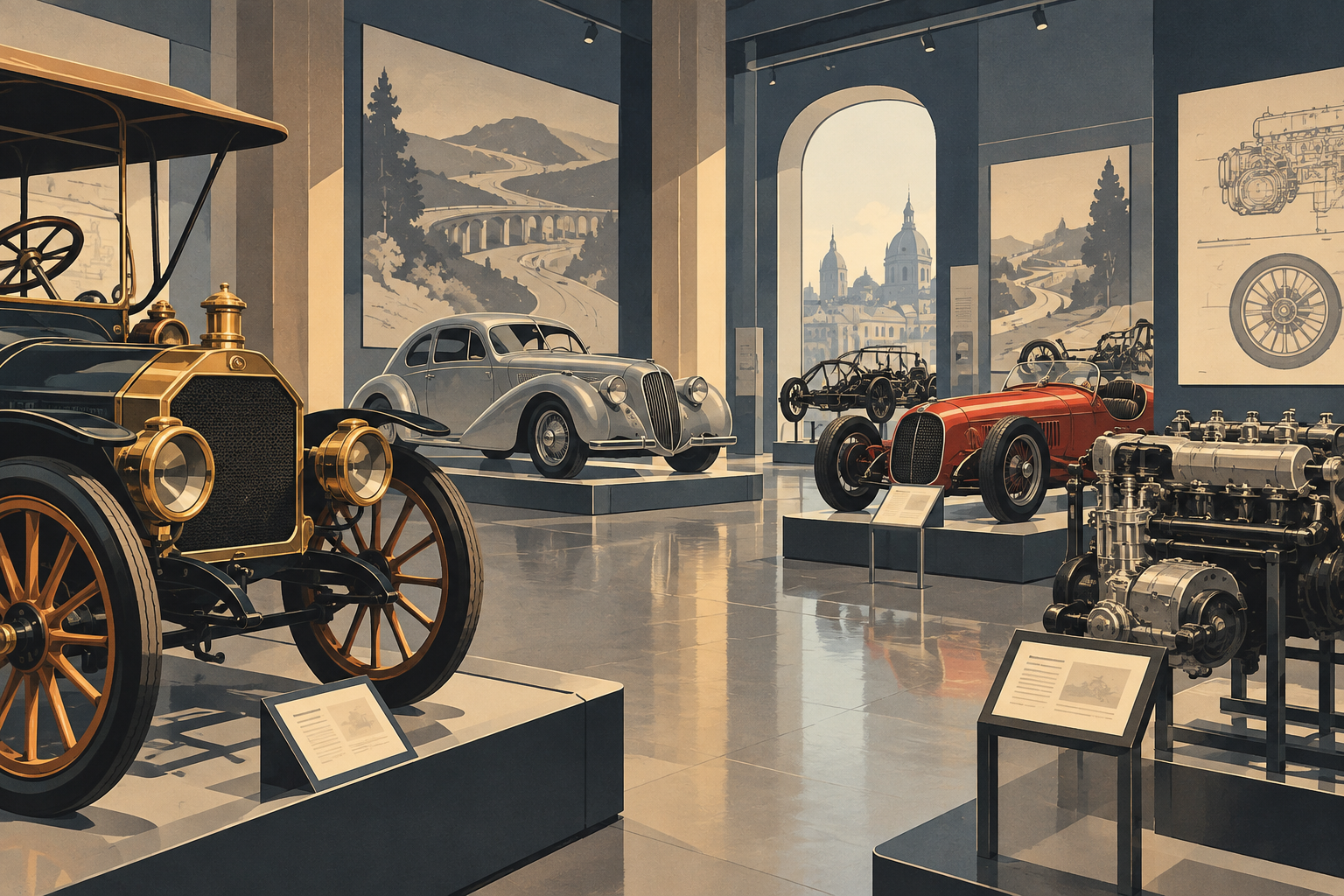
A car or motorcycle in a museum does not, by itself, explain an entire period. It may suggest speed, industry, design or personal memories, but it needs context in order to become readable heritage. The sources assembled for this article make it possible to approach that work of interpretation through several European cases: MAUTO in Turin, a collection connected with the Spanish Army in Torrejón de Ardoz, an exhibition on official mobility services in Madrid, and a Berlin museum devoted to two-wheeled vehicles. They do not constitute a complete history of motoring, nor do they support a full chronology of makes and models. They do, however, document different ways of preserving and presenting vehicles and associated objects.
The vehicle as an object, not an isolated icon
MAUTO states that its collection includes 181 pieces dated between 1854 and 1939, of which 73 were displayed when the museum opened to the public in 1939 beneath the stands of the Municipal Stadium. The figure includes 55 cars, 62 engines and 30 chassis. This is particularly revealing: an automotive collection is not made up solely of complete bodies. Engines and chassis make it possible to discuss construction, mechanical solutions and technical change without reducing the account to an automobile’s exterior appearance.
The museum dates the beginning of its historical core to collector Carlo Biscaretti di Ruffia, who began gathering cars, chassis and engines in 1933. It also frames its display as a narrative connected with cultural and social movements, scientific research and technological achievements. This should be understood as MAUTO’s institutional approach, not as proof that every vehicle on display represents all those processes on its own. Its editorial value lies in reminding us that interpretation is part of exhibition-making.
Collecting also means preserving documentation
The Museographic Automobile Collection at the San Cristóbal Barracks in Torrejón de Ardoz provides another perspective. According to its institutional brochure, its holdings originated in the former Spanish Army Automobile School, established in 1931. Those holdings included cars, motorcycles and numerous manuals. This origin highlights a significant difference from a collection focused on a brand’s development or a model’s appeal: here, vehicles are connected with training, maintenance and institutional use.
Manuals matter because they help place an object within concrete practices. A vehicle may retain visible components, but documentation may indicate how it was described, handled or taught in its context. The brochure also mentions a gearbox and an engine installed in vehicles in the collection. The presence of separate components opens a technical reading that does not rely on a complete automobile being operational.
Public mobility broadens the story
In 2015, El País described an exhibition at Spain’s State Vehicle Fleet that brought together cars and motorcycles used in official services, alongside police vehicles, traffic vehicles, ambulances, off-road vehicles and trucks. The exhibition also included a reconstruction of the service chief’s office from the early 1950s, as well as mechanical and electrical tools, some made in the organisation’s own workshop.
This assemblage shifts attention away from the car as individual property and towards public infrastructure. The interest is not only in which vehicle survives, but in who used it, what service it provided and which trades made its continued operation possible. Tools and workspaces are not decorative additions: they allow transport to be linked with repair, management and coordination. The source does not supply a complete catalogue or support claims about the features of specific models, but it does confirm that public-mobility interpretation can include vehicles, tools and working environments.
Two wheels, workshop and replica
Berlin’s visitor page on the Zweiradmuseum describes a former horse stable arranged as a workshop, with around 30 historic motorcycles, bicycles, mopeds and sidecars. It dates the models from 1920 to 1960 and says that Stefan Klinkenberg’s team restores collectors’ objects, makes motorcycle parts and produces replicas of 1950s Steib sidecars.
This information requires a distinction that is often blurred: the original vehicle and the replica. A replica may have educational or functional value, but it does not automatically equal the historic item that inspired it. Likewise, making a replacement part in order to recover a vehicle does not make that part period-original. The source supports the statement that this museum-workshop carries out restoration and parts manufacture; it is not enough to assess methods, degrees of intervention or the authenticity of each example.
What can be verified, and what remains outside the record
The consulted sources support the existence of collections bringing together cars, motorcycles, engines, chassis, manuals, tools and service vehicles. They also support specific dates for MAUTO’s public opening in 1939 and for the creation of the former Automobile School in 1931. They do not, however, provide enough information to reconstruct every object’s full history, registration details, individual provenance, restoration work or conservation conditions.
That limit does not diminish the collections’ value. On the contrary, it encourages careful looking. Rather than turning every old vehicle into an absolute symbol of a decade, the cited institutions show that a motoring museum may be organised around technical systems, professional training, public mobility or the culture of two wheels.
Conclusion
Motoring history becomes richer when the vehicle stops being an isolated image. In Turin, the car conceptually shares space with engines and chassis; in Torrejón, with manuals and training; in Madrid, with public services, tools and trades; in Berlin, with workshop practice, bicycles, mopeds and the distinction between originals and replicas. These are different approaches, documented by the available sources, and they encourage a museum visitor to ask a less obvious question than “what model is it?”: “what network of techniques, work and uses enabled this object to reach this place?”
- Decade
- Before 1950
- Region
- Europe
- Level
- Introduction
- Entities
- Museum
Sources and references
- El MAUTO - MAUTOwww.museoauto.com · 2026-09-20
- Museo del Motor - Costa Blancawww.museodelmotor.com · 2026-09-20
- Historia del coche oficial | Noticias de Madrid | EL PAÍSelpais.com · 2026-09-20
- Folleto de la Colección Museográfica del Automóvilpatrimoniocultural.defensa.gob.es · 2026-09-20
- Historia del vehículo en Berlin (Zweiradmuseum) | visitBerlin.dewww.visitberlin.de · 2026-09-20