A toy enters a museum after changing status. Before becoming a collection piece, it may have been used, given as a gift, sold as merchandise or kept as a domestic keepsake. That journey matters as much as its appearance. A doll, a train, a construction set or a tea set may activate personal memory, yet a cultural institution must also explain which social, technical and commercial relationships made the object possible. Nostalgia may open the door; context is what turns emotion into knowledge.
From everyday object to document
The Royal Collections Gallery notes that toys are tied to histories of purchase, gifts, intergenerational transmission and shared use. Its display about the toys of Alfonso XIII and Victoria Eugenia’s family adds a crucial element: photographs held by the Archivo General de Palacio place them in specific rooms and connect them with those who used them. Without such documentation, an object retains material presence but loses part of its ability to explain everyday life.
Museum entry does not mean that a toy alone represents an entire era. A family, royal or private collection reflects particular purchasing means, tastes and preservation decisions. In the case of those royal toys, the source itself notes purchases from France and the United Kingdom alongside purchases from Spanish bazaars and department stores. This mixture speaks of consumption networks, but it does not justify treating one privileged family’s experience as the general experience of Spanish childhood.
A mirror, not a copy, of society
Spain’s Museum of Costume offers a useful proposition: through toys, children acquire skills and values expected in their society, while the toy reflects its historical moment and aesthetic values. This should be read as an invitation to ask questions rather than as an automatic equivalence between toy and reality. Which activities does it propose? Which roles does it present as desirable? Which materials, technologies or models of home does it normalise? Who could access it, and who was excluded?
The Madrid exhibition Del juguete al cielo. Un siglo de historia, 1880-1980 makes a particularly productive exhibition method visible: linking toys to socioeconomic, technical, cultural and political changes, and sometimes comparing them with photographs of the real object or means of transport they recreate. The method prevents displays from becoming an album of isolated memories. A vehicle model, for example, may relate to industrial design, changing mobility or childhood imagination; identifying and dating it is not enough.
The same exhibition states that plastic displaced wood and tinplate by the late 1950s and that electrical components began to be introduced. This is not merely a sequence of materials. It allows questions about manufacturing, production cost, appearance and a toy’s capabilities. Still, the available evidence does not establish how every household received that change, nor does it support one universal account of use.
Collecting is also selecting
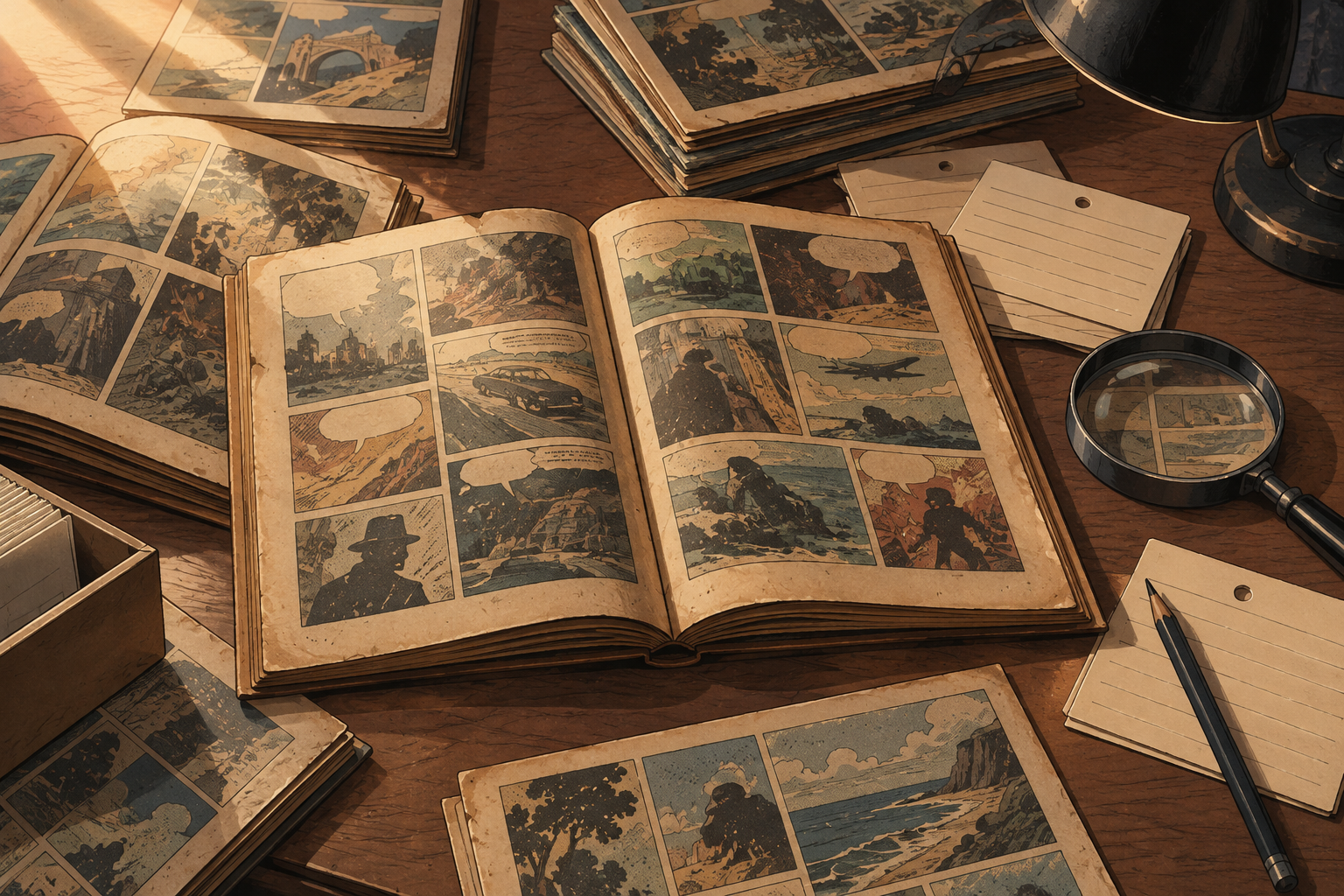
Every collection preserves and, at the same time, leaves things out. The academic article on the Museu del Joguet de Catalunya describes holdings of tens of thousands of toys, trading cards, comics, illustrated stories, nativity figures, small theatres and music boxes, assembled as material culture of childhood and popular culture. The breadth of the group challenges a rigid boundary between “toy” and other objects connected with play, imagination, learning or family leisure.
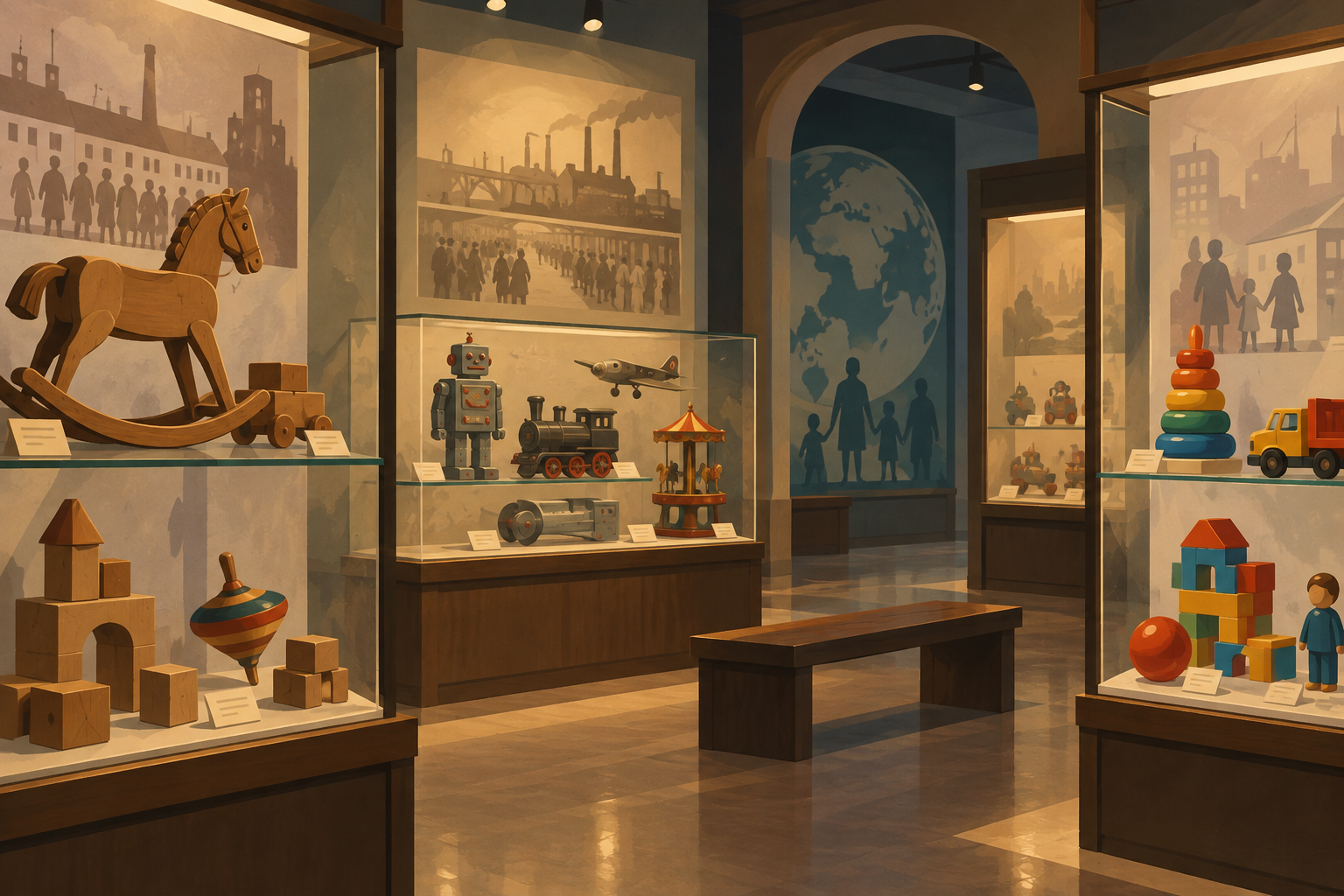
Yet scale does not remove the need to explain criteria. Why was one box saved and another was not? What provenance is known? How does one item relate to the rest of the holdings? The study also addresses the ontological change undergone by a museum-displayed toy: an object made to be handled is protected behind glass. This transformation is necessary in many cases, but it should be made visible. Visitors do not encounter childhood’s toy exactly as it was; they encounter an object stabilised, catalogued and arranged through a contemporary narrative.
The Valencian Toy Museum provides another example of how a collection’s history can be part of its interpretation. Its holdings rest on a donation to the town of Ibi by workers from the Cooperativa Payá, and consist chiefly of toys made in Ibi and Germany. The museum connects collecting, conserving, researching, educating and disseminating heritage with recognition for toy workers and entrepreneurs. The object can therefore speak of play, but also of work, local industry and the transmission of skills.
From display case to archive
Conservation does not only mean display. Colombia’s Pedagogical Museum presents itself as custodian of collections of games and toys, school objects and documentary and bibliographic holdings. Its approach links toys to school memory, educational practice, childhood and material culture. It is a useful warning against the assumption that a toy museum should be arranged solely around rarity or visual appeal.
The Colombian institution describes handmade toys as objects that generally represent and preserve the cultural traditions of peoples and regions. This makes it possible to value a coca, pirinola, spinning top or yo-yo without reducing it to a frozen image of “the traditional”. Understanding them requires information about materials, manufacture, circulation, rules of play, local names and changes in use. Where that information is missing, the responsible approach is to say so rather than fill the account with generic recollections.
Archives also protect less spectacular traces: photographs, inventories, labels, catalogues and acquisition records. The Royal Collections Gallery demonstrates the worth of room photographs; the Pedagogical Museum stresses the coexistence of objects and documentary holdings. In both cases, accompanying information is not an add-on: it enables the shift from “an old toy” to an item with verifiable provenance and relationships.
Nostalgia as a starting point, not a method
The institutions considered acknowledge a toy’s emotional force. That emotion can make someone pause at a display, compare generations or recall family practices. The problem begins when emotion becomes sufficient explanation. Saying that every earlier era was more creative, simpler or more authentic is not supported by a preserved object. Neither is the reverse: a new material does not, by itself, determine a better or worse play experience.
A rigorous exhibition can retain the affective dimension without abandoning uncomfortable questions. It can explain that dolls and tea sets appear in photographs of the royal family’s rooms and encouraged imagination and preparation for adult life, as the Gallery states. At the same time, it must clarify that such associations reveal social expectations in their context, not natural destinies for those who played. It can recognise Ibi’s local industrial pride without concealing that a collection represents a particular selection.
Conclusion: looking slowly in order to preserve better
A museum toy deserves a double gaze. On one hand it is a material object, with form, wear, technology, provenance and sometimes documentation. On the other, it is an access point to networks of production, trade, education, affections and social representation. Neither dimension should absorb the other.
The sources reviewed agree in treating toys as heritage and as evidence of material culture. They also show complementary paths: photographs of use, comparison with historical contexts, archives, research, collections linked to local industry and attention to handmade objects. The limits of what can be verified matter just as much. Not every toy retains its full history, and a display case never contains the whole childhood of an era. Acknowledging that incompleteness does not weaken the museum; it turns curiosity into a critical practice of memory.
- Decade
- Before 1950
- Region
- Spain
- Level
- Enthusiast
- Entities
- No linked entities
Sources and references
- Anti-juguetes o la «memoria lúdica» tras un cristal: Una ...dialnet.unirioja.es · 2026-09-18
- Juguetes Reales - La Galería de las Colecciones Realeswww.galeriadelascoleccionesreales.es · 2026-09-18
- «Del juguete al cielo» | Condeduque Madridwww.condeduquemadrid.es · 2026-09-18
- Producción Artesanal – MUSEO PEDAGÓGICO COLOMBIANOmuseopedagogico.pedagogica.edu.co · 2026-09-18
- Pasado, Presente y Futuro - Museo del Juguetewww.museojuguete.com · 2026-09-18
- Juguetes - Museo del Traje | Ministerio de Culturawww.cultura.gob.es · 2026-09-18