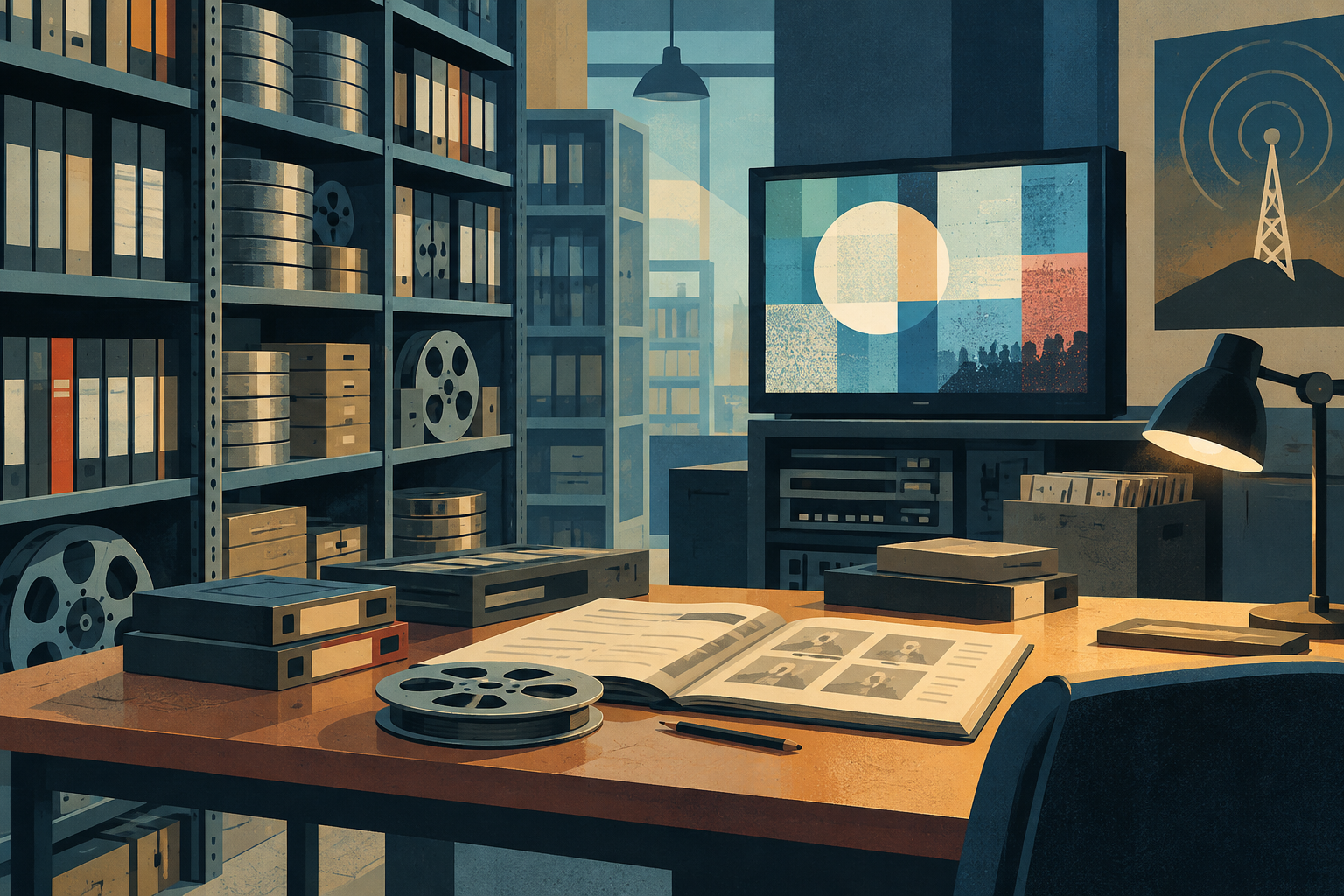
An image does not reach the future alone
On 6 December 2006, the creation of Mexico City’s Museo Archivo de la Fotografía (MAF) was published. The date matters for more than administrative reasons. According to the Censo-Guía de Archivos de España e Iberoamérica, the institution brings together more than a century of images connected with successive local administrations’ efforts to provide public services and infrastructure. Its creation responded to the need to preserve that past and to establish a policy for safeguarding and conserving still images that had been held for decades by the Dirección General de Comunicación Social.
Photography appears here as an administrative record, but that definition does not diminish it. The images register changes before, during, and after urban works; they are therefore both evidence of institutional activity and material for reading the city’s transformations. The MAF is a useful case for understanding a central question of visual culture: preserving a photograph does not merely mean storing a surface bearing an image.
From administrative use to historical value
The Censo describes the MAF as a space for the conservation, research, and dissemination of photography, with particular attention to twentieth-century historical moments and to the transformation of Mexico City. That movement—from an image made as official support to a historical document—is crucial. An archive receives not only isolated images, but also series, functions, provenance, and relationships with other records.
Spanish Ministry of Culture documentation on museum archives provides a helpful parallel. Museum files may bring together letters, assignment or deposit orders, photographs, and other records that help build the history and significance of a collection. The point is careful but plain: a photograph’s meaning often depends on what accompanies it. Separating it from those links may ease visual circulation, but can also reduce what it allows researchers to know.
Preservation is not a single recipe
The material challenge does not admit universal solutions either. The Museo de Zaragoza explains that its historical holding includes around 4,500 items on metal, glass, paper, and plastic, and that preventive conservation work has had to be individualized because of that diversity. Its example reminds us that “photography” does not name one stable object, but a range of materials and techniques with different needs.
Historical cellulose-nitrate plastic is particularly revealing. The museum describes individual cotton-fibre paper enclosures, ventilation, and cold storage as measures used to control deterioration. This is neither a home instruction nor a method that can be transferred without professional assessment; it does show that preservation depends on correctly identifying the support and addressing its particular risks.
Digitisation expands access; it does not replace the archive
Spain’s National Photography Plan stresses that new technologies have opened an expanded field for conservation, knowledge, dissemination, and research into photographic heritage. Digitisation can multiply access routes and reduce handling of originals for certain purposes. It does not, however, remove the need to preserve the object or its contextual data.
A reflection published in Clip by the Spanish Society for Scientific Documentation and Information emphasizes unique identification and contextual metadata. Without them, a digital surrogate may remain visible while becoming difficult to locate, connect, or interpret. For an urban archive on the scale of the MAF, future accessibility depends as much on the images as on knowing what they are, where they came from, and which series they belong to.
Photography, video, and the cultural record
The issue extends to audiovisual material. MACBA Archive argues that, especially since the 1950s, artistic production cannot be understood solely through the artwork: the document forms part of a complex cultural language. Its holdings include material from a group active from 1977 to 1983 concerning social-video projects, internal organisation, production photographs, and work sessions.
That example does not make the MAF a video archive; the supplied sources do not state that. It does place photography and video within a shared problem: an image may be an artwork, a record, a working tool, or evidence of a process, and often several of these at once. Responsible preservation should not flatten those roles.
What can be verified, and what remains open
The sources document the publication creating the MAF, its conservation, research, and dissemination mission, and a holding of more than two million examples according to the census record. They also state that the collection was held in cardboard boxes and that classification was expected to begin in 2008. They do not, on their own, establish the present status of every classification, digitisation, or consultation process.
That limit does not make the case less valuable. It requires a distinction between the documented institutional project and claims about subsequent development. The MAF shows that photographic heritage is preserved not simply because an image is old or appealing. It is preserved because its materials, descriptions, and context allow a city to continue questioning its own memory.
Conclusion
The creation of the Museo Archivo de la Fotografía formalised a recognition: administrative and urban images are part of historical heritage. Practices described by museums, archives, and preservation plans lead to the same conclusion. Keeping a photograph requires caring for its material; making it accessible requires describing it; understanding it requires retaining, where possible, the connections that produced it. An archive does not stop time, but it creates conditions in which an image can retain more than its appearance.
Documentary gallery


- Decade
- 2000s
- Region
- Latin America
- Level
- Enthusiast
- Entities
- Museum
Sources and references
- Censo-Guía de Archivos de España e Iberoaméricacensoarchivos.cultura.gob.es · 2026-09-20
- ARCHIVOS DE LOS MUSEOS ESTATALES - | Ministerio de Culturawww.cultura.gob.es · 2026-09-20
- La conservación de la fotografía en el Museo de Zaragoza – Museo de Zaragozawww.museodezaragoza.es · 2026-09-20
- Clip de SEDIC, Revista de la Sociedad Española de Documentación eedicionsedic.es · 2026-09-20
- Archivo | MACBA Museo de Arte Contemporáneo de Barcelonawww.macba.cat · 2026-09-20
- PLAN NACIONAL DE FOTOGRAFÍA www.mecd.gob.es/planes-nacionales/planes.htmlwww.cultura.gob.es · 2026-09-20