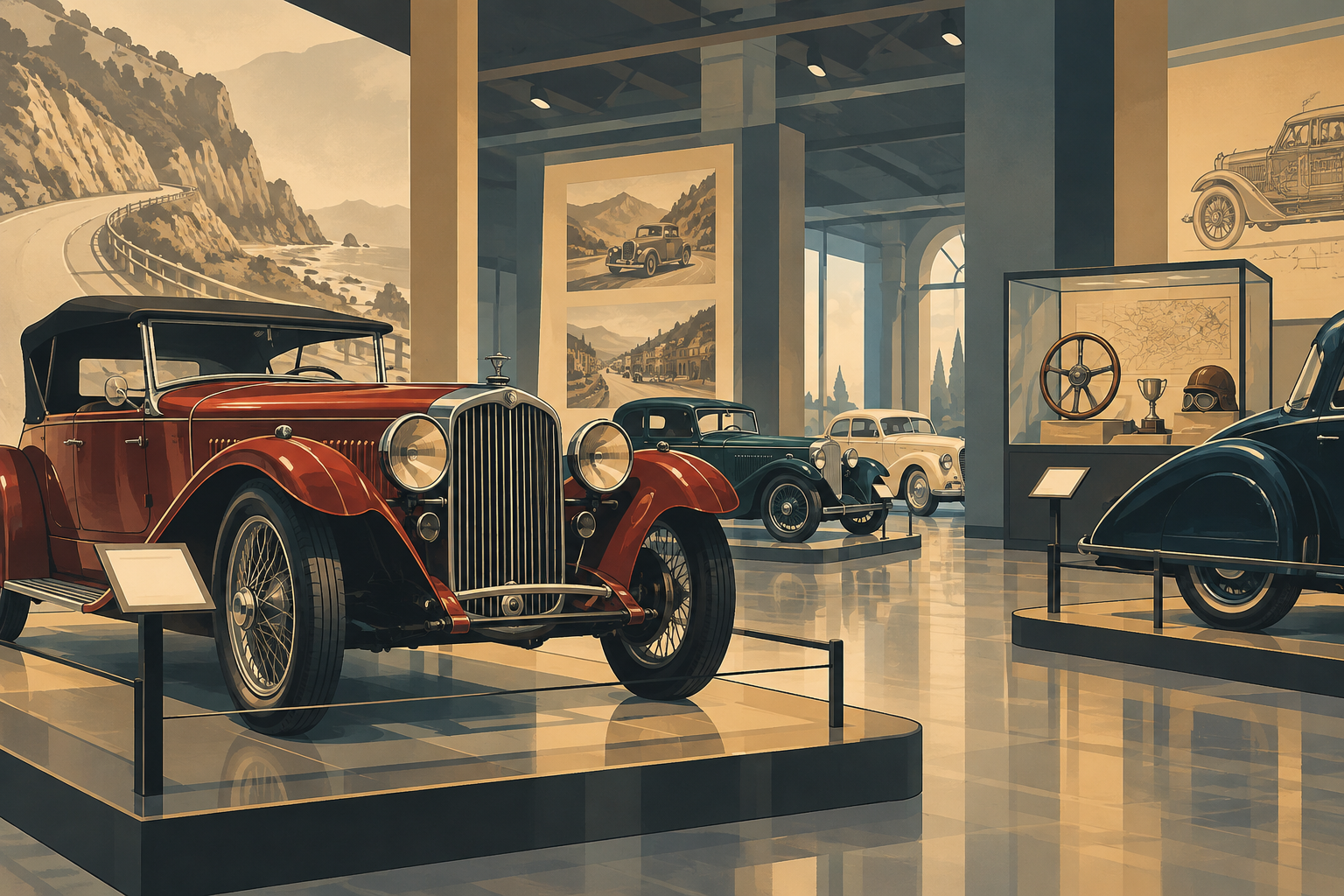
A vehicle is not an isolated object
A historic automobile can appear self-contained: bodywork, wheels, mechanics and an approximate date may be enough to identify it. Yet the institutions cited in the evidence suggest a wider reading. A vehicle brings together technical solutions, design choices, working practices, everyday mobility and, at times, a direct connection with public administration or popular culture. The motor museum turns these layers into a visible narrative.
That does not mean that every museum tells the same story, or that a collection alone equals a complete history of the automobile. What can be verified here is more specific: different centres preserve vehicles alongside engines, chassis, documents, tools or period settings. Their approaches help us consider what is gained and lost when a machine moves from the road into a gallery.
MAUTO and the collection as a material archive
MAUTO places the origin of its oldest core in Carlo Biscaretti di Ruffia’s collecting work, begun in 1933. The institution says it opened to the public in 1939, in spaces beneath the municipal stadium stands, with 181 pieces dated from 1854 to 1939. Its own description counts 55 cars, 62 engines and 30 chassis.
That breakdown matters. An automobile museum need not be reduced to complete, photogenic body shells. Engines and chassis can explain matters partly concealed by exterior form: mechanical architecture, changing components and vehicle construction. MAUTO also frames its exhibition as a narrative linked to cultural, social, scientific and technological movements.
Recording the trades as well
The automotive collection at the San Cristóbal barracks in Torrejón de Ardoz comes from the holdings of the former Spanish Army School of Motoring, created in 1931. Its institutional leaflet mentions cars, motorcycles, manuals and other materials, as well as a gearbox and an engine installed in vehicles in the collection.
This case broadens the focus. Motor heritage is not made only of exceptional models. Manuals, parts and the trace of a specialist school speak of training, maintenance and technical organisation. Displaying them with vehicles helps avoid a purely decorative view. It also recalls that mobility history includes those who drove, repaired, trained staff and managed fleets.
Public vehicles and service memory
A report in El País on Spain’s state vehicle pool describes an exhibition where official cars and motorcycles stood alongside police, traffic, ambulance, off-road and truck vehicles. It also mentions a reconstruction of the service chief’s office in the early 1950s and mechanical and electrical tools, some made in the workshop itself.
The value of such a group lies in the different question it asks. Rather than only asking which model is rarest or fastest, it asks what a vehicle did, which institution operated it and what network of work it required. An office reconstruction and preserved tools provide context without replacing the main object. They are useful when clearly identified as museum reconstruction rather than an untouched scene from the past.
The motorcycle and the workshop as exhibition language
Berlin’s Zweiradmuseum is described as occupying a former stable fitted out as a workshop. According to visitBerlin, it contains around 30 historic motorcycles, bicycles, mopeds and sidecars. The same account describes Stefan Klinkenberg and his team restoring objects, making replicas and producing parts for pre- and post-war motorcycles.
A workshop setting can make the material dimension of a two-wheel collection easier to read. It also requires editorial care: a replica, a part made today and an original historic part are not the same thing. Their value may differ, and all can be useful, provided the museum clearly states what each is. Authenticity is not simply a matter of looking old; provenance and condition must be explained.
The museum as narrative, not catalogue
Information on the Juan Manuel Fangio Technological-Cultural Centre and Motor Museum dates its creation to 22 November 1986. It lists, among the vehicles displayed, a 1903 Peugeot, a 1912 Daimler, an 1898 Krieger electric vehicle and a Yruam designed in Argentina between 1927 and 1928. The list shows a collection’s possible breadth: different technologies, origins and uses can coexist without a single evolutionary line explaining the whole.
The Motor Museum on the Costa Blanca, meanwhile, presents recovered automobiles as an opportunity to observe restoration, design and conservation decisions. That idea is useful if one distinction remains firm: recovering a vehicle does not justify erasing its material history. Patina, older repairs and documented absences may all hold relevant information.
Limits and conclusion
The available sources describe institutions and examples, but they do not support an exhaustive inventory, a comparison of conservation methods or verification of the current state of every cited object. Nor are they enough to establish that one display strategy is universally preferable.
Even with that limit, the cases share a sound idea: a historic vehicle gains meaning when accompanied by context. Engines, chassis, manuals, tools, workspaces and explanations of use are not minor accessories. They are evidence that lets us see cars and motorcycles as technology, design and social experience, rather than only as motionless icons.
- Decade
- Before 1950
- Region
- Global
- Level
- Enthusiast
- Entities
- No linked entities
Sources and references
- El MAUTO - MAUTOwww.museoauto.com · 2026-09-19
- Museo del Motor - Costa Blancawww.museodelmotor.com · 2026-09-19
- Historia del coche oficial | Noticias de Madrid | EL PAÍSelpais.com · 2026-09-19
- Folleto de la Colección Museográfica del Automóvilpatrimoniocultural.defensa.gob.es · 2026-09-19
- Historia del vehículo en Berlin (Zweiradmuseum) | visitBerlin.dewww.visitberlin.de · 2026-09-19
- Día de los museos: Tres historias que tenés que escuchar | Parabrisasparabrisas.perfil.com · 2026-09-19