A small object with a material history
A sticker may seem like a minimal unit: a printed image, sometimes meant to be pasted in and sometimes kept. Yet reducing it to that form overlooks the mechanism that turns it into a collectible. A sticker gains meaning by belonging to a series, by finding a numbered space in an album, by being duplicated, and by circulating among people. A collection is not merely a sum of pieces of paper: it is a practice of searching, sorting, remembering, and talking.
The available evidence permits a cautious outline for Spain. The Museum of Sticker Albums in Estadilla places the first known albums to arrive in the country at the end of the nineteenth century, linked to imported goods—such as dates, cocoa, or vanilla—whose wrappers carried multicoloured pictures. That origin matters: before becoming an independently purchased item, the sticker worked as a commercial accompaniment to an everyday product.
Printing made broad circulation possible
Technique shaped the object’s reach. A document from the Museo del Juego notes the appearance of chromolithography in 1837. Material collected by El trastero de Palacio connects the process with lower costs that brought printed images closer to popular audiences. This technical fact should not be turned into a complete explanation: chromolithography did not create collecting on its own, but it helped make colour reproduction more accessible and allowed series to circulate differently.
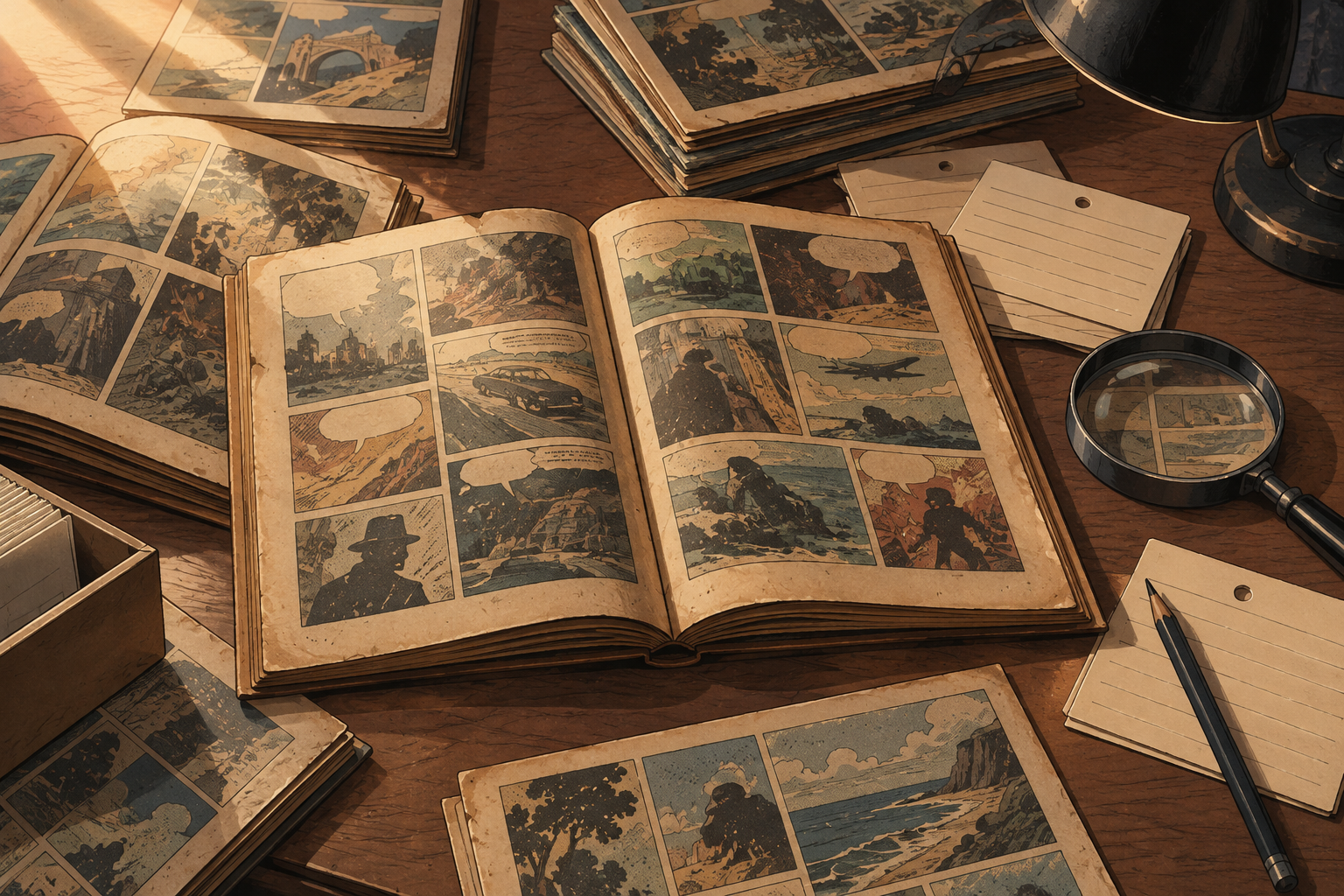
In that context, stickers stood between illustration, advertising, and play. They could depict characters, countries, flags, or popular-culture subjects; they could also accompany the consumption of food, tobacco, and other products. This blend explains why old albums are now documents of graphic design and commercial habits as well as records of leisure.
From promotion to the packet
Estadilla’s chronology describes a decisive change. After pictures inserted in wrappers and matchbox phototypes, whose peak it places at the beginning of the twentieth century, stickers spread during the 1920s through tobacco brands, chocolate, and other products. The same museum states that, in the post-war period, the first packets were sold so children could buy them without purchasing the consumer goods that had previously included them.
That shift changed the relationship with the collectible. Purchase no longer depended solely on a food item or brand; it became organised around the series itself. The packet introduced uncertainty: it did not guarantee a particular piece and made duplicates predictable. This is not a minor detail. A duplicate turns an individual acquisition into a possible relationship with somebody else.
Album, absence, and repetition
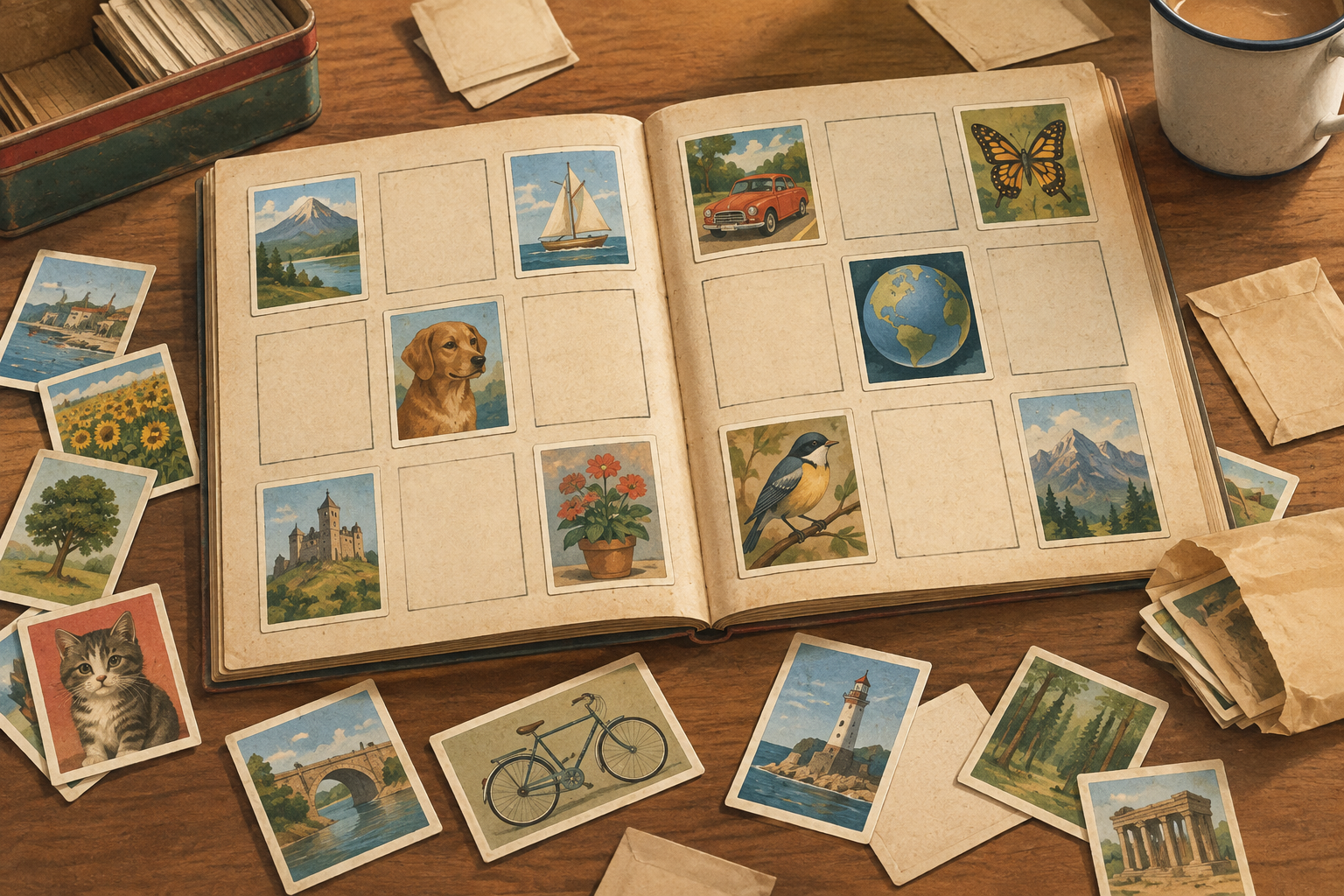
The album structures the desire to complete. Its empty spaces turn an open series into a visible route: they show what has been gathered and, above all, what is missing. El trastero de Palacio defines an album as a publication with empty, numbered spaces in which stickers are pasted; it is a simple but effective cultural technology. Numbering, sorting, and reserving a place for every image gives the collection a specific goal.
It also changes the scale of each piece. A loose sticker can be an appealing image; within an album it is also a necessary or repeated part. From this comes the social vocabulary of collecting: a duplicate is not an absolute failure but an item with potential exchange value. The activity may happen at home, at a kiosk, in a playground, or at meeting points, but it always needs implicit rules about condition, perceived rarity, and equivalence.
Football, licences, and shared culture
Thematic specialisation broadened the format’s presence. ABC states that the first LaLiga sticker albums date from the 1940s and 1950s, and that Colecciones Este and Panini changed the Spanish landscape in the 1970s. The same outlet reports that Panini issued its first LaLiga album in the 1979/80 season under the CromoCrom name, after an earlier approach to Spain through the 1974 Germany World Cup album.
Football collecting brings together sporting identification, squad updates, and everyday conversation. Yet the logic could move between subjects. Cinco Días mentions among Panini’s Spanish collections Fútbol 82, Transformers, Los Disfraces de Mortadelo, The Lion King, and Harry Potter and the Half-Blood Prince. The list alone cannot measure the impact of each, but it does show the album’s ability to connect sport, animation, comics, and film through one shared practice of completing and swapping.
A system that coexisted with screens
In 2009, Cinco Días described the sticker’s commercial continuity alongside video consoles and noted that Panini’s website allowed orders of up to 40 stickers to complete a collection. The fact does not prove that digital media replaced or defeated a physical format; rather, it shows coexistence. The internet could help locate missing pieces, while the album remained material and swapping retained a social dimension.
The limits of what can be verified matter. The supplied sources are insufficient to establish a complete history of every Spanish publisher, to count collectors, or to identify one collection as the most important. They do support the claim that the format moved through different distribution channels and that its use changed with them.
Conclusion: completing is more than owning
The persistence of stickers is better understood by looking at the system rather than the individual image. Printing enabled dissemination; commercial promotion brought them into consumption; the packet made purchase independent; the album organised absence; and the duplicate opened the way to exchange. Each element needs the others.
That is why an incomplete album is not necessarily a failed object. It makes a history of choices, searches, and contacts visible. For someone preserving it today, it may be a paper artefact; for the person who filled it, it was also a particular way of taking part in a shared culture.
- Decade
- Before 1950
- Region
- Spain
- Level
- Enthusiast
- Entities
- No linked entities
Sources and references
- Una historia de cromos | Pixartprintingwww.pixartprinting.es · 2026-09-17
- El mundo de los cromos, una historia de ayer y hoy | El trastero de Palacioeltrasterodepalacio.wordpress.com · 2026-09-17
- Museo del Álbum de Cromos de la Villa de Estadillaturismosomontano.es · 2026-09-17
- Los cromos resisten el auge de las videoconsolas | Empresas | Cinco Díascincodias.elpais.com · 2026-09-17
- Cromos imposibles, 'repes' y demás mitos sobre la colección de LaLigawww.abc.es · 2026-09-17
- COLECCIÓN DE JUEGOS INFANTILES: LOS CROMOSmuseodeljuego.org · 2026-09-17