The store is also part of the story
In a decorative arts museum, preservation begins long before an object reaches an exhibition room. The National Museum of Decorative Arts describes care for its collections as integrated into the museum’s work: it aims to protect the physical integrity of objects and the art-historical information they convey. This broadens what we usually mean by decoration. An object is not only a form, material or visual element; its history also depends on keeping its context and records available.
Organisation is a preservation decision
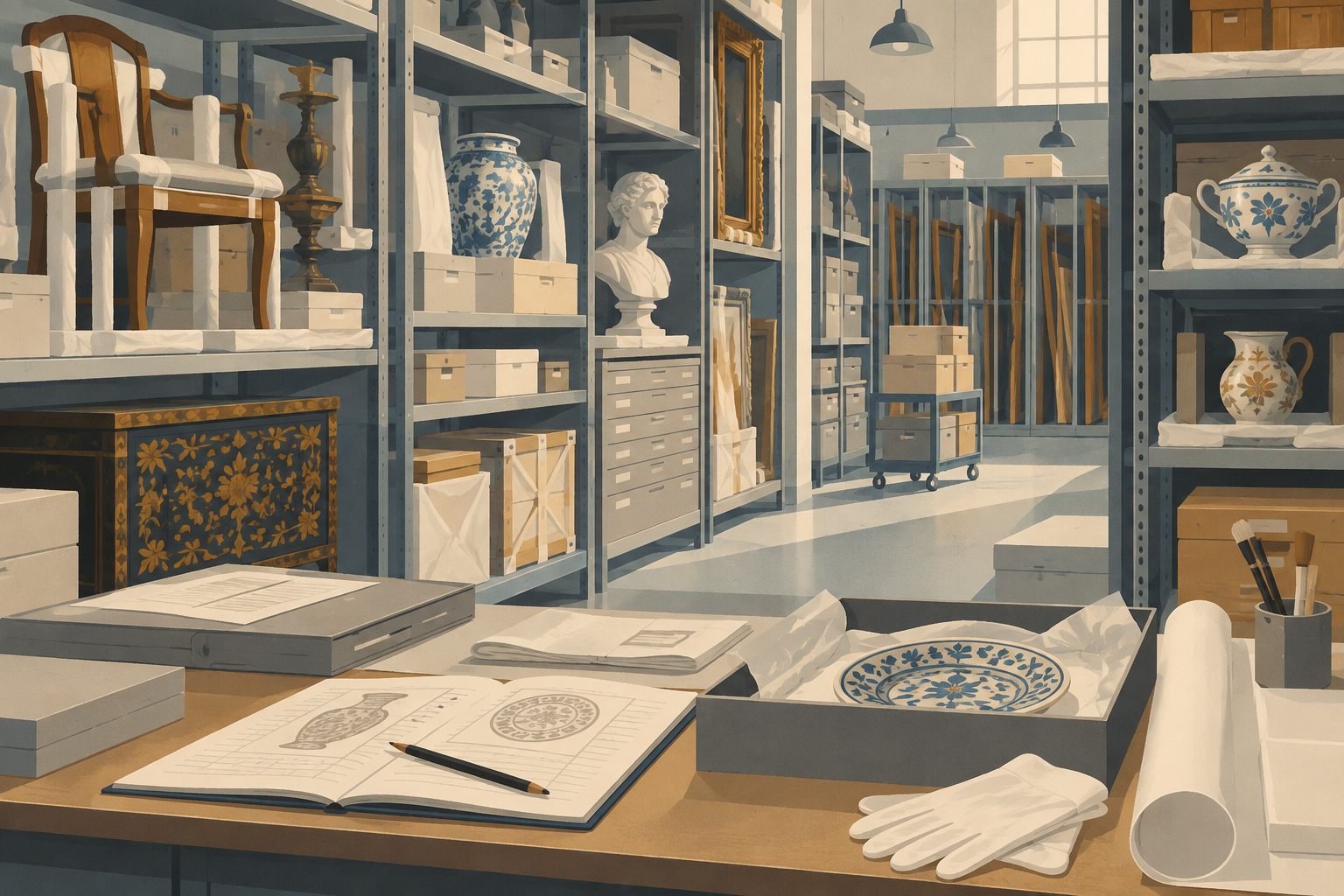
Storage organisation is not an administrative detail separate from collection care. The museum explains that large, heavy objects should be placed in low areas so they can be reached without a ladder, while smaller, fragile objects may be kept in special supports, trays or removable boxes. The stated aim is to make handling quicker and safer and to support preservation.
This organisation does not turn storage into an exhibition, but it affects how a collection can be accessed and moved. As an editorial reading, it shows that logistics are part of material culture too: an object that is protected, findable and accessible can be studied without being separated from its documentation.
Recording in order to compare
Studying an object requires more than a general description. The National Museum of Decorative Arts says that condition reports are accompanied by photographs to help identify changes in an object’s condition and, where possible, by condition maps. It also notes that analytical techniques can provide information about materials, construction methods, alterations and additions.
Written and photographic records make it possible to compare observations over time. On their own, they do not prove an interpretation about an object’s origins or history, but they preserve information that can support later reviews. The distinction matters: recording an observation is not the same as asserting something that has not been established. The museum’s account of ongoing review makes documentation part of care, rather than a formality added afterwards.
From one-off repair to prevention
A 1999 article in Museum International discusses preventive conservation as a policy museums had begun to establish. The supplied text describes it as a systematic process, open to review and improvement, rather than a spontaneous activity. This shifts attention away from repairing damage only after it occurs and towards the conditions and practices that affect collections.
Other supplied museology resources connect conservation, documentation and collection management. Together, the evidence supports a limited conclusion: prevention does not mean that every kind of damage can be anticipated or avoided. It means organising observation, storage and handling as recurring responsibilities. The sources do not establish which specific measures are applied to each individual object when those measures are not documented.
What we can—and cannot—claim
The available sources support the view that caring for a decorative arts collection involves protecting objects, maintaining related information, recording condition and considering how items are stored and handled. They also show that museum catalogues can include information about an object’s condition, treatments, biography and bibliography. However, the evidence here does not identify particular objects, specific interventions or quantified results, so it cannot support claims about the conservation history of an individual piece.
Looking at storage in this way changes the idea of decoration as mere appearance. Preservation depends on quiet decisions—how an alteration is recorded, where an object is placed or how it can be safely removed—that make continued study possible. Care does not replace the history of objects; it helps keep the conditions for investigating that history accessible.
- Decade
- 1990s
- Region
- Spain
- Level
- Introduction
- Entities
- Museum
Sources and references
- Conservación - Museo Nacional de Artes Decorativas | Ministerio de Culturawww.cultura.gob.es · 2026-09-23
- Museum Internacional No 201 (Vol LI, n° 1, 1999) Conservación preventivawww.ibermuseos.org · 2026-09-23
- Capítulo 9 - Conservación y restauración de los fondos museísticos. Criterios admitidos. Agentes destructores. Incidencia de los factores ambientales en la conservación de los bienes cultures. - Fco Javier Zubiaur Carreñowww.zubiaurcarreno.com · 2026-09-23
- instrucciones para la gestión y organización de archivos ...www.navarra.es · 2026-09-23
- Estudio y documentación - Museo Nacional de Artes Decorativas | Ministerio de Culturawww.cultura.gob.es · 2026-09-23
- LA CONSERVACION PREVENTIVA EN LOS MUSEOS Teoría y prácticawww.museosdetenerife.org · 2026-09-23
- Capítulo 10 - El museo como centro de investigación. La necesidad de documentar las piezas en el museo. Tendencias documentales actuales. Normalización y gestión integral del museo. - Fco Javier Zubiaur Carreñowww.zubiaurcarreno.com · 2026-09-23