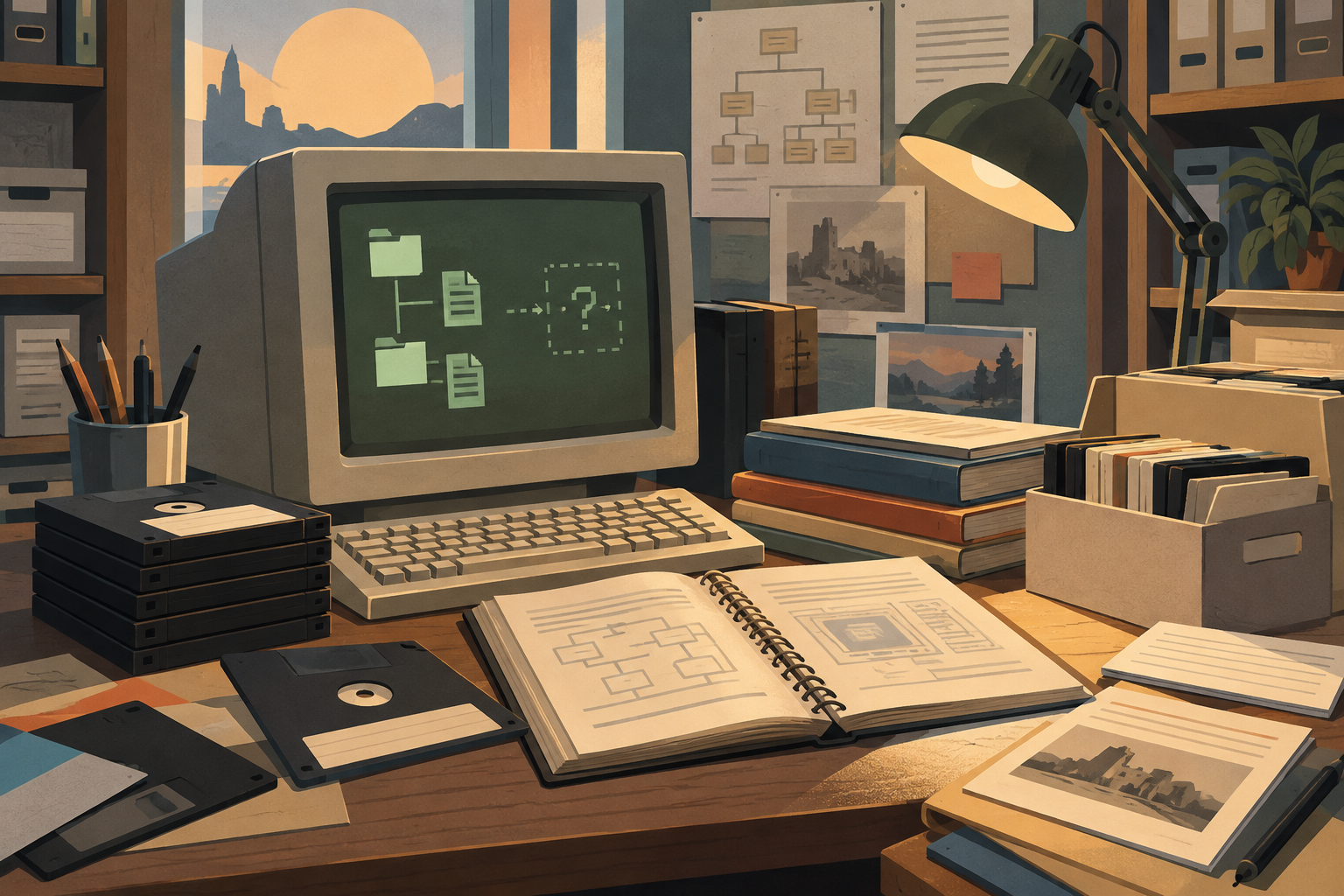
An old program may reach us as a disk, a box, a manual, a digital copy or a catalogue entry. Each trace answers different questions. Preservation is not simply about keeping a medium: it also depends on being able to say what it is, where it came from, what documentation accompanies it and what remains unknown. The available sources let us explore this perspective through archival and museum practice, although they do not provide a technical chronology of platforms or a comprehensive list of specific programs.
The object is more than its medium
Museum documentation brings together materials with varied origins, formats and cultural value. Navarra’s instructions for organizing archives stress that documents related to collection objects form part of their context and should remain connected to them. Applied cautiously to software, this idea discourages treating a disk or digital copy as if it exhausted a program’s identity. Packaging, instructions, annotations, provenance and catalogue records may each provide different information. The source does not set out a software-specific protocol; this connection is an editorial application of its general principle of context.
Identify before telling a story
The National Archaeological Museum describes its archive as a written record of the institution’s life since its foundation in 1867 and says that it also holds documentation from other personal and institutional collections. Its page on documentation also describes identification, conservation assessment, digitization and cataloguing work relating to the Siret Archive. These are concrete examples of work that makes materials findable and makes explicit how they have been described.
For old software, the cautious lesson is not to assume those procedures already apply to programs, but to ask verifiable questions: what exactly is being described? Is the record about the medium, the documentation, or both? Which information comes from a label, and which from an institutional record? Without such details, an appealing description can easily become an attribution the sources do not support.
Catalogues that connect information
The MAN page explains that DOMUS is used to describe and catalogue museum and documentary collections, and that its terminology work includes thesauri for cultural context and generic classification. CER.es, in turn, describes itself as Spain’s Digital Network of Museum Collections. These references document tools and services for describing and consulting museum collections; they do not prove that their catalogues include old software or that a particular program has been digitized there.
That distinction matters. A catalogue can help locate an object and connect it with contextual information, but its existence alone does not show that an object is accessible, executable or described in the detail required for computing research. Responsible writing should distinguish the existence of a catalogue from the actual presence of a program in it.
Communities and the limits of the evidence
An article by Historiacompu on retro-software preservation emphasizes the role of communities in identification, recovery and dissemination, and mentions Internet Archive and The MADE as initiatives associated with software and video-game collections. It also points to difficulties linked to the obsolescence of systems and file formats, as well as the importance of responsible use and copyright. This is a general-interest article, not a technical record or a detailed institutional study; its claims should therefore be attributed to that publication and not extended beyond what it says.
The supplied evidence identifies no software versions, release dates, required equipment, specific file formats or legal conditions for individual works. Nor does it establish that community and institutional preservation follow one standard method. What it does support is that identifying, arranging, describing and contextualizing are central archival tasks, and that the article on retro software considers community participation and responsible access important.
Preservation also means keeping a record
Archival documentation does not replace an object; it helps us understand it and distinguish what is known from what is uncertain. The archival instructions, the MAN’s documentation work and CER.es provide a framework for thinking about description and access. The article on retro software makes the direct connection to digital preservation, although with less technical depth.
The conclusion is deliberately limited: telling the history of an old program requires more than naming a medium or repeating an unsourced date. It requires preserving and describing the traces that allow it to be identified, making clear how those traces relate to one another and acknowledging gaps. The sources consulted cannot close those gaps for particular programs, but they do show why documentation is essential to any reliable account of digital heritage.
- Decade
- 1990s
- Region
- Spain
- Level
- Enthusiast
- Entities
- Museum
Sources and references
- Documentación - | Ministerio de Culturawww.man.es · 2026-09-23
- instrucciones para la gestión y organización de archivos ...www.navarra.es · 2026-09-23
- Archivo histórico - | Ministerio de Culturawww.man.es · 2026-09-23
- Descubre el secreto para la preservación del software retro que las comunidades no quieren que sepas ️historiacompu.net · 2026-09-23
- Clip de SEDIC, Revista de la Sociedad Española de Documentación eedicionsedic.es · 2026-09-23
- CER.es Colecciones en Red - Ministerio de Culturaceres.mcu.es · 2026-09-23