The Internet was not synonymous with pages
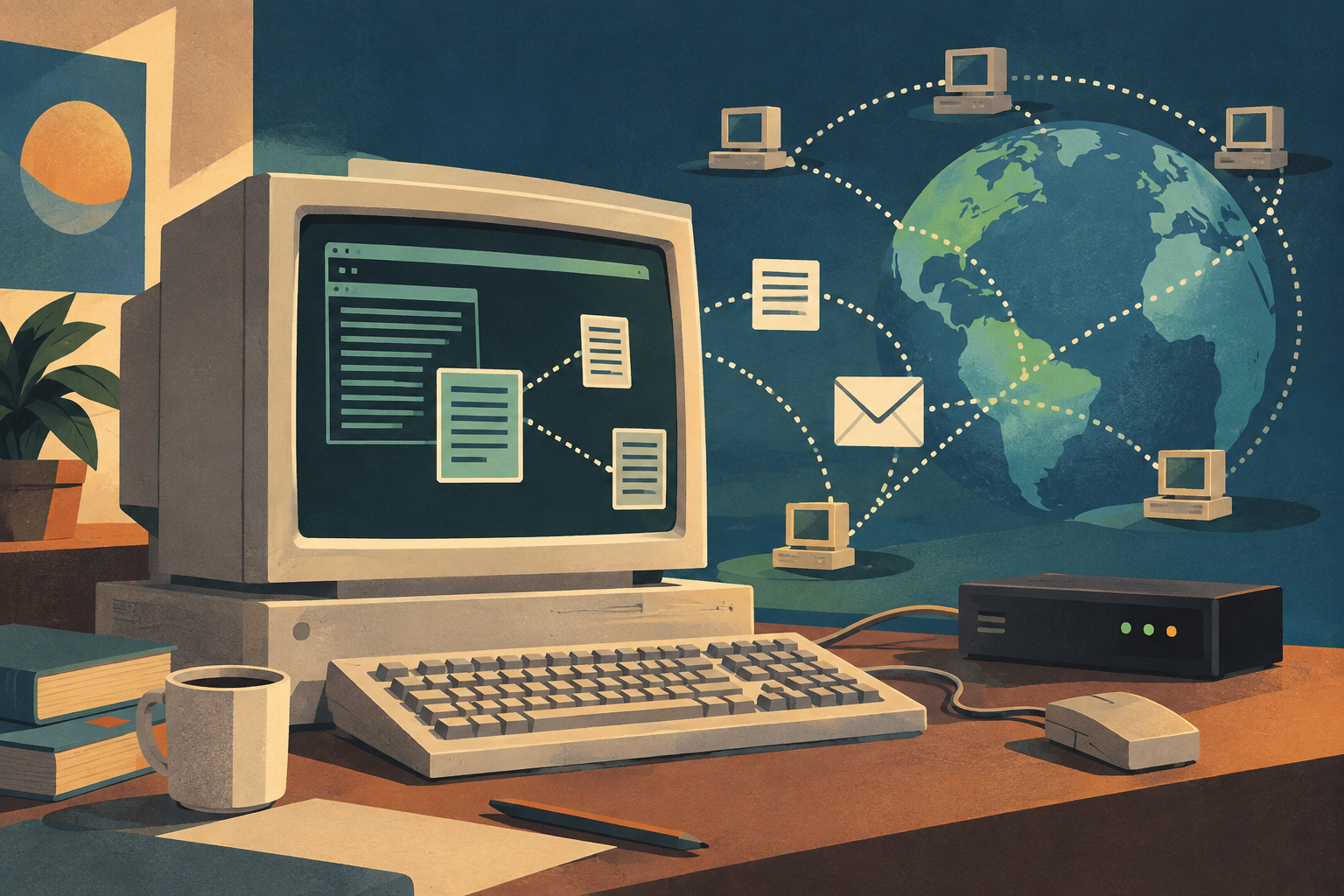
Remembering the earlier Internet often brings to mind a screen of text, a browser and a page that takes time to appear. That image belongs to a real experience, but it does not sum up the network’s history. The sources consulted distinguish the Internet, understood as infrastructure and a collection of networks, from the World Wide Web, a system of linked documents that used that infrastructure. The distinction matters: other uses and forms of communication existed before browsing pages became the most recognizable way to be connected.
Internet Society’s brief history describes a network designed to support different functions: sharing files, accessing remote resources and collaborating. It also notes that networks and technologies changed over time while the infrastructure accommodated new computing environments. This perspective helps avoid an oversimplified timeline in which the Internet seems to begin suddenly with the home browser.
Communication before browsing
Among the services that preceded or coexisted with the Web, email has a prominent place in Internet Society’s account. It describes an email utility that made it possible to organize messages, read them selectively, archive them, forward them and reply. The source presents email as the most important network application for more than a decade and emphasizes its effect on communication between people.
That detail matters because it shifts attention from the public page to everyday exchange. Using the Internet did not only mean finding information: it also meant sending messages, retrieving files and accessing remote machines. The UPC history page mentions remote access and file transfer alongside email and online conversations. These services were not identical and did not necessarily reach the same audiences, but together they show why “the Internet” cannot be reduced to “the Web.”
The Web adds linked documents
CCCB Lab places the development of HTML by a CERN group led by Tim Berners-Lee in 1990 and describes a prototype built in 1991. It highlights the remote consultation of files through text linked to other files. This concise account points to the Web’s distinctive contribution: presenting documents that can lead to other documents through links.
The Web is not described here as an entirely separate network, but as a use of existing infrastructure. That distinction helps explain why the growth of browsing did not immediately erase email, file transfer or other services. Internet Society’s history stresses the network’s ability to accommodate successive functions and technologies. The cultural change was that linked documents offered a particularly visible way to explore and publish information.
From academic networks to a broader experience
Documentation in the Universidad Politécnica de Madrid’s digital archive provides a specific Spanish example. According to its description, a TCP/IP subnet organized at its School of Telecommunications Engineering was operational on 2 December 1985. The same source says that RedIRIS achieved direct IP connectivity with the rest of the world in December 1990. These are specific milestones in a national and academic history; by themselves, they do not describe access in every Spanish home or tell us how many people were connected.
On another level, the UPC history page says that the publication of WWW technology and browsers helped open the Internet to a wider public, including commercial activity and personal pages. This suggests a change in access and use, but does not mean earlier services disappeared or that expansion was uniform. The Web made the Internet easier to recognize through visible pages; it did not turn the Web into the whole network.
Searching, sharing and remembering
The sources offer examples of how the experience changed. Wikipedia identifies WebCrawler, in 1994, as the first full-text web search engine and notes that before it searches were limited to page titles. Since the evidence here comes from an encyclopedic source, this should be treated as that source’s attribution, not as a claim independently verified by the material available.
CCCB Lab notes that Napster popularized a distributed form of peer-to-peer file sharing in 1999. This example shows that the history of the Internet in the 1990s cannot be reduced to browsing: it also includes file circulation and different models of communication. The source describes its popularization but does not provide enough detail here to reconstruct its technical operation, reach or legal controversies.
What we can say—and what we cannot
Taken together, the sources support a clear reading: the Internet was an infrastructure that accommodated multiple services; email had early importance; the Web introduced linked documents on that infrastructure; and, as the Web and browsers spread, personal and commercial pages became more visible. The Spanish milestones from 1985 and 1990 add documented local context.
The supplied evidence does not support a complete history of household connections, their costs, speeds or differences between countries. Nor does it document a universal experience: access, skills and available services varied, though the material here cannot specify those differences. The earlier Internet should therefore not be reduced to a single screen or a uniform nostalgia. It was a network of varied functions, whose history did not begin with pages and whose later development depended on shared infrastructure.
- Decade
- 1990s
- Region
- Global
- Level
- Introduction
- Entities
- World Wide Web
Sources and references
- Historia de Internet - Wikipedia, la enciclopedia librees.wikipedia.org · 2026-09-24
- Una breve historia de Internet - Internet Societywww.internetsociety.org · 2026-09-24
- Historia de Internet: ¿cómo nació y cuál ha sido su evolución? -www.telefonica.com · 2026-09-24
- Internet: una historia en construcción | CCCB Lab - CCCBlab.cccb.org · 2026-09-24
- La evolución de internet desde su creación hasta hoywww.marketingdirecto.com · 2026-09-24
- Historia de internetwww.fib.upc.edu · 2026-09-24
- Historia de Internet y de sus inicios en España | Archivo Digital UPMoa.upm.es · 2026-09-24