Television That Could Not Be Stored on Tape
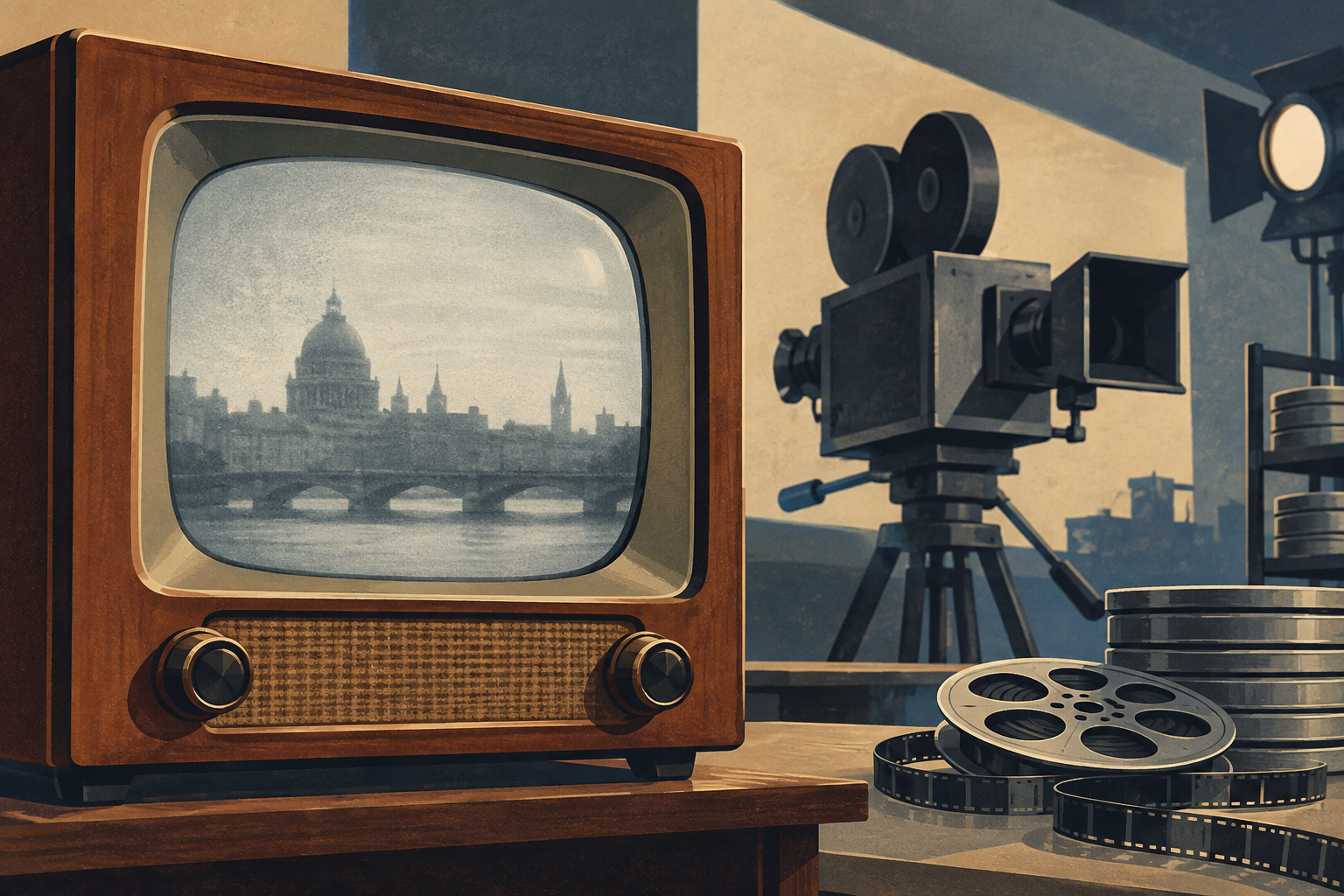
Television is often imagined through the domestic set, yet its early decades raised another decisive question: how could a broadcast be preserved? According to the UPM Museum of Telecommunications, from the beginning of regular broadcasts in the mid-1940s until 1956, the only available way to record television programmes was to use a motion-picture camera and then process the film. This was not incidental. It enabled delayed broadcasts and the creation of programme archives.
That detail changes how early television should be viewed. The signal served transmission, but permanence depended on a cinematic medium and process. Television could be immediate; its memory required filming and processing.
Transmission Is Not Recording
The ETSIT Museum defines television as a system for transmitting and receiving moving images and sound at a distance, through radio waves or specialised cable networks. The definition describes the signal’s journey to the receiver, the television set. It does not, by itself, explain how a broadcast could be watched again later.
The distinction matters because it prevents present-day convenience from being projected onto the past. Before a separate television recording medium was available, recording a programme meant transferring its image to film and waiting for processing. Early television archives should therefore not be understood as automatic collections of broadcasts: they resulted from technical decisions and material work.
The Spanish Demonstration of 1948
The medium’s history was also built through public demonstrations. RTVE places, after the Spanish Civil War, demonstrations by the Dutch company Philips at the 1948 Feria de Muestras. The source does not allow that test to be treated as a full account of television’s establishment in Spain, but it does document an early encounter between a fair-going public and television technology.
That scale should be preserved. A demonstration does not necessarily mean stable programming or a consolidated network. Its interest lies in showing television as a visible technical novelty before sets and broadcast routines became normal in homes.
From Event to Archive
The need to record for delayed transmission and preservation reveals two dimensions of television. A programme was, first, an event occurring before an audience. It could also become a document, but only through additional work. Film made that second future possible.
The RTVE Museum explains that its pieces are located, placed in their historical context and given an initial cleaning; when appropriate, technical support is requested for restoration. Although this testimony concerns museum work, it shows that television objects and materials do not speak for themselves. Their historical value depends on identification, context and careful preservation.
What the Sources Allow Us to Say
The supplied evidence supports three specific points: television transmits moving images and sound at a distance; regular broadcasts existed from the mid-1940s; and, until 1956, programme recording relied on a motion-picture camera and film processing. It also supports the occurrence of Philips demonstrations at Spain’s 1948 Feria de Muestras.
It does not, however, allow a complete timetable of Spanish broadcasts, specific technical features of the fair equipment, or the contents of recorded programmes to be reconstructed here. Respecting those limits matters: technical history becomes clearer when it does not fill gaps with plausible but undocumented detail.
Conclusion
Before videotape, television did not lack memory, but its memory was cinematic. Camera, film and processing connected an ephemeral broadcast to the possibility of repetition or archival survival. The 1948 demonstrations documented by RTVE also show that television’s arrival in Spain had a public, experimental dimension. Between the travelling signal and the surviving image stood technical work that is now easily overlooked.
- Decade
- Before 1950
- Region
- Spain
- Level
- Introduction
- Entities
- Museum
Sources and references
- Historias de las Telecomunicaciones – Museo de Telecomunicacionesblogs.upm.es · 2026-09-22
- Museo RTVE. Un acercamiento único a nuestra historia a través de la tecnología televisiva. - TM Broadcasttmbroadcast.es · 2026-09-22
- Televisión – Museo ETSITmuseotelecomvlc.webs.upv.es · 2026-09-22
- Historia de la televisión - Telefónicawww.telefonica.com · 2026-09-22
- Los inicios de la televisión en Españawww.rtve.es · 2026-09-22