A medium built for the present
Television can be defined, in basic terms, as a system for transmitting and receiving moving images and sound at a distance. It may be distributed through radio waves or specialised networks, while the television set receives the signal. This description seems simple, yet it contains a decisive condition for understanding the medium’s early years: broadcasting was primarily directed towards the moment of reception. Once a programme ended, the signal was not automatically turned into a reusable object.
The supplied evidence places the beginning of regular broadcasts in the mid-1940s. In that setting, preserving a television item, delaying its transmission or leaving a record of it required a solution outside the transmission chain itself. Present-day expectations should not be projected backwards, when content can be stored, copied and retrieved comparatively easily. Early television combined a promise of immediacy with considerable material fragility.
Film as the only available record
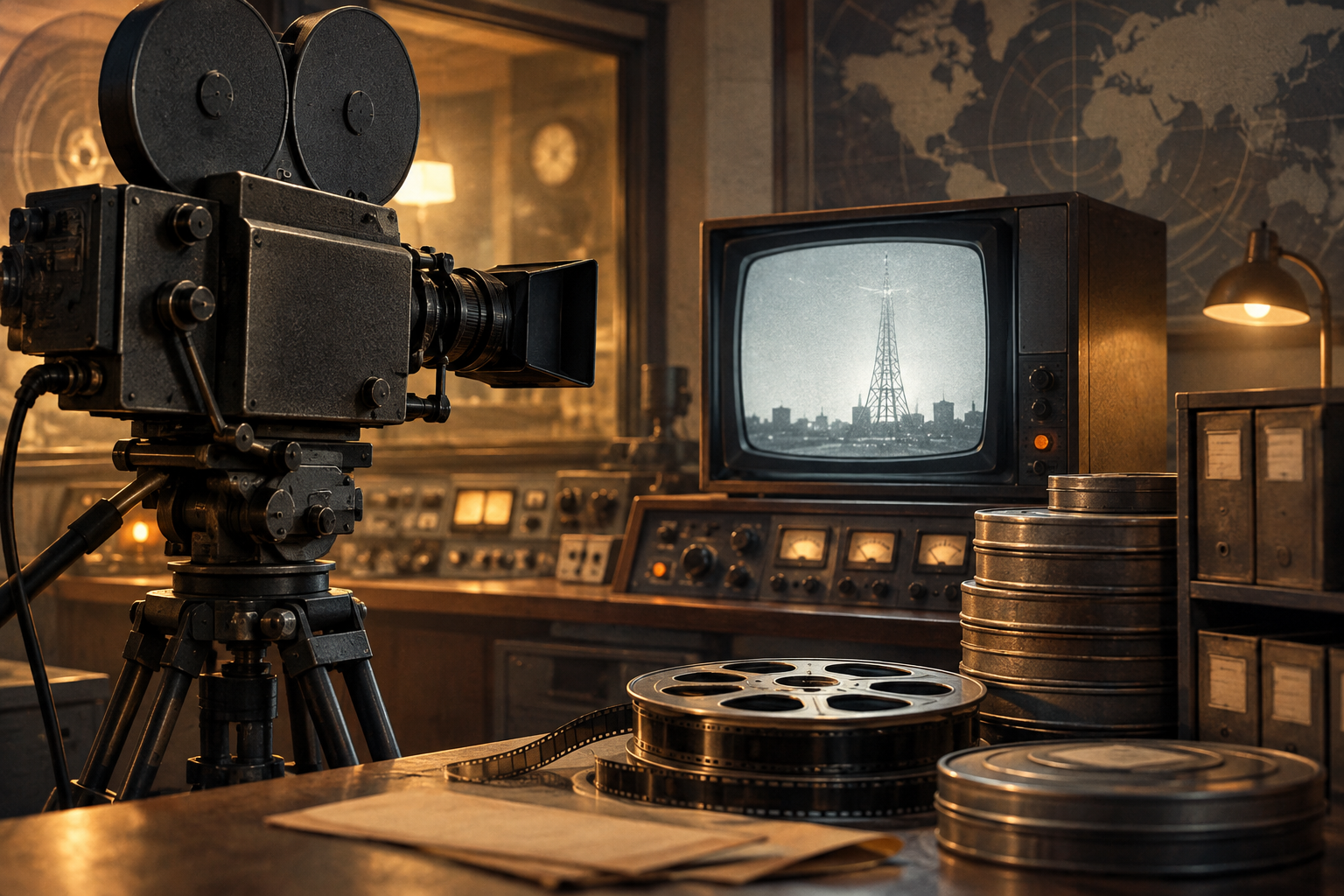
According to the UPM Museum of Telecommunications, from the start of regular broadcasts in the mid-1940s until 1956, the only available way to record television programmes was to use a motion-picture camera and then develop the film. This was not an incidental detail: it was necessary both for delayed broadcasts and for programme archives.
That statement requires two operations to be separated. First came the television transmission; afterwards, the film obtained through camera and development could become a record. Preservation was therefore not an inherent property of the signal. It relied on an additional photographic process, physical materials and a later development stage. This chain helps explain why television history cannot be reduced either to receivers or to programmes that happened to be broadcast.
Film also imposed an obvious practical constraint: recording required preparation and subsequent work. The source does not allow costs, timings or proportions of preserved programmes to be calculated, and it would be unwise to do so. It does establish that delayed transmission and archiving required a specific technical mediation. Every surviving document depended on more than a wish to preserve it: it had to be capable of being filmed and developed.
Broadcasting, delaying, archiving
These three actions are often merged because they can now occur within one digital infrastructure. In the period described by the evidence, they should be considered separately. Broadcasting meant sending a signal to an audience. Delaying meant having a record that could support a later transmission. Archiving meant retaining that record beyond an immediate need.
A motion-picture camera as a recording resource connects all three, but does not make them identical. A recording could serve a delayed broadcast without guaranteeing permanent preservation. Likewise, a programme having aired does not itself prove that it was kept. This difference matters when approaching nostalgic accounts of “old television”: collective memory may retain titles, faces or events, while available media may be partial or dependent on institutions that safeguard them.
The importance of archives also appears in the RTVE Museum example. The supplied information says that the museum can draw on RTVE’s historical archive and on NO-DO in order to contextualise its objects. It does not prove that every programme has survived, nor does it justify describing specific holdings, but it does confirm the value of linking technical objects, preserved images and their period. An isolated device explains little; one connected to documents and histories of use can gain cultural meaning.
Spain: tests, institutions and context
Spanish television also appears in the evidence as a field of testing before consolidation. RTVE states that, after the Civil War, the Dutch company Philips carried out tests at the 1948 Feria de Muestras. The fact is limited, but useful: it shows that television’s arrival was not a single instantaneous act, but a process involving demonstrations and technical experimentation.
This evidence does not allow that test to be reconstructed in detail or consequences to be assigned that the supplied sources do not specify. What can be verified is the reference to Philips and the 1948 fair. It can also be verified that television is understood as a transmission-and-reception technology, not merely as a domestic appliance. The distinction makes it possible to view Spanish beginnings beyond the screen: transmitters, receivers, demonstration venues, technical staff and ways of organising a signal were all needed.
The photograph mentioned by National Geographic, published to publicise a television test on 27 November 1936, offers another clue to the period: public images of early television could present the medium as a novelty. It does not demonstrate a Spanish experience or describe a particular schedule, but it helps place the social interest sparked by demonstrations of the new system.
What changed later, and what should not be assumed
Samsung’s source places the company’s mass production of a digital television set in 1998 and the launch of Bordeaux in 2006. These facts belong to a much later stage and do not, by themselves, explain the medium’s full development. They do, however, underline the distance between television whose preservation relied on film and a later market associated with digital sets.
That distance does not justify imagining an uninterrupted line of progress. The sources available here do not detail every format, standard or transition between 1956 and the cited 1998 and 2006 models. Nor do they permit digital television’s development to be assigned to one company. The most useful editorial lesson is methodological: a technical chronology must respect its gaps and must not turn a corporate reference into a total history.
Conclusion: memory was also a technology
Early television was a medium of presence: images and sound arrived at a distance as broadcasting occurred. Yet it was also a medium that had to devise ways not to vanish. Until 1956, according to the cited institutional source, the motion-picture camera and film development were the only available means of recording programmes. Archiving was therefore not an automatic consequence of broadcast, but a technical and material task.
Seeing that constraint changes how a screen, camera or museum piece can be valued. They are not merely relics of an old design. They belong to a network that made it possible to transmit, delay and, in some cases, preserve. What the evidence establishes with certainty is limited, but sufficient for a firm conclusion: in television’s early years, preserving the present required filming it.
- Decade
- Before 1950
- Region
- Spain
- Level
- Enthusiast
- Entities
- Museum
Sources and references
- Hace 100 años, unas "imágenes borrosas" cambiaron el mundo: así fue el nacimiento de la televisiónhistoria.nationalgeographic.com.es · 2026-09-20
- Historias de las Telecomunicaciones – Museo de Telecomunicacionesblogs.upm.es · 2026-09-20
- Museo RTVE. Un acercamiento único a nuestra historia a través de la tecnología televisiva. - TM Broadcasttmbroadcast.es · 2026-09-20
- Televisión – Museo ETSITmuseotelecomvlc.webs.upv.es · 2026-09-20
- Los inicios de la televisión en Españawww.rtve.es · 2026-09-20
- La televisión: un recorrido por la historia de uno de los grandes placeres de la humanidad – Samsung Newsroom Méxiconews.samsung.com · 2026-09-20