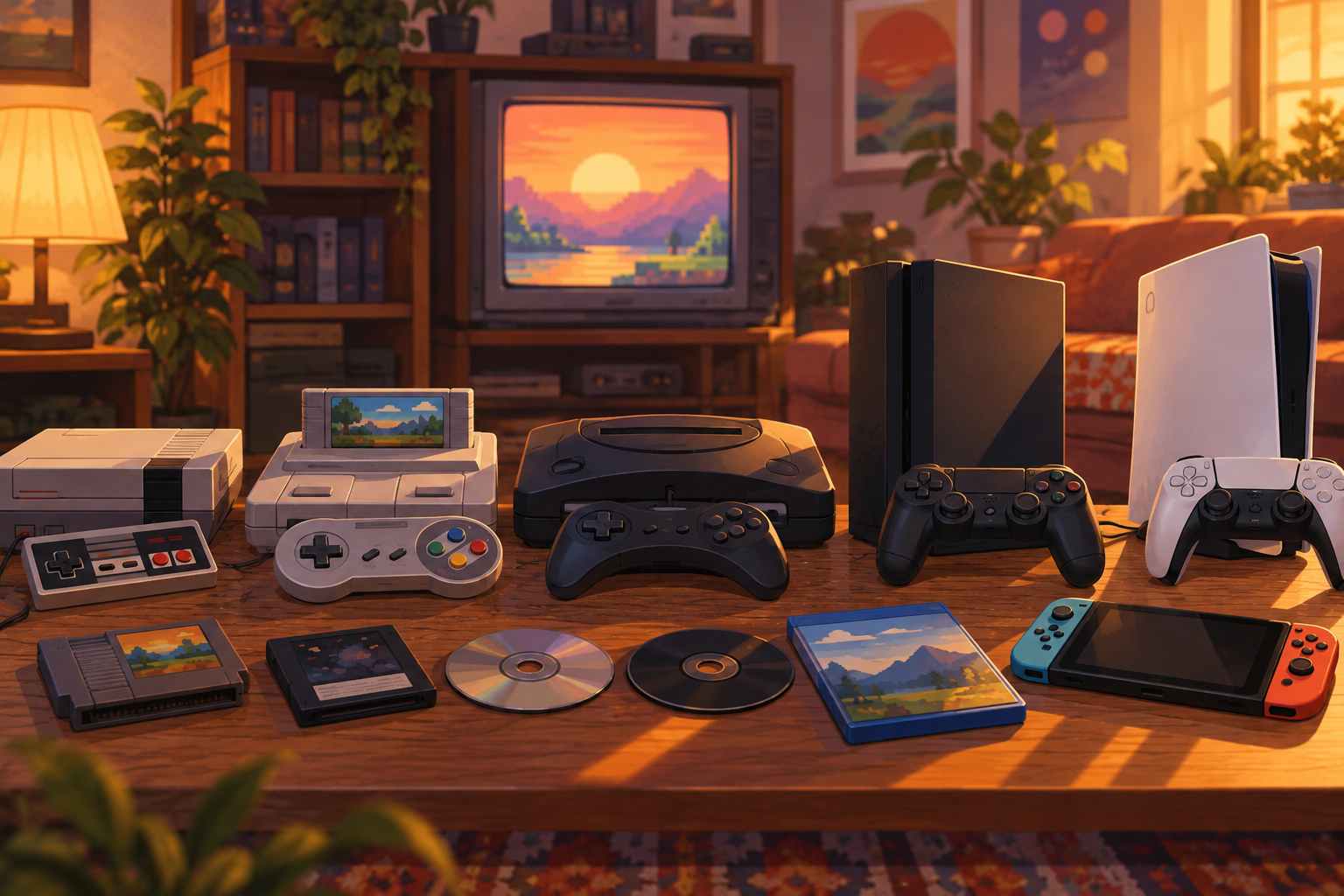
There was no single history
Telling the history of consoles as an orderly succession of machines and generations is convenient, but it can obscure differences in markets and contexts. The available sources point to at least three distinct settings: the production, distribution, and consumption of clone consoles in Mexico during the 1970s and 1980s; the crisis that mainly affected the United States and Canada from 1983; and competition among 16-bit systems in the early 1990s. Bringing them into conversation is useful, as long as they are not presented as identical chapters of one experience.
The supplied material cannot reconstruct every detail of these histories. It does, however, support a cautious interpretation: a console is more than a technical specification. It is also a product that reaches particular households through particular forms of production and distribution, and whose significance depends on its surroundings.
Mexico: looking beyond dominant brands
The study The Historical Impact of Mexican Clone Consoles in the 1970s and 1980s explicitly proposes examining their production, distribution, and consumption. That approach shifts attention from the familiar story of major companies toward systems that may be left out of better-known timelines. One example named in the evidence is the Poc-Tanc console.
The supplied information does not detail its specifications, exact date, manufacturer, or production volume. It would therefore be irresponsible to assign it features or quantify its importance. What is supported is the value of studying it as part of a local history of clone consoles and of the ways these products circulated and were used.
This change of perspective also points to a common limitation of general accounts: a machine’s absence from an international list of familiar systems does not prove that it lacked significance in its own context. More precise claims about Poc-Tanc would require additional sources and direct documentation.
The 1983 crisis was not universal
The supplied general history of video games describes a crisis beginning in 1983 that primarily affected the United States and Canada, and which it says did not end until 1985. The same passage contrasts that situation with Japan, where Nintendo released the Famicom in 1983, and Europe, where microcomputers were gaining ground.
That contrast matters because it prevents a regional crisis from becoming an automatic explanation for events everywhere. The source describes the situation in broad terms; the available material does not provide a quantitative sales comparison or a country-by-country study. The scale should be preserved: the source identifies a crisis with particular geographic centres, not a uniform pause in the global history of consoles.
Generations: a tool, not a natural rule
Popular timelines often group consoles into generations. The Universitat Politècnica de Catalunya source uses the label “16-bit generation” for an early-1990s competition that included Mega Drive, Super Nintendo, PC Engine—known as TurboGrafx in the West—CPS Changer, and Neo Geo. It also says Neo Geo matched arcade technical performance, but that its high price limited its mass arrival in homes.
The label helps organize an era, but it does not make every machine equivalent. A single group can contain systems with different trajectories and different levels of household access. Another supplied source cautions that a processor’s bit count alone does not necessarily determine its power: architecture and speed also matter. Generations are therefore a practical way to organize a story, not a complete technical scale or a rule requiring every new console to double the previous one.
What can be said—and what remains open
The sources support a more plural history than a simple list of releases: study Mexican clone consoles alongside their conditions of production and circulation; distinguish the North American crisis from developments in Japan and Europe; and describe 16-bit competition without reducing it to a number.
They do not, however, provide a complete inventory, precise dates for every model, sales comparisons, or a reconstruction of how each system was experienced in every household. Nor are they enough to establish a direct relationship between Mexican clone consoles and events in other markets. These limits do not undermine the approach; they mark where the account must stop until more evidence is available.
The strongest conclusion is methodological. Console history improves when told in the plural: with attention to local markets, regional differences, and what technical categories explain—and leave out. A timeline can orient the reader; it should not replace the history that still needs documenting.
- Decade
- 1980s
- Region
- Global
- Level
- Enthusiast
- Entities
- No linked entities
Sources and references
- 103 El impacto histórico de las consolas clónicasecos.cide.edu · 2026-09-23
- Videoconsola - Wikipedia, la enciclopedia librees.wikipedia.org · 2026-09-23
- Historia de los videojuegoswww.fib.upc.edu · 2026-09-23
- Evolución de las consolas de videojuegos - GlosarioIT: Glosario Informáticowww.glosarioit.com · 2026-09-23
- Historia de las consolas de Video Juegos Capital Video Games -www.capitalvideogames.com · 2026-09-23
- Timeline: Historia de las videoconsolas - Un repaso cronológico a la historia de las consolas de videojuegos, destacando la fecha en que se pusieron a la venta las diferentes máquinas y sus principales características técnicas. | Timetoast Timeline Makerwww.timetoast.com · 2026-09-23


