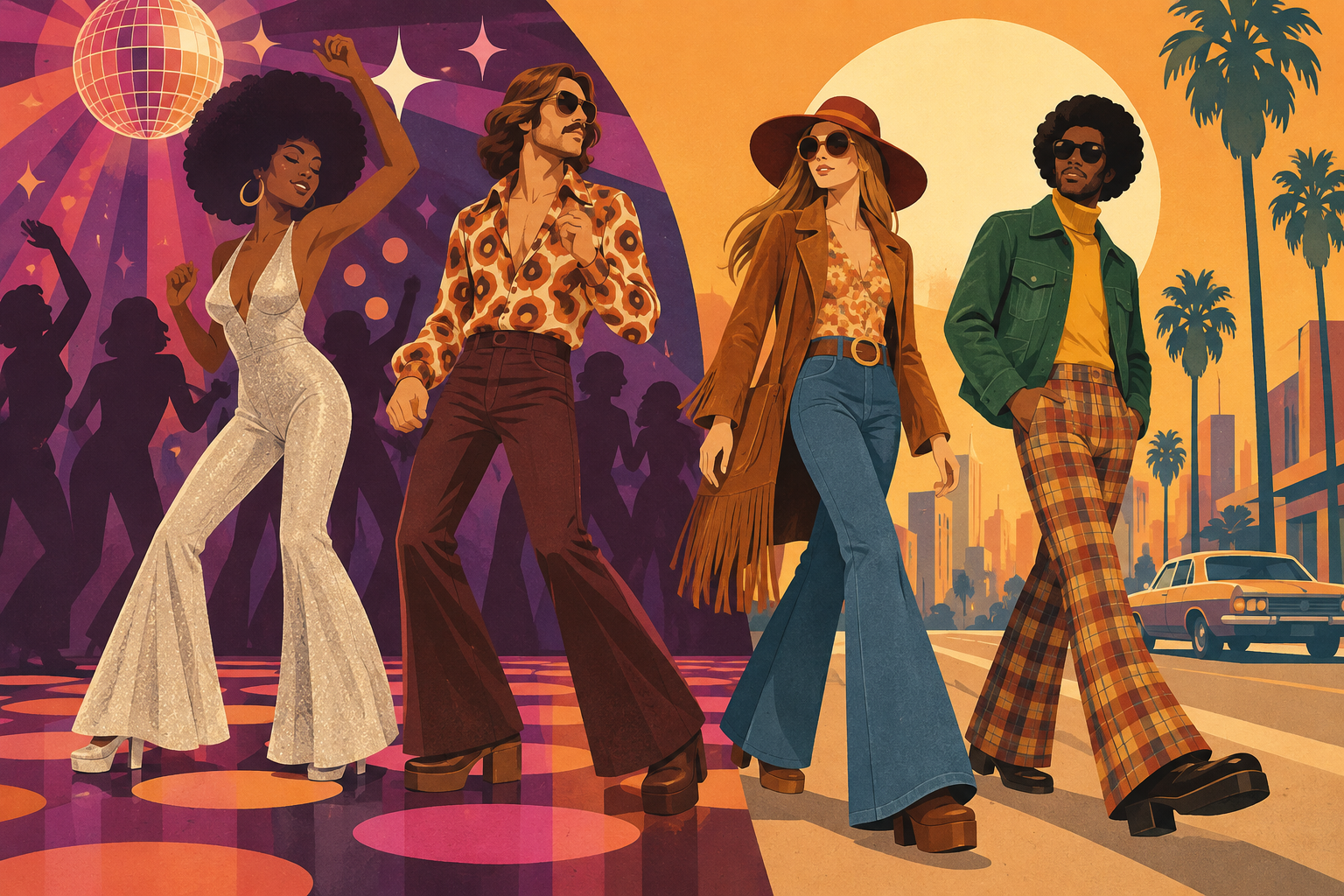
There was no single seventies uniform
Talking about “1970s fashion” can suggest one defining image, but the sources gathered here point to a decade of varied trends. CEAC, in a popular overview, associates the seventies with the disco era and mentions Lycra and platform shoes. Audaces, meanwhile, links urban fashion to hip-hop culture, which it says emerged in African American and Latino communities during that decade. These are clues to distinct expressions; they do not establish that either represented society as a whole or that they developed in the same way everywhere.
The distinction matters: a dance floor, a street and an everyday wardrobe are not interchangeable settings. The sources allow us to outline several strands, but not to reconstruct in detail what each group wore, how often they wore it or in which cities.
The disco image and its materials
In CEAC’s account, the disco decade is associated with synthetic fabrics such as Lycra and with platform footwear. This connection helps explain how a silhouette can condense a retrospective image of an era: stretch and added height are prominent features in that description. It does not prove, however, that Lycra was unique to the decade, that everyone wore it or that platforms were the only footwear that mattered.
These garments are best treated as visual signs of a trend, not as a comprehensive inventory. The source provides no production figures, consumption patterns or comparisons between countries. Claims about their relative popularity or who could afford them would therefore require further documentation.
The street and urban culture
Audaces places hip-hop’s emergence in African American and Latino communities in the 1970s and attributes a significant influence on urban fashion to it. This shifts attention from fashion understood solely as seasonal novelties towards the relationship between style and culture. It also cautions against reducing dress history to designers or runways.
The supplied evidence does not list specific garments or describe how these influences spread. It would be unsound to turn the mention into a list of accessories or to assign a uniform appearance to diverse communities. What can be said is that the source recognizes urban culture as an influence and that an account of the decade should make room for those expressions.
Fashion as social history
The Museo del Traje and the Community of Madrid provide a useful counterpoint, although the cited materials concern other periods. The museum’s page presents fashion as a field that expanded its reach over the last few centuries, moving beyond elite circles. The Madrid exhibition on 1940–1970 considers designers, models, costume designers, actresses and anonymous residents, and notes the coexistence of stylistic references in the city.
These references do not, by themselves, prove how people dressed in the seventies. They do support a way of framing the question: consider fashion as a social practice and take account both of professional figures and of those who wore clothes in everyday life. The general history page also describes fashion as aesthetic and sociological. That framework helps prevent one isolated silhouette from becoming a complete explanation of an era.
What we can conclude—and what remains unknown
The available sources support a limited reading: 1970s fashion can be approached through at least two distinct threads, the disco aesthetic associated with Lycra and platforms, and hip-hop’s influence on urban fashion. A general fashion-history overview and an article on the recurrence of trends also remind us that fashion is often interpreted in relation to other periods. But the sources cited here do not provide a detailed chronology, documentation of specific garments or testimony from wearers.
The strongest conclusion is not that there was one “seventies look,” but that available summaries select different symbols to explain the decade. Further work would require collection catalogues, dated photographs, contemporary press and specialist studies. Until then, disco and the street are useful points of entry, provided they are not mistaken for a complete portrait of 1970s fashion.
- Decade
- 1970s
- Region
- Global
- Level
- Introduction
- Entities
- Museum, Museo del Traje
Sources and references
- Historia de la moda - Wikipedia, la enciclopedia librees.wikipedia.org · 2026-09-24
- La moda en la historia - Museo del Trajemuseodeltrajevirtual.com · 2026-09-24
- Así fue... Exposición: En Madrid. Una historia de la moda, 1940-1970 | Comunidad de Madridwww.comunidad.madrid · 2026-09-24
- Historia de la moda: del origen a la actualidad | CEACwww.ceac.es · 2026-09-24
- 10 HITOS SOBRE LA HISTORIA DE LA MODA - Fashion Radicals Magazinewww.fashionradicals.com · 2026-09-24
- Todo sobre la historia de la moda y su evoluciónaudaces.com · 2026-09-24


