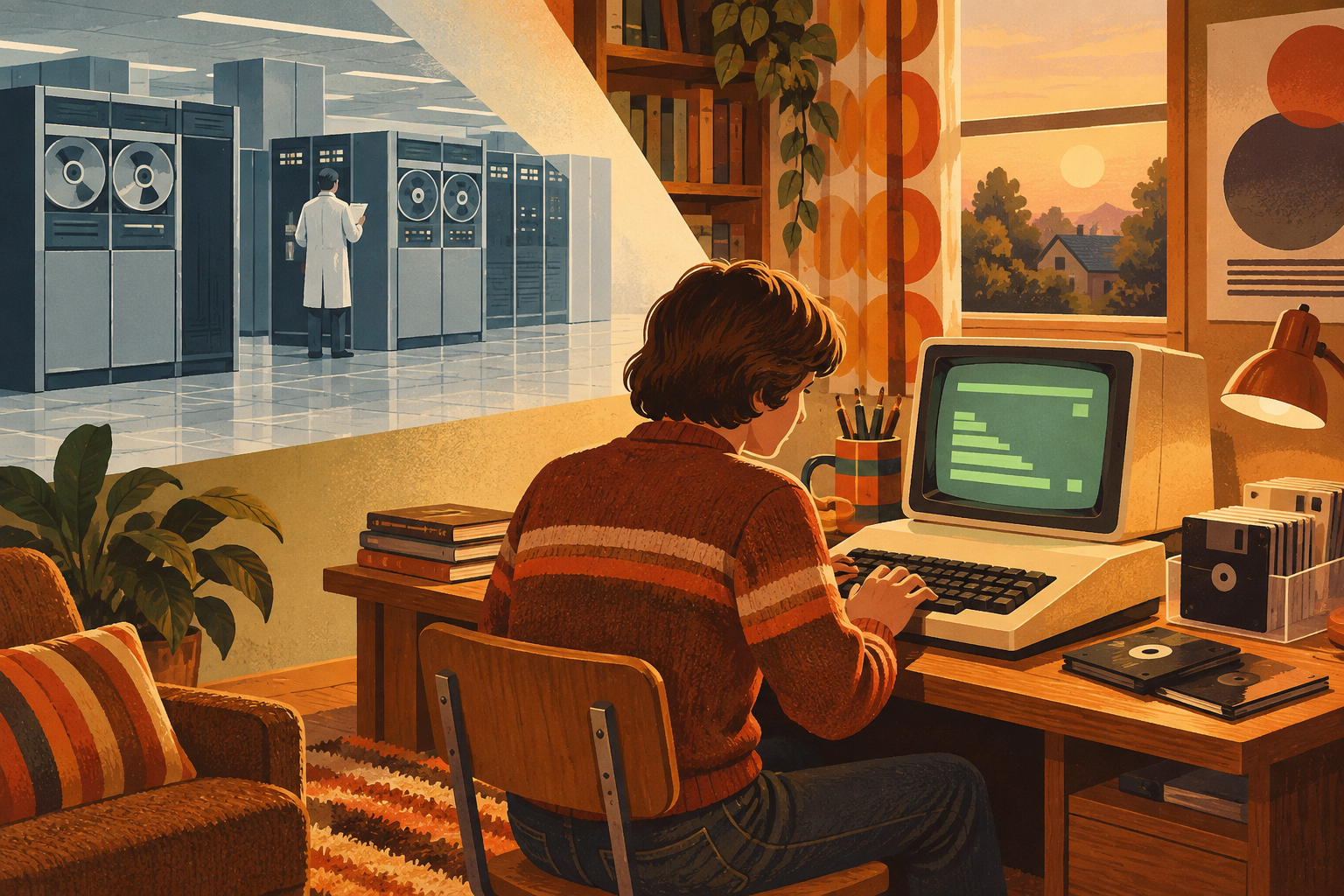
A change of scale, not a single origin
Calling the 1970s the decade in which the personal computer was born is useful only when understood as a synthesis, not as the story of one invention. The available evidence supports a more precise statement: during that decade, a market for personal computers appeared, grew, and began to consolidate. The Universitat Politècnica de València’s Computer Museum explicitly places that process in the 1970s and proposes 1977 as a symbolic starting point through the phrase popularized by Byte: the “1977 Trinity,” associated with Apple, Commodore, and Tandy Corporation.
That interpretation does not make 1977 an absolute boundary. A computing-history account published by Pandora FMS stresses that technical transformations are linked: the transistor enabled the integrated circuit; the integrated circuit enabled the microprocessor; and the microprocessor enabled the personal computer. The value of that sequence is that it reminds us a domestic product does not emerge in isolation. It relies on components, manufacturing, programming, media, uses, and expectations already under development.
The decade can therefore be read as a transition in scale. Computing ceased to be imaginable only as infrastructure associated with organizations and could increasingly be imagined as a machine that individuals might acquire, program, and appropriate. The supplied sources do not allow a full reconstruction of every price, configuration, or timetable in that transition. They do allow us to identify the elements that structure the story without presenting a complex development as an inevitable sequence.
The microprocessor as a material condition
The introduction of microprocessors in the 1970s is among the milestones highlighted by the material. Infodigital presents it as a fundamental point and connects its arrival with computers becoming smaller, faster, and more accessible; it also interprets it as the start of the personal-computing era. Pandora FMS provides a complementary explanation: the microprocessor emerged from a chain of previous innovations and created the conditions for the personal computer.
The two levels should be kept distinct. Saying that the microprocessor was decisive does not mean it alone explains every machine, manufacturer, or user practice. It means that it altered the material possibilities for integrating computing capacity into smaller systems. The reduction in size described by the Historical Computing Museum of the Universidad Politécnica de Madrid can also be seen in information media: the bulky, heavy hard drives of 1970s computers gave way to progressively lighter, higher-capacity formats.
The component’s cultural importance lies in that connection between technology and availability. A change in electronic integration does not automatically equal democratization; accessibility depends on who makes, distributes, teaches, and uses machines. Yet without the reduction in scale that the sources associate with microprocessors, the personal-computer model would have had a very different material horizon.
1977 and the “Trinity”: a label for an emerging market
The “1977 Trinity” helps organize the memory of a period; it does not exhaust its diversity. The UPV source identifies Apple, Commodore, and Tandy Corporation as protagonists of that moment. Infodigital makes the reference concrete through the Apple II, Commodore PET, and TRS-80, arguing that these systems brought personal computers to the mass market.
The label matters because it shifts attention from one isolated device to a convergence of proposals. Three names do not represent all computing of the period, but they show that the phenomenon did not depend exclusively on one company. They also help explain why the market became a market: product families and options emerged that could be recognized by different audiences.
Even so, “mass market” should be read cautiously. The received evidence uses that expression, but supplies no sales figures, geographical distribution, or buyer profiles. Adding them would not be responsible. What can be verified here is the source’s interpretive position: those systems played a role in moving personal computing from hobbyist enthusiasm toward a broader commercial presence.
Two clocks: Unix and the machines’ internal time
1 January 1970 provides another milestone, of a different kind. The Spanish General Council of Official Professional Colleges of Computer Engineers and a popularizing source both identify that date as the beginning of the Unix era, used to handle dates internally in computers. It is not the birth of the personal computer, nor a date that summarizes all computing in the decade. It is a time convention that reveals another dimension of computing: machines need to represent time through operational rules.
This detail is useful because it prevents the 1970s from being told only as a succession of cases and brands. The personal computer required visible hardware, but computing is also organized through less visible systems, formats, and conventions. The Unix era remains an understandable reference because it expresses time as a count from an agreed point.
The sources do not describe which specific systems adopted that convention or its later technical consequences. That limit matters. What is solid is the stated date and its general function; any further explanation would require specific documentation absent from the available evidence.
From the PC opening to compatibles
Accounts of the 1970s often continue toward IBM’s PC and the compatible-PC universe. IndexDesarrollo states that IBM restricted the BIOS of its PC and that other makers could build a PC provided they did not use IBM’s BIOS. According to the same text, Compaq opened the way and many manufacturers followed, beginning the era of clones and, eventually, computers assembled from parts.
That passage describes a development after the “1977 Trinity” formulation, but it clarifies why the 1970s should not be studied as a closed episode. Decisions about architecture and components can extend their effects into future markets. It also shows that personal-computer history does not depend solely on designing an appealing machine: it depends on which parts are controlled, which may be reproduced, and which compatibilities are established.
The evidence offers neither precise dates for each step nor technical BIOS documentation. The editorial value therefore lies in preserving the structure of the claim, attributed to its source, without turning it into a detailed chronology. The expansion of compatibles appears as a continuation of the process, not as proof that all personal computers were equivalent.
What remains—and what cannot be concluded
The cited museums help reveal the material legacy of these transformations. UPM preserves a collection of close to 3,000 objects related to the evolution of computing and communications, with 200 pieces on display. RetroAcción organizes its Historical Computing Museum into areas devoted, among other fields, to components, home computers, Apple machines, PC compatibles, portable computing, servers, and terminals. These museum divisions are not a complete chronology, but they make visible that computer history is composed of machine families, peripherals, and contexts of use.
The central lesson of the 1970s is therefore twofold. On one hand, the decade brings together technical and commercial conditions that the sources connect to the personal computer: microprocessors, specific systems, and market expansion. On the other, it requires distrust of overly linear accounts. A milestone may be a system date, a component, a product family, or a compatibility decision.
With the supplied evidence, it is not possible to assign one unique “first” personal computer, quantify the social reach of each model, or establish definitive rankings among manufacturers. It is possible to conclude that the 1970s were a decisive period of changing scale. The computer became a closer commercial and cultural possibility, while its technical foundations and invisible rules continued to determine what those new machines could become.
- Decade
- 1970s
- Region
- Global
- Level
- Introduction
- Entities
- Museum
Sources and references
- Fechas importantes en la informática | indexDesarrollo, Diseño web, desarrollo web, redes sociales, vídeo y fotoindexdesarrollo.com · 2026-09-20
- Historia del Ordenador Personal - Web del Museo de Informática 2.0museo.inf.upv.es · 2026-09-20
- Museo histórico de la informáticawww.upm.es · 2026-09-20
- 10 hitos clave en la historia de la informática - Tu ventana al mundo digitalinfodigital.ciberlinea.net · 2026-09-20
- Museo de Informática Histórica (MIH) | Asociación RetroAcciónwww.retroaccion.org · 2026-09-20
- Historia de la informática: línea temporal de hitos importantespandorafms.com · 2026-09-20
- Viaje por la historia de la Informáticawww.ccii.es · 2026-09-20


