An Editorial Machine for Returning
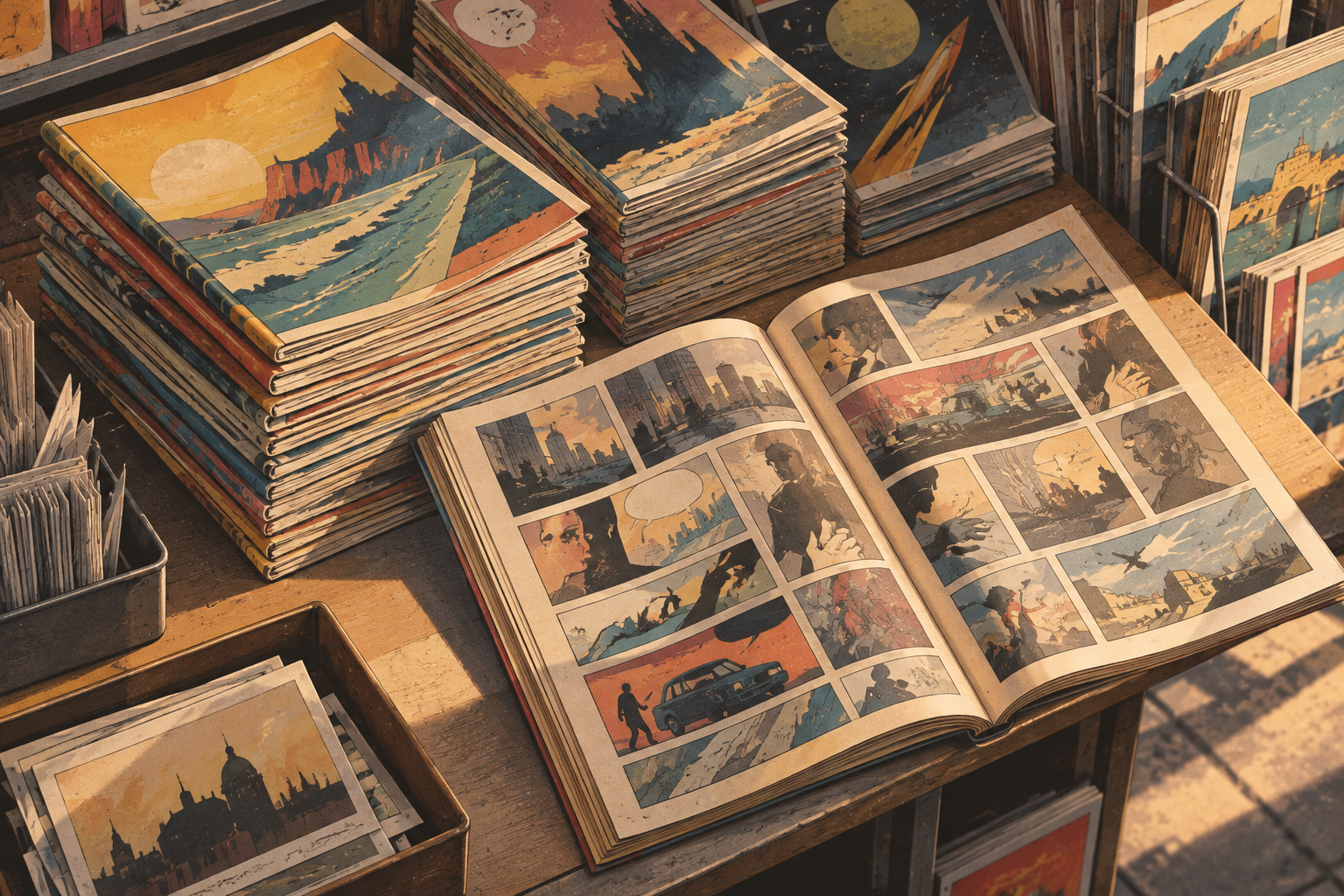
A comics magazine was not merely a container for strips and stories. Its decisive feature was periodicity: it turned reading into an appointment and a story into a promise of continuation. A dictionary or academic definition may describe a magazine as a periodical publication containing text and images; in comics, that condition also shaped how works were made, bought, discussed and remembered. For much of the twentieth century, magazines were an especially common publishing format for comics. That broad statement should not flatten every national tradition into one model, yet it helps explain why the individual issue holds such a strong place in readers’ material memory.
The magazine brought several functions together in one object. It could present episodes, mix creators and tones, include illustration or supplementary text, and give readers a sequence of installments. The result was unlike reading a completed work in one volume: each issue introduced pauses, interruptions and returns. Waiting was part of the experience.
Serialization Is More Than Splitting a Story
Serialization is often imagined as a story cut into parts. It is more complicated than that. The available documentation notes that, in certain periods, it was common to publish comics in chapters in magazines and later gather them in an album or graphic novel. It also warns that dating a work can be difficult: a series may be placed at a character’s first appearance, while a later book may correspond to the collection of parts published earlier.
This matters to any retro perspective. A magazine reader encountered a work under different conditions from someone who reaches it through a collected edition. The first met fragments, editorial rhythms and often other material around them; the second receives a unity prepared later. Neither experience is automatically more authentic. They are different editorial objects, with different temporalities.
A chronology should therefore not be overly tidy. A collected volume’s date does not necessarily replace the first-publication date, and first publication alone does not summarize a work’s later life. The magazine makes this layered history visible: creation, installment, reception and eventual collection.
The Issue as Mixture and Context
A comics magazine was defined as much by its contents as by the coexistence of those contents. On opening it, readers encountered not only an isolated narrative but a selection. That mixture might place short stories beside serials, humor beside adventure, or material from different origins together. Not every magazine followed the same formula, and the evidence gathered here does not justify a universal structure; still, the format encouraged comparative reading among pieces sharing pages, periodicity and an audience.
This is why magazines require study beyond celebrated titles. The object includes page order, section continuity, advertising when present, design and material qualities. Even the distinction between publications conceived as comics and magazines or books that include a complete comic can be difficult in publishing counts. A study of the Spanish industry in 2020 and 2021 stresses precisely this classification problem. The boundary between a publication containing comics and a comic publication is not always stable.
From Newsstand to Other Media
The transformation of magazines should not be told as an instant disappearance. A specialist source says the format now occupies a very small place in the market and notes the 2019 arrival of Alta Tensión and Planeta Manga, while La Resistencia ended its run with its tenth issue. These are specific examples of persistence and closure, not global statistics. They show that formats can change in weight without necessarily vanishing altogether.
At the same time, comics reading has adapted to digital media. The evidence distinguishes webcomics—created for online distribution and reading, with resources such as scrolling or screens—from downloadable digital comics for offline reading, for example as PDFs. This distinction matters: not every comic read on a screen follows the same editorial logic. A webcomic may design its rhythm for navigation; a downloadable file may preserve pagination closer to print.
A change of medium does not cancel the magazine’s historical value. Instead, it clarifies its specificity. Where a screen may offer continuous access or an archive, the periodical imposed a shared cadence and an object limited by its sales period. That temporary scarcity shaped the relationship to each installment.
Mass Culture, Art and Institutional Recognition
Discussion of comics has long moved between their popular, industrial dimension and their aesthetic consideration. A recent historiographical reflection emphasizes that comics remain present in print and have adapted to different media; it also argues that they can be understood as a distinctive manifestation of art and culture, not merely as mass-culture products. There is no need to choose only one category. The magazine shows how both could coexist: it was a reproducible, periodic product meant to circulate, but it could also be the site of consequential graphic, narrative and formal decisions.
Museum interest confirms that comics have entered preservation and exhibition circuits, although this does not remove the challenges of displaying them. The Museu del Còmic i la Il·lustració presents itself as a national museum devoted to the field and lists satirical press, weeklies, children’s press, magazines, graphic novels and original art among its holdings. That list is telling: the magazine is not a disposable precursor, but a documentary category alongside other media and originals.
What Can Be Verified, and What Still Needs Research
The supplied sources support the view that magazines were a central format through much of the twentieth century, enabled installment publication and now hold a more limited contemporary position. They also support the coexistence of print and digital reading, and the complexity of classifying editorial products that contain comics. They do not, by themselves, establish one cause for the decline of every magazine or justify applying one country’s figures to another.
Such caution is useful for collectors and readers. An old magazine matters not only because it contains a first appearance, and a collected edition is not simply a late substitute. Each records a mode of access. Preserving issues, indexes and editorial context helps reconstruct how reading worked when continuity depended on returning to a newsstand, bookshop or other outlet.
Conclusion
The comics magazine made periodicity into a narrative and cultural tool. It organized waiting, placed works in relation and left a material trace that does not disappear when stories move to albums or screens. Its current role may be smaller than in earlier decades, but studying it remains essential: it explains not only what was published, but how a community of readers learned to return to panels, issue after issue.
- Decade
- 1970s
- Region
- Global
- Level
- Enthusiast
- Entities
- Museum
Sources and references
- Historia visual del cómic, la novela gráfica, el manga y los tebeos – Alberto Albarránwww.albertoalbarran.com · 2026-09-22
- El cómic. Una interpretación más allá de las masas - Revista Comunicaciónrevistacomunicacion.com · 2026-09-22
- Manuel Barrero (2022): "La industria del cómic en España en 2020 y 2021", Documento en Tebeosferarevista.tebeosfera.com · 2026-09-22
- Inicio - Museu del Comic i la ilustraciónmuseudelcomic.org · 2026-09-22
- Pasado y presente de las revistas de cómic – Jot Down Cómicscomics.jotdown.es · 2026-09-22


