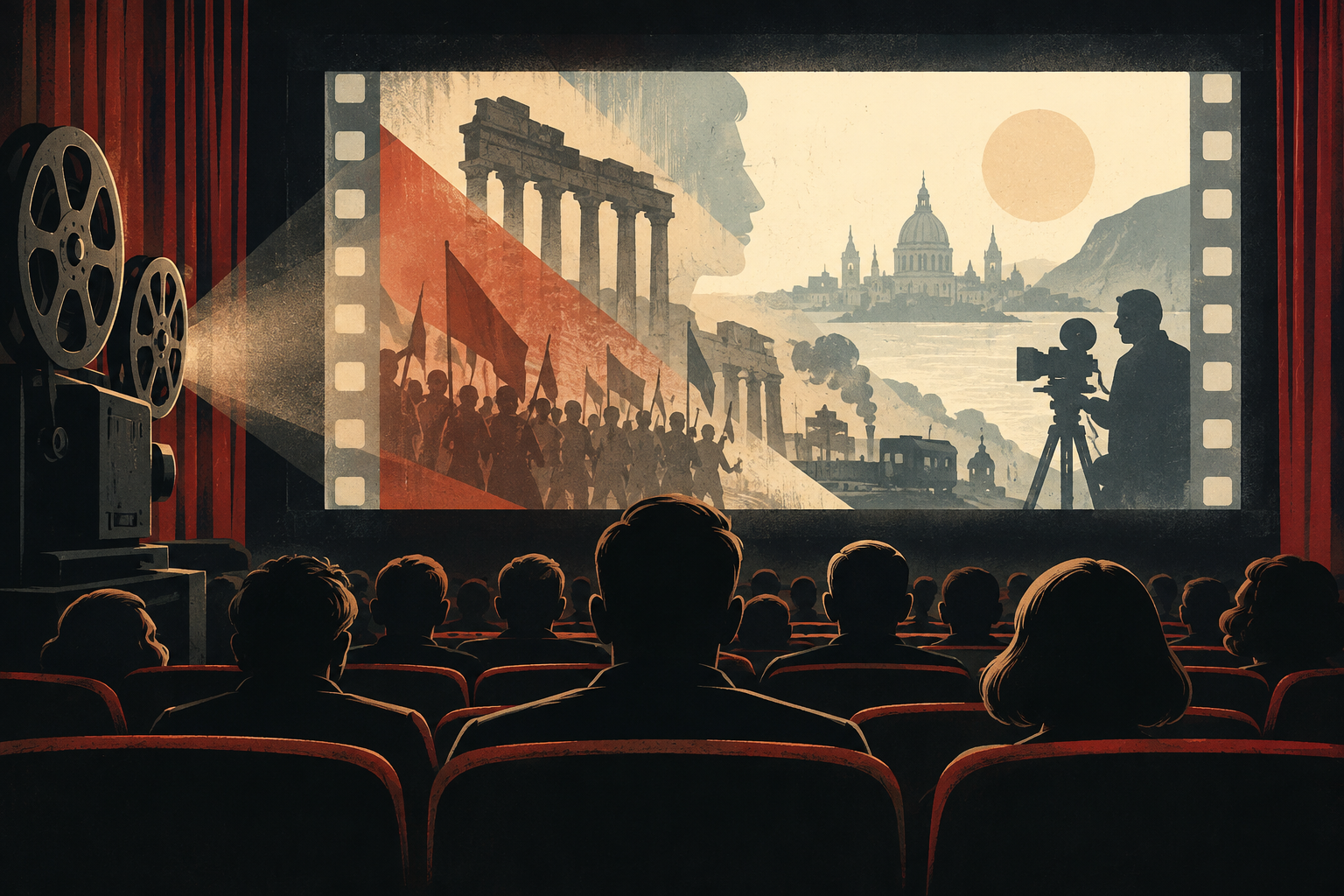
A film set in the past does not thereby become a transparent chronicle. Its value for history depends both on what it represents and on the choices that shape that representation. The references gathered here approach this distinction from several angles: cinema as a source, the representation of events, film documentation and studies of particular national cinemas. They also require us to acknowledge a limit: the supplied records provide titles and partial summaries, not the full contents of every work. This article therefore offers verifiable questions, not conclusions that the available evidence cannot support.
A source is not a mirror
A work available through DADUN is titled “Cinema as a Source of History”. That title poses a useful methodological question: what kind of source is a film, and what can it contribute? The answer should not be reduced to checking whether a scene accurately reproduces an event. A film can also be studied as a constructed representation, with a point of view, a selection and a narrative form.
This does not mean every film is equally useful for every historical question. It means that we first need to define what we are looking for: information about an event, about how it was imagined, or about how a later period chose to narrate it. These are connected but distinct objects of analysis. Confusing them leads us to treat a scene as direct evidence of something it merely stages.
Events turned into stories
J. M. Caparrós Lera’s article, “102 Major Contemporary Historical Events in Cinema”, groups films connected with historical events. The available extract mentions Patton (1970) and Nicholas and Alexandra (1971), among other titles from earlier decades. The record supports the limited claim that cinema has offered narratives about contemporary events and periods; on its own, it does not let us assess each film’s accuracy or reconstruct its reception.
When reading this kind of film, it helps to distinguish at least three layers: the event it refers to, the representation it offers and the context in which it was made. This avoids a misleading equivalence between history and staging. It also helps frame specific questions: which episodes take centre stage, which are absent, and what relationship does the narrative establish between individuals and historical processes? Without consulting the films and full studies, these questions should remain a method, not become answers attributed to a particular work.
Form documents a point of view too
The educational CLIO site presents a history-and-cinema overview that includes references to Z (1968), The Confession (1970) and State of Siege (1973), associated in the supplied extract with Constantin Costa-Gavras, Yves Montand, Simone Signoret and Jorge Semprún. The extract does not provide an analysis of these films. It does show that cinema around the 1970s has been approached through works, filmmakers and contexts, rather than only as a list of release dates.
This suggests a reading principle: alongside asking what a film tells, we can examine how it shapes its account. Framing, the order of events and the choice of protagonists can guide a viewer’s interpretation. This is a general analytical proposal, not a verified description of the works named above. A case study would require viewing each film and consulting sources on its production and reception.
From national cinema to social memory
Academic records widen the field without licensing easy generalisations. A chapter in A History of Spanish Cinema is titled “The ‘Third Way’ and Middlebrow Spanish Cinema in the 1970s”. Another record identifies a study by Israel Rodríguez on the political history of Mexican cinema in the seventies. Their titles point to research focused on particular national cinemas and periods; they are not enough to summarise the authors’ arguments.
The records also include Carlos Eduardo Daza-Orozco’s History of Childhood in Colombian Cinema and Antonio Zirión Pérez’s work on ethnographic cinema, collaborative strategies and applied visual anthropology. Based only on the information supplied, these titles show that film studies can intersect with questions of childhood, politics, collaboration and cultural representation. They do not show that these approaches are interchangeable: each requires its own corpus, context and evidence.
What can be said, and what remains open
The sources support a bounded conclusion: scholarship connects cinema and history through the representation of events, film documentation and the study of national traditions or social subjects. They also identify examples and research titles associated with the 1970s. The supplied extracts do not provide enough information to measure these works’ public influence, determine their historical accuracy or reconstruct how audiences saw them at the time.
The practical conclusion is straightforward. Using cinema as a source does not require treating it as literal proof or dismissing it as fiction. It requires defining the question, distinguishing a film from what it represents and checking claims against relevant documentation. A screen does not open a neutral window onto the past; it offers a way of seeing it. That way of seeing can itself become an object of history, provided we do not mistake it for the whole of history.
- Decade
- 1970s
- Region
- Global
- Level
- Enthusiast
- Entities
- La confesión
Sources and references
- 102 Grandes acontecimientos históricos contemporáneos en el cinee-archivo.uc3m.es · 2026-09-25
- El Cine como fuente de la Historia - DADUNdadun.unav.edu · 2026-09-25
- Historia y Cineclio.rediris.es · 2026-09-25
- Capítulo cuarto. La «tercera vía» y el cine español middlebrow en la década de 1970doi.org · 2026-09-25
- Sobre Israel Rodríguez, El nuevo cine y la revolución congelada. Historia política del cine mexicano en los setentadoi.org · 2026-09-25
- Miradas cómplices: cine etnográfico, estrategias colaborativas y antropología visual aplicadaopenalex.org · 2026-09-25
- Historia de la infancia en el cine colombianoopenalex.org · 2026-09-25


