A photograph is also a relationship
An archival image rarely arrives alone. It may belong to an institutional campaign, a report, a case file, a shoot or a working sequence. It may have been copied, annotated, cropped, published or moved from one box to another. When it is separated from those traces, it remains visible, but it becomes harder to explain what it records, who made it, what it was used for and how it entered a collection.
This distinction matters especially for photography and video. MACBA’s Archive offers a useful proposition: since the beginning of the twentieth century, and particularly from the 1950s onwards, artistic production cannot be understood through the artwork alone; documents form part of a complex cultural language. This does not mean treating every sheet or print as an autonomous object. It means acknowledging that contextual material can change how an image is read.
From support to documentary set
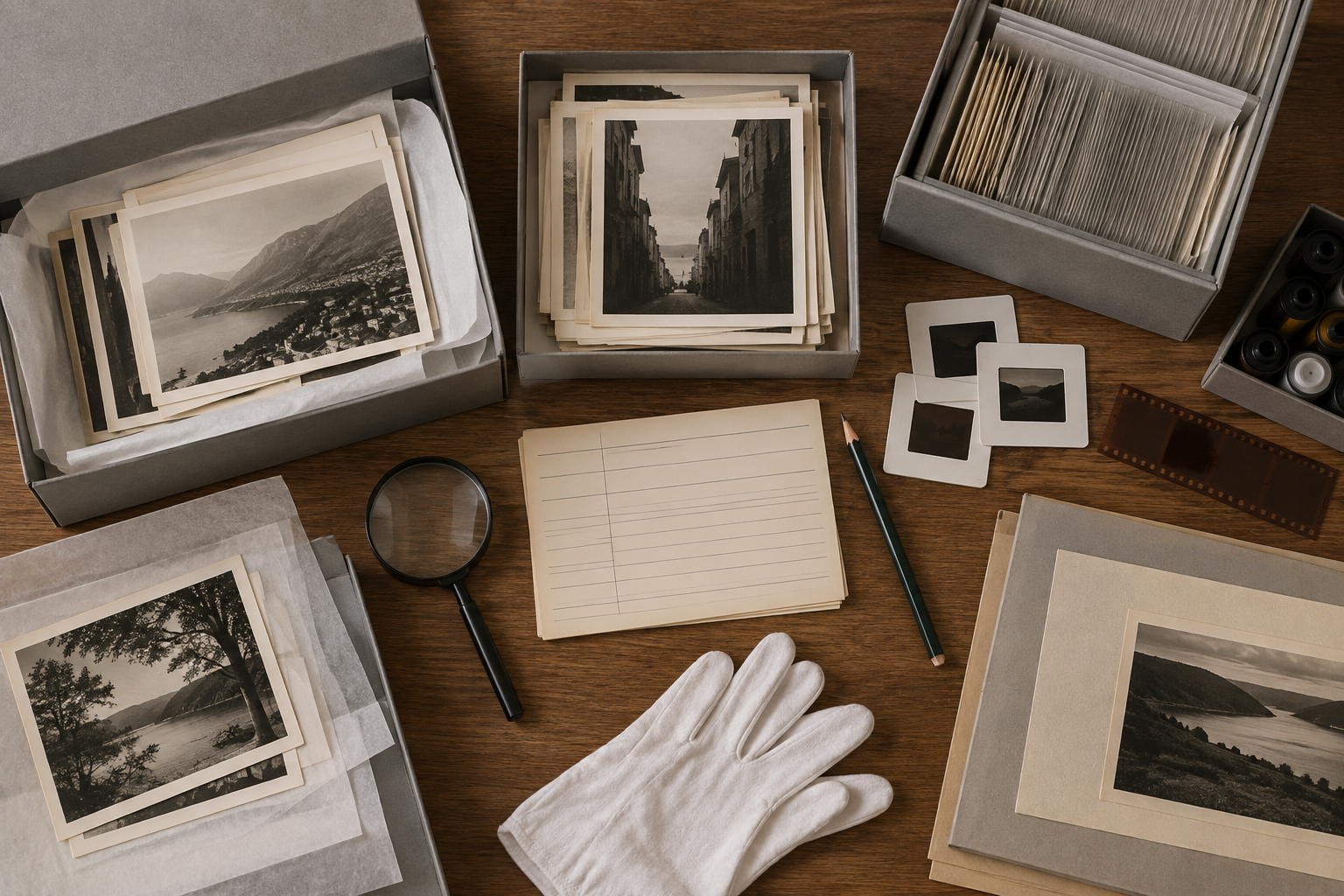
The Museum of Zaragoza illustrates the material variety that a historical photographic archive can contain: metal, glass, paper and plastic. Such diversity rules out a single solution. The museum describes individually tailored preventive conservation and stresses that its holdings are a source for research into both its collections and Aragón’s cultural heritage.
Its account of historic plastics is especially instructive. For cellulose nitrate materials, the museum documents individual alkaline-pH cotton-fibre paper enclosures, ventilation and cold storage as measures to control deterioration. This does not turn those measures into a home recipe: they are institutional decisions described within a museum setting, using conservation materials and furniture. What the account does establish is that the support determines the strategy, and that an image cannot be preserved while ignoring its physical composition.
Digitisation is not the same as loss of context
Spain’s National Photography Plan notes that digital technologies have expanded the possibilities for conserving, understanding, disseminating and researching photographic heritage. That expansion is genuine, but a digital surrogate does not itself retain every meaning of an original. Without information about provenance, series, approximate date, support, known authorship, interventions and access restrictions, a digital repository can become a mass of images that are difficult to find or interpret.
Documentation concerning the network of State Museum Archives makes the same point through the need for unique identification and contextual information. It also warns that digitised material is insufficient when it lacks metadata that will make the images retrievable later. Access, in other words, depends on both the visible image and the descriptive structure around it.
Social video: shoots, documents and photographs
MACBA’s Archive holds a fonds created between 1977 and 1983 by a group associated with social-video projects. The available description states that it contains records of those projects and of the group’s internal organisation, as well as an extensive collection of photographs of shoots and working sessions. This example calls for care: a photograph made during a shoot is not necessarily a frame, nor merely a promotional illustration. It may record equipment, people, organisational decisions or production conditions absent from the finished audiovisual work.
Removing production photographs from project documents and archival information can therefore impoverish the whole. The evidence provided does not permit reconstruction of the videos’ specific contents or the group’s identity. It does establish that the archive preserves materials able to place audiovisual practice within its working environment.
The archive as urban and institutional memory
Mexico City’s Museo Archivo de la Fotografía demonstrates the issue on another scale. Spain’s Censo-Guía de Archivos says that its creation was published on 6 December 2006 and describes an institution devoted to conserving, researching and disseminating photographs that reflect the city’s transformations during the twentieth century. It also reports holdings of more than two million items and notes that images had served for decades as official supporting documentation.
Here photography is not presented only as artwork or memory: it is evidence of administration, infrastructure and urban change. Cultural value does not rely solely on whether a print is visually striking. It also relies on a verifiable relationship to the activity it recorded and to the administrative series that explain its function.
Limits and responsibilities
The sources reviewed do not establish a universal method or diagnose the condition of any particular collection. Nor do they justify equating digitisation with long-term preservation, or promising open access to every item. Museums themselves may require appointments or authorisation for consultation, photography and filming, in the interests of preservation, safety and respect for visitors.
The strongest lesson is less spectacular than visible restoration: preserving photography and video means preserving material, arranging the set and recording context. A digital copy can broaden access; suitable housing can extend material continuity; robust description can return an image to its place in history. None of these layers replaces the others. Together, they make an archive searchable, interpretable and transmissible.
- Decade
- 1980s
- Region
- Spain
- Level
- Technical
- Entities
- No linked entities
Sources and references
- Censo-Guía de Archivos de España e Iberoaméricacensoarchivos.cultura.gob.es · 2026-09-17
- La conservación de la fotografía en el Museo de Zaragoza – Museo de Zaragozawww.museodezaragoza.es · 2026-09-17
- Clip de SEDIC, Revista de la Sociedad Española de Documentación eedicionsedic.es · 2026-09-17
- ISSN: 1578-4282 ISSN (cd-rom): 1695-9884 Deposito legal: J-154-2003revistaselectronicas.ujaen.es · 2026-09-17
- Archivo | MACBA Museo de Arte Contemporáneo de Barcelonawww.macba.cat · 2026-09-17
- PLAN NACIONAL DE FOTOGRAFÍA www.mecd.gob.es/planes-nacionales/planes.htmlwww.cultura.gob.es · 2026-09-17


