The network did not begin as a screen of links
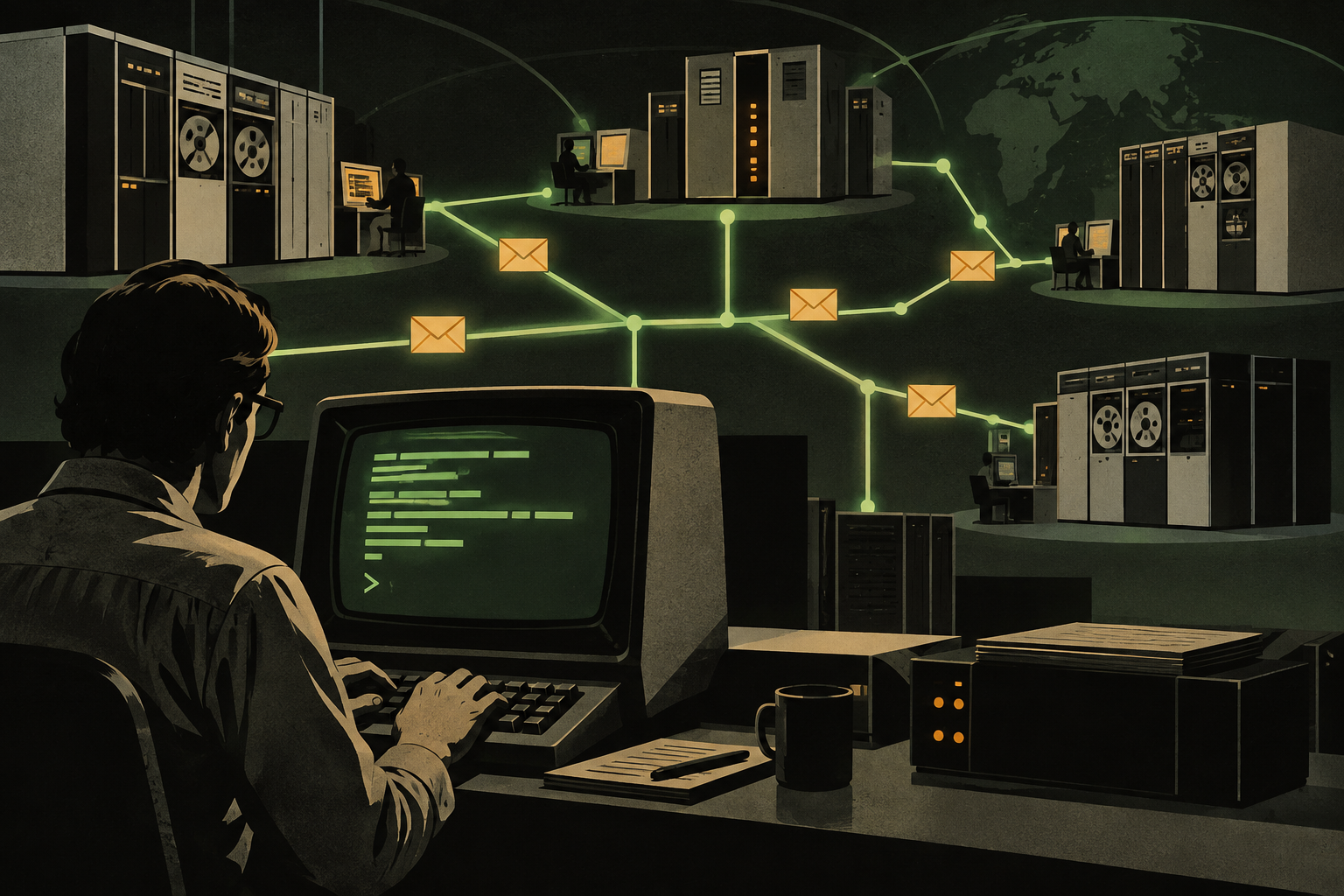
Speaking of “old Internet” often produces an overly compact image: a modem, a rudimentary page, or a .com address. That image belongs to a later phase. Before the World Wide Web became the network’s most visible layer, Internet was largely a set of technical problems and working agreements: how to communicate between different machines, move information, identify destinations, and enable separate programs to understand one another.
Internet Society’s historical material places ARPANET at the centre of this process. In its early years, computers were added to the network while host-to-host protocols and network software were developed. In December 1970, the Network Working Group, led by S. Crocker according to that account, produced an initial host protocol specification. This was not a home product or a consumer experience; it was infrastructure under construction.
ARPANET: connecting scarce resources
A practical idea explains part of the initial logic. Computers were expensive resources, and connecting them could cost less than duplicating them. The network enabled people at one machine to use resources hosted by another. This is why two early uses highlighted by Internet Society are remote login and file transfer.
Remote login, commonly associated with Telnet, made it possible to operate another system from a distance. File transfer addressed another need: moving data or programs between connected machines. Both services correct a frequent anachronism. The early network was not centred on visual browsing or uninterrupted content consumption; it was used to share computing capacity, documents, and access.
Its growth was neither linear nor the achievement of a single inventor. Internet Society describes packet satellite networks, packet radio networks, and other DARPA research programmes as activities involving many collaborators. Email, file sharing, remote access, and later Web functions therefore appear as practices and layers that accumulated over time.
Protocols: rules that enabled exchange
A protocol is not a spectacular application. It is a set of rules that lets different systems exchange data intelligibly. Without shared rules, a network of heterogeneous machines breaks into isolated connections. With them, an operation can travel between equipment and programs that were not designed as one product.
Internet Society’s account also records an important limit of early models. TCP worked well for applications such as remote access and file transfer, but packet-voice research in the 1970s showed that packet loss could not always be corrected by TCP; in some cases, the application itself had to handle it. This technical detail is revealing. The network did not advance because a universal solution existed from the start, but because designs were tested against specific uses and failures.
An IEBS overview identifies TCP/IP in 1983 as a milestone in Internet expansion. Editorially, the date needs careful reading: it marks the importance of a protocol transition, but does not mean every use, institution, or personal experience changed at once on the same day.
Email changed the priority of use
Among early services, Internet Society considers email probably the innovation with the greatest impact. That statement need not become a story of individual genius. Its consequence matters more: infrastructure built to interconnect computers also became a means for coordinating people and groups.
Research teams used the mechanisms available to collaborate. Email, alongside file exchange and remote access, reduced dependence on sharing the same place and schedule. In this sense, technical and social history cannot be separated. A protocol, mail program, or mailing list shapes who can participate, what is recorded, and how quickly a conversation circulates.
The monthly publication ConneXions, produced from 1987 to 1996, is useful evidence of this interoperability culture. Internet Society describes it as a magazine focused particularly on network-protocol development and preserves scanned copies as an archive. It is more than an editorial curiosity: it shows that compatibility debates formed a visible part of technical network life.
There was search and organisation before the Web
The Web did not invent the need to locate information. The Internet history overview cited on Wikipedia notes that, during the 1980s and early 1990s, projects including Gopher, WAIS, and FTP Archive List tried to organise distributed data. It also states that, as ARPANET grew, the HOSTS.TXT file distributed by SRI International became less practical, and the Domain Name System offered a technical response.
These examples should be treated cautiously, yet they point to an essential idea: the challenge of information abundance and discovery predates commercial search engines and social networks. Every solution involved a way of classifying, naming, or navigating resources. The Web became an access interface for much of the public, but it neither erased earlier layers nor exhausts Internet history.
An open history, not a ladder of milestones
CCCB Lab warns that a chronology built from familiar milestones also exposes major gaps in research and reflection. That warning is valuable for technological nostalgia. Lists of “firsts” simplify processes involving institutions, standards, infrastructure, maintenance, and distributed communities. They can orient readers, but they cannot replace research into who built, funded, operated, or was excluded from each network.
The Digital Archive of the Polytechnic University of Madrid presents work on the beginnings of Internet in Spain based on bibliography and contributions from pioneers involved in those deployments. Its description itself reminds us that national and local histories need situated sources; a global chronology is not enough to explain how a technology was adopted in every context.
The lesson of Internet before the Web is not that everything was simpler. It was often more technical, less accessible, and dependent on institutional resources. Its legacy lies in the practices it normalised: asynchronous communication, remote access, file circulation, and continual negotiation of standards. Seen this way, the Web was a decisive layer, but not the network’s absolute beginning.
- Decade
- 1970s
- Region
- Global
- Level
- Enthusiast
- Entities
- No linked entities
Sources and references
- Una breve historia de Internet - Internet Societywww.internetsociety.org · 2026-09-19
- Internet: una historia en construcción | CCCB Lab - CCCBlab.cccb.org · 2026-09-19
- Historia de Internet - Wikipedia, la enciclopedia librees.wikipedia.org · 2026-09-19
- Historia de Internet y de sus inicios en España | Archivo Digital UPMoa.upm.es · 2026-09-19
- Historia de Internet - Internet Societywww.internetsociety.org · 2026-09-19
- Conoce la historia de Internet desde su primera conexión hasta hoy | IEBS Business Schoolwww.iebschool.com · 2026-09-19


