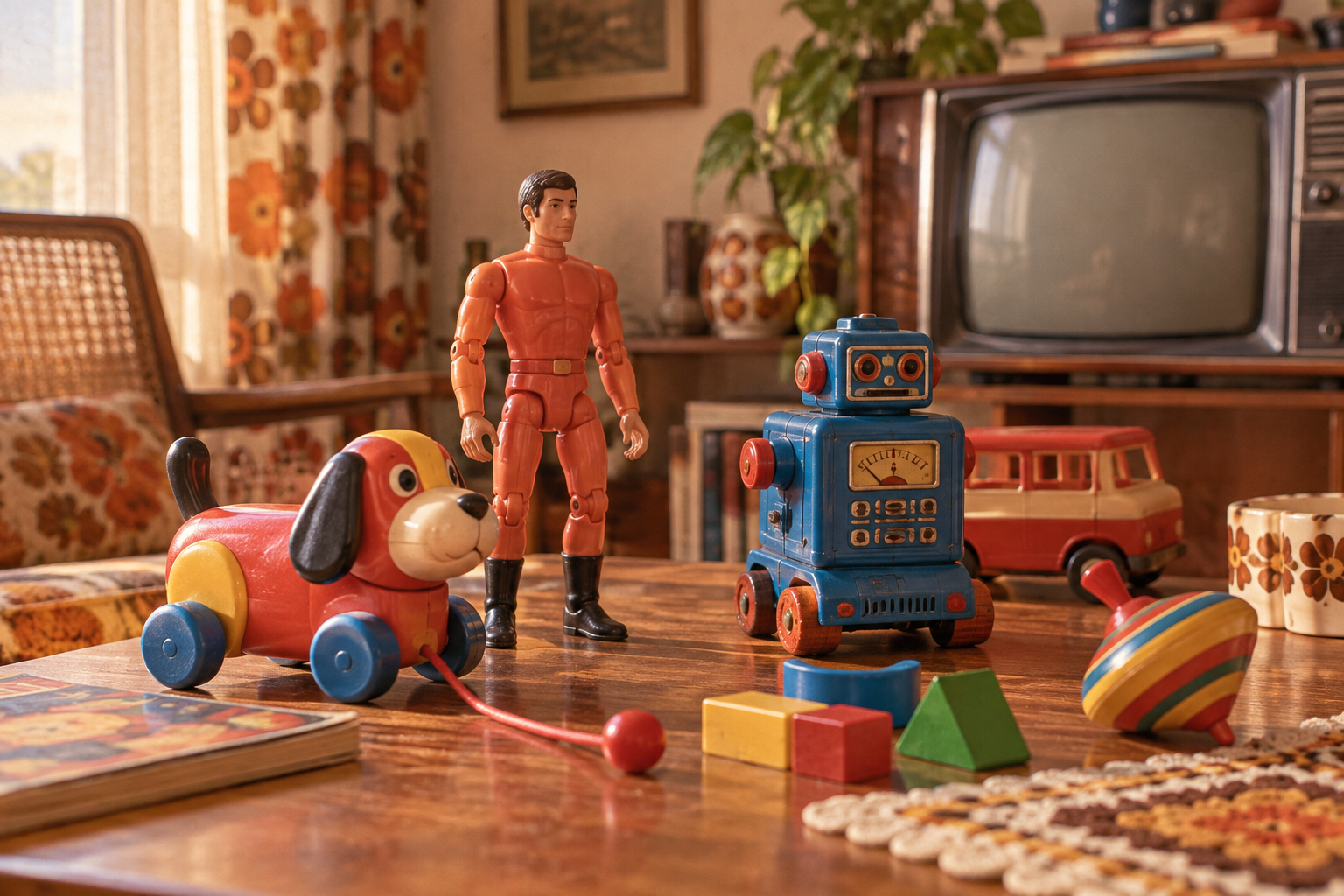
A visible change in materials
The 1970s hold a revealing place in the history of Spanish toys. Not because a single object can summarize everything that happened, but because the available sources allow several concurrent changes to be seen: a prominent presence of plastic and its derivatives, toys powered by batteries or wind-up mechanisms, and consumption which, according to the exhibition account published by Los Juguetes de Olivia, grew until it became mass consumption compared with earlier decades. That wording needs careful reading. It describes a trend proposed by a collection and its exhibition narrative; it does not permit every Spanish family, factory, or toy shop to be treated as having had the same experience.
That is precisely where the toy’s historical interest lies. It is an object of use, design, and desire, but also a material record of how an era imagined childhood. The Quiroga-Monte Collection exhibitions presented by Condeduque and Fundación Ibercaja approach toys in relation to their sociological context. This approach prevents the 1970s from being reduced to a nostalgic list of names. It prompts questions about visible materials, offered forms of play, and the objects that have survived as evidence.
From durable pieces to everyday plastic
The supplied documentation does not permit production percentages or a complete industrial chronology to be established. It does allow plastic and its derivatives to be noted as predominant among 1970s toys in Olivia Sánchez de Terán’s collection account. This matters because material affects appearance and use: it can enable vivid colours, light casings, moulded parts, and formats that combine different elements in a single toy.
Still, a simplistic opposition between a past of traditional materials and an entirely plastic present should be avoided. Major exhibitions on Spanish toy history assemble highly varied pieces across broad periods: Fundación Ibercaja presents an evolution from 1870 to 1970, while Condeduque frames its exhibition from 1880 to 1980. On that long scale, the 1970s are both continuity and change. Dolls, vehicles, construction sets, and figures continued; their finishes, availability, and market position often changed.
Plastic alone does not explain a piece’s cultural value. A toy is preserved for its design, the history of the person who played with it, its box, or the context around it. That is why a museum does not merely display striking objects: it turns them into documents. The Valencian Toy Museum defines its work through the conservation, research, and dissemination of toy heritage. This offers a useful way to view a 1970s piece: identify and contextualize it first; interpret it afterward.
Batteries, wind-up mechanisms, and movement
A further characteristic recorded by Olivia’s source is the coexistence of battery-operated and wind-up toys. Coexistence matters more than the misleading idea of instant replacement. Within one decade, different mechanisms and experiences could be found: winding a toy, using a switch, watching movement unfold, or incorporating movement into an invented play story.
It would not be prudent to infer technical specifications, levels of access, or identical habits in every household from this. Nor can the evidence establish that battery toys completely displaced wind-up mechanisms. What can be verified is more specific: both types are identified as present in the panorama being described. That precision is enough to show that the 1970s toy was not only static. Its design could propose repeatable actions and a direct link between hand, mechanism, and imagination.
This also helps explain why conservation requires care. A piece missing parts, its original mechanism, or provenance information may remain evocative, but it loses some documentary power. For responsible collecting, boxes, instructions, and accessories are not decorative extras: they can help identify the object and prevent premature attributions.
Articulated figures and play worlds
Historia del Juguete identifies Airgam as a Catalan company known chiefly for its articulated Airgam Boys figures, launched during the 1970s. This is a limited but useful datum: it confirms the presence of a Spanish articulated-figure proposal within the period. It should not be expanded into claims about licences, variants, figures, or commercial strategies absent from the supplied evidence.
An articulated figure’s cultural importance does not rest on its mechanism alone. A figure invites character-making, movement through settings, and the linking of accessories and stories. That potential connects with Historia del Juguete’s observation about doll lines and accessories presented in boxes containing settings: packaging could participate in play rather than merely protect merchandise. The source does not permit that description to be assigned to a particular brand, but it supports a useful analytical point: toy, accessories, setting, and packaging could form a narrative whole.
Figures did not exhaust the decade’s catalogue. Ibercaja’s exhibition mentions dolls, Scalextric, tin cars, and Cine Exin among its hundreds of pieces. Not all necessarily belong to the 1970s, nor is that mention a detailed product record. Its value here is different: it shows the variety of categories through which Spanish collections narrate toy history. The decade should be read within that variety, not as the exclusive domain of one format.
Consumption, childhood, and representation
Condeduque relates Spain’s baby boom to the 1950–1970 period and cites INE data for 14 million births. This context does not, by itself, prove a direct cause for every 1970s toy, but it helps explain why exhibitions place objects alongside broader social processes. Childhood was not an abstraction: it was a population, a domestic setting, a gift-giving practice, and an audience for products.
The statement that consumption became mass consumption must remain at the level supported by the source. It is a historical characterization, not a universal measurement. Its value is in moving attention from the isolated object to its circulation. A toy could be designed for repetition, displayed in a shop, given on a special occasion, and then integrated into everyday life. When it appears in a display case decades later, it carries some of those layers, even when not all can be recovered.
What can be stated, and what remains open
The assembled sources support a reasonable, though incomplete, picture of Spanish toys in the 1970s: plastic became more visible; batteries and wind-up mechanisms coexisted; consumption is described as more widespread; and articulated figures had Spanish representatives such as Airgam Boys. They also support a method: relate toys to their social environment and treat them as material heritage.
Many questions remain open: exact launch calendars, regional distribution, prices, sales, the makeup of individual catalogues, and specific play experiences. They should not be filled with generalized memories or facts lacking an identifiable source. The best legacy of these pieces may be to teach slower looking. Beyond automatic nostalgia, the 1970s toy offers a history of materials, mechanisms, packaging, uses, and collections. Its memory lies not only in recognizing it, but in understanding what evidence it retains and what questions it still deserves.
- Decade
- 1970s
- Region
- Spain
- Level
- Introduction
- Entities
- Museum, Museo Valenciano del Juguete
Sources and references
- Historia del Juguetehistoriadeljuguete.com · 2026-09-22
- «Del juguete al cielo» | Condeduque Madridwww.condeduquemadrid.es · 2026-09-22
- Jugar y soñar. Historia del juguete español (1870-1970) | Fundación Ibercajawww.fundacionibercaja.es · 2026-09-22
- La exposición “Historia del juguete y juguetes con historia” | Los Juguetes de Olivialosjuguetesdeolivia.com · 2026-09-22
- Los Juguetes De Los Años 70 Más Populareswww.rincondeljuguete.com · 2026-09-22
- historia - Museo del Juguetewww.museojuguete.com · 2026-09-22


