A small object with a broad history
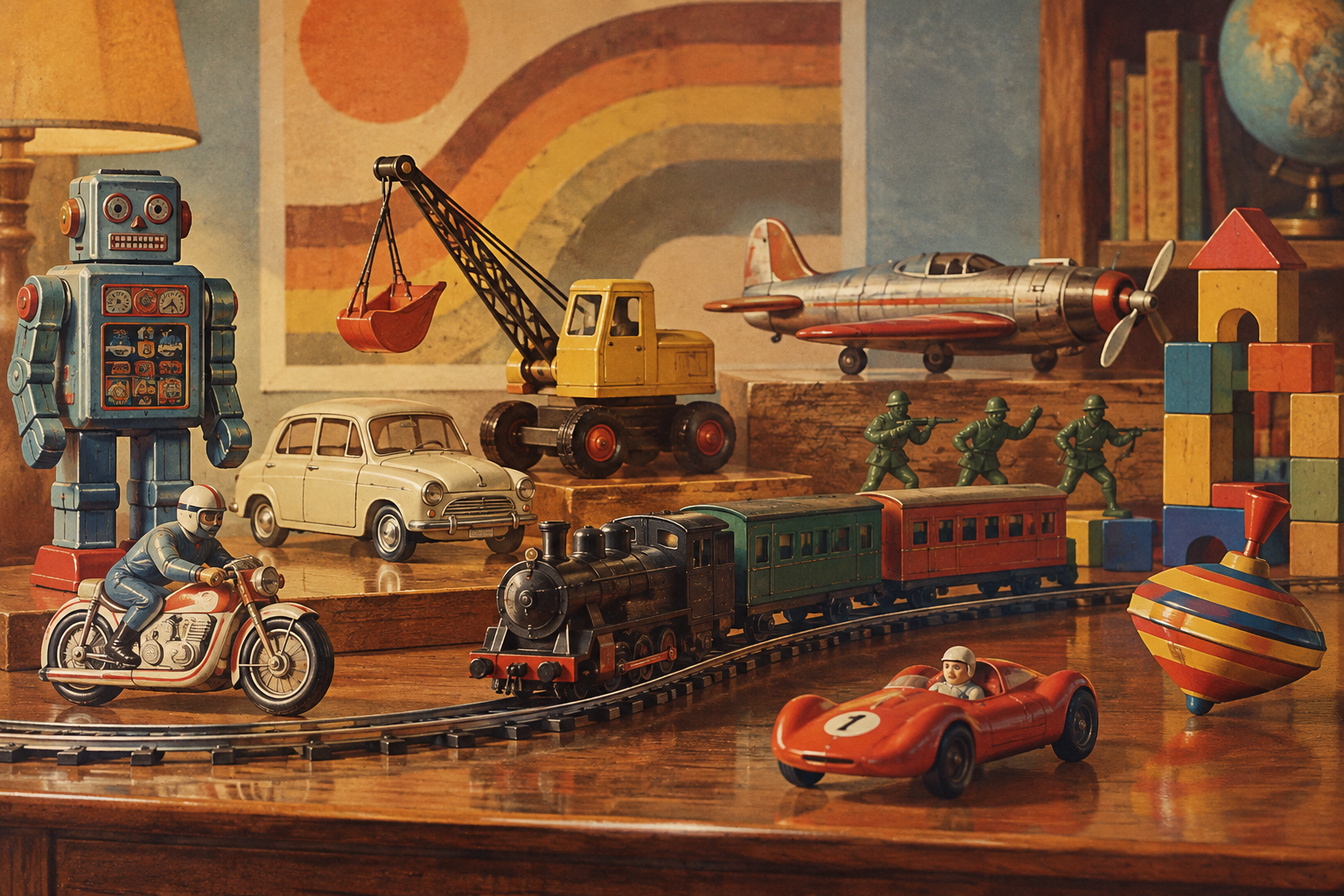
A toy is not a transparent record of childhood, yet it preserves tangible traces of how a society imagined leisure, technology, consumption, and daily life. Madrid’s exhibition “Del juguete al cielo” approached a century of Spanish toys, from 1880 to 1980, by connecting objects with their sociological context and, in some cases, with photographs of the real objects or means of transport they reproduced. This is a useful method: a toy may seem like an isolated miniature until it is viewed alongside the aspirations, materials, and media of its time.
From manufacture to cultural product
The consulted sources place industrialisation at the centre of a major transformation. Production moved beyond solely domestic or craft solutions and entered wider systems of manufacturing and commerce. The Toy Museum of Almassora recalls processes linked to so-called gachas, moulds, and hardened, coloured figures. This is not merely a technical anecdote: materials shaped form, cost, durability, and the kinds of objects that reached homes.
Over time, toys also acquired a more visible cultural role. Gentemenuda’s historical overview notes that, during the twentieth century, fashions, advertising, and media contributed to rapid diversification. This should be treated as a general framework rather than a single explanation. Preserved collections contain very different objects; what they share is their place in a world where play also involved design, markets, and public imagery.
The 1970s: consumption, screens, and new expectations
For the 1970s, television advertising is a particularly relevant documented factor. The Toy Museum of Almassora states that growing consumption was closely linked to television and that toy companies found it their principal advertising medium. This does not by itself measure the success of any brand or product, but it does illuminate a change of scale: toys could be presented to large audiences at once through moving images, demonstrations, and short narratives.
The same source describes a shift from cable-guided vehicles to remote-controlled models. The change suggests a technical aspiration: a toy’s appeal lay not only in representing a car or train, but also in creating an experience of control. Electrification had already opened related paths. Almassora dates the first electric trains with transformers, track switches, automatic brakes, and tunnels to 1931. Later decades did not begin from nothing; they developed a material culture already connecting miniature scale, movement, and mechanism.
Design, industry, and place
Spanish toys cannot be reduced to a list of famous brands. The Valencian Toy Museum in Ibi explains that much of its collection comes from a donation by workers of the Payá Cooperative and consists mainly of toys made in Ibi and Germany, alongside pieces from elsewhere in Spain and the world. That provenance encourages us to see objects alongside the people who made, preserved, and donated them.
The Polytechnic University of Valencia highlights symbolic, creative, socioeconomic, cultural, and industrial-design dimensions that often receive less attention. This is essential if nostalgia is not to flatten the subject. A toy car or doll may evoke memory, but it is also the outcome of decisions about raw materials, manufacturing processes, aesthetics, distribution, and imagined audiences.
Museums do more than accumulate objects
Heritage institutions do more than display old things. Ibi’s museum was inaugurated on 20 December 1990 and identifies collecting, conserving, researching, educating, and disseminating this heritage among its aims. Almassora’s museum, created on 22 December 2010 from the Arenós and Agut family collection, renews its temporary exhibitions annually to present different holdings. Their models differ, but both make toys a subject for research and public interpretation.
The UPV adds a productive idea: a museum can be thematic and contextualise objects with images or music from each period rather than rely only on chronology. For an object so bound to use and imagination, this raises richer questions. Which technologies became desirable? Which visions of mobility, home, or adventure circulated? What did it mean to give, collect, or repair a toy?
Limits and legacy
Not every memory establishes a historical fact, and preserved toys do not represent every part of society equally. The available sources document institutions, exhibitions, and broad changes; they do not suffice to reconstruct sales, prices, universal preferences, or every family’s experience. It is also important to distinguish between an object made in Spain, one sold in Spain, and a Spanish memory of toys: related categories, but not identical ones.
Even with these limits, toys form an unusually expressive archive. Madrid’s 500-piece exhibition and Cairn’s academic discussion, spanning terracotta dolls to interactive electronic toys, share an insight: toys are best understood in their historical setting. That does not diminish their emotional force. It expands it by revealing the materials, workers, designs, campaigns, families, and historical ways of imagining play behind each object.
- Decade
- 1970s
- Region
- Spain
- Level
- Enthusiast
- Entities
- Museum
Sources and references
- Museo del Juguete de Almassorawww.almassora.es · 2026-09-21
- Museo del Juguete - Memoria Viva - UPVmemoriaviva.upv.es · 2026-09-21
- «Del juguete al cielo» | Condeduque Madridwww.condeduquemadrid.es · 2026-09-21
- Historia de la cultura infantil a través de los juguetes | Cairn.infoshs.cairn.info · 2026-09-21
- Pasado, Presente y Futuro - Museo del Juguetewww.museojuguete.com · 2026-09-21
- Historia del juguete: De la prehistoria a nuestros días .www.gentemenuda.es · 2026-09-21


