A small object with a broad context
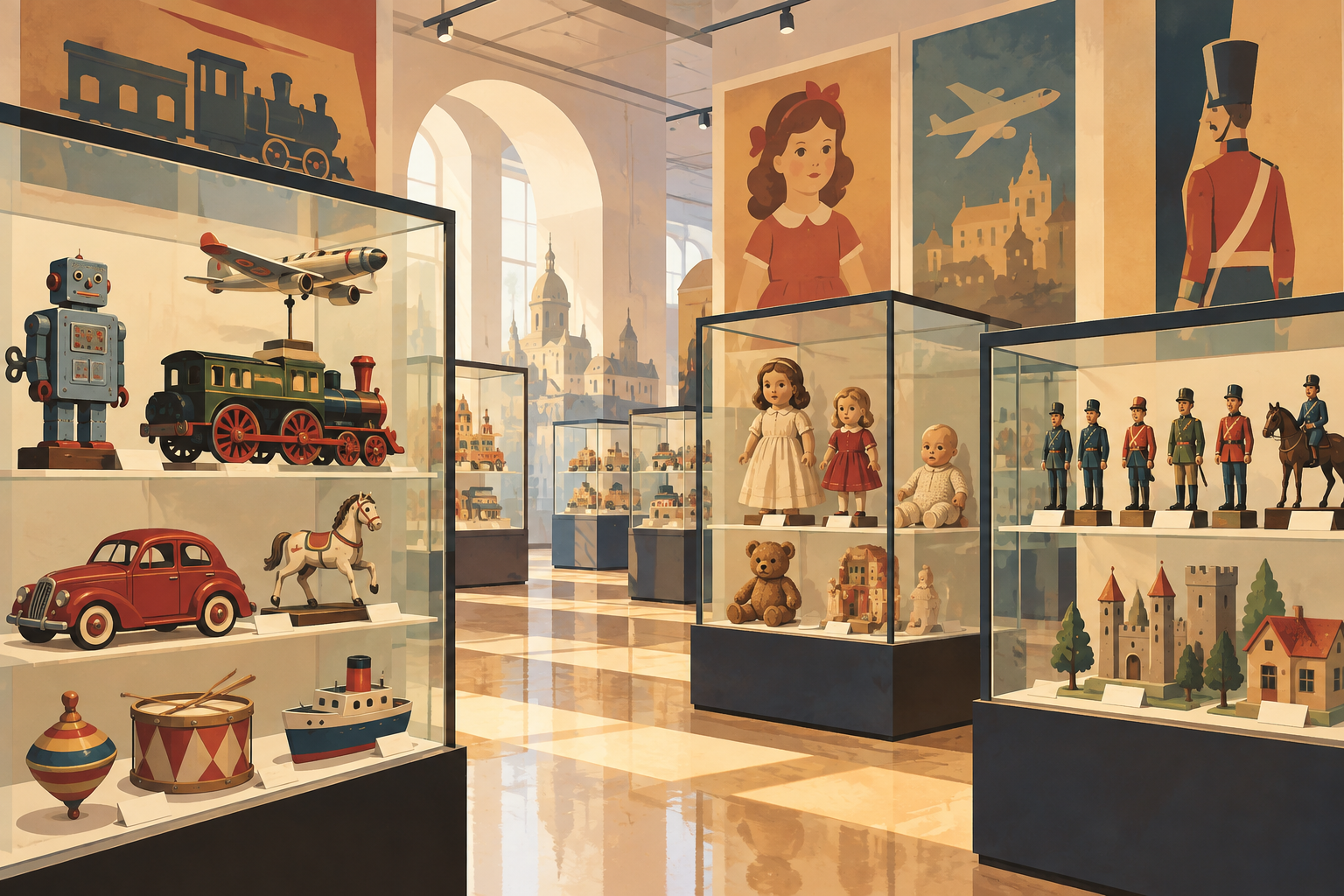
A toy can be a domestic object, an industrial product, a family memory and a design document at the same time. That accumulation of meanings explains why studying toys is not limited to identifying a brand or dating a model. Institutions and exhibitions devoted to toys suggest another scale of reading: observing materials, forms, manufacturing methods, advertising, childhood imaginaries and changes in consumption.
The Madrid exhibition Del juguete al cielo displayed 500 pieces from the Quiroga-Monte Collection across the period from 1880 to 1980. Its approach is especially useful because it related objects to their sociological context and, at times, to photographs of the real means of transport they reproduced. The toy was therefore not presented as an isolated miniature, but as a material interpretation of an era.
From local manufacturing to shared heritage
The case of Ibi shows how industrial memory and the memory of play can be preserved together. The Toy Museum opened on 20 December 1990 and was provisionally housed in Casa Gran. Its collection began with holdings donated to the town by workers of the Payá Cooperative, accumulated during the life of the original company. According to the museum, toys made in Ibi and Germany predominate, although objects from other parts of Spain and the world are also present.
This origin matters. A collection born from holdings connected to labour makes it possible to consider toys not only from the perspective of those who played with them, but also of the people who designed, manufactured, assembled, distributed and preserved them. The planned display of original machinery and tools extends that view. Rather than a history made only of finished products, it outlines one in which tools and industrial know-how are also heritage.
When the museum changes the way we look
The Toy Museum of Almassora was established on 22 December 2010 from the antique toy collection of the Arenós and Agut family. Its temporary exhibitions are renewed annually in order to show the collection as a whole. That rotation has an important consequence: the collection is not fixed into a single narrative. Each new selection can foreground a material, a type of toy, a period or a relationship between objects.
The museum’s information also describes twentieth-century technical changes. It mentions the first electric trains with transformers, track switches, automatic brakes and tunnels, launched in 1931; it also notes the move from cable-guided vehicles to remote control. These are examples of how a play object can incorporate technical solutions recognisable to children and families. They should not, however, be treated as an inevitable story of progress: every object needs to be placed within its documented date, use and context.
Design, advertising and consumer culture
Television appears in Almassora’s documentation as a main advertising medium for toy companies. This helps explain that the twentieth-century toy was also a commodity shaped by images, campaigns and consumption calendars. Advertising did not replace play, but it influenced product visibility and expectations around it.
Historia del Juguete identifies Famosa as an emblematic Spanish toy company and dates the launch of the Nancy doll to 1968. It also states that Geyper, founded in 1945, launched Geyperman in 1975. These are two specific references within a much wider panorama. By themselves, they do not justify a total explanation of the Spanish market, but they show how dolls and action figures can become entry points for studying changes in style, audiences and product strategies.
Collecting is not merely accumulating
The Polytechnic University of Valencia suggests linking a museum archive with historical records and a leisure-product database. The stated aim is to provide a historical and industrial overview of the sector, from its origins to current markets. It is a useful direction for domestic collections: cataloguing an object is not simply assigning it a brand. It also involves recording provenance, materials, condition, inscriptions, accessories, documentation and relationships with other objects.
The same source imagines a museum arranged by themes and contextualised with images or music from each period, rather than necessarily in chronological order. This shifts the usual question — what came first — towards others: what uses a toy represented, what aesthetic it offered, what technique it made visible and what forms of play it enabled or suggested.
Limits of an object-based history
Toys can reveal a great deal, but they do not speak for themselves. A display case does not automatically demonstrate how everyone played, what all children wanted or how an entire market worked. Surviving objects depend on earlier decisions: what was made, what endured, what was donated and what could be catalogued. It is therefore important to distinguish documented facts from contemporary interpretation.
The academic article on children’s culture published in Enfances & Psy recalls a trajectory from ancient terracotta dolls to interactive electronic toys, shaped by cultural and industrial revolutions. Its framework encourages us to avoid simplified nostalgia. Materials change, techniques accelerate and meanings are negotiated in every period.
Conclusion
Seeing Spanish toys as cultural documents connects design, industry, advertising, technology and everyday life without reducing any of those dimensions to anecdote. The museums in Ibi and Almassora, the UPV proposals and contextual exhibitions provide tools for doing so carefully. The most interesting object is not necessarily the rarest or best known one: it may be the piece whose provenance, material and context help us ask better questions about the material culture of play.
- Decade
- 1970s
- Region
- Spain
- Level
- Introduction
- Entities
- No linked entities
Sources and references
- Historia del Juguetehistoriadeljuguete.com · 2026-09-19
- Museo del Juguete de Almassorawww.almassora.es · 2026-09-19
- Museo del Juguete - Memoria Viva - UPVmemoriaviva.upv.es · 2026-09-19
- «Del juguete al cielo» | Condeduque Madridwww.condeduquemadrid.es · 2026-09-19
- Historia de la cultura infantil a través de los juguetes | Cairn.infoshs.cairn.info · 2026-09-19
- Pasado, Presente y Futuro - Museo del Juguetewww.museojuguete.com · 2026-09-19


