A small object with many layers
A toy collection is neither a line of innocent objects nor a simple storehouse of nostalgia. A toy retains material traces—wood, fabric, tinplate, rubber, or plastic—but it can also point to ways of making, selling, giving, playing, and remembering. That is why museums, researchers, and collectors treat toys as part of childhood’s material culture. Yet an object’s documentary value does not arise automatically from its age or emotional appeal. It depends on the information that accompanies it, how it has been preserved, and the questions asked of it.
Madrid’s Del juguete al cielo exhibition explicitly connected Spanish toys with socioeconomic, technical, cultural, and political changes from 1880 to 1980. Its method related displayed pieces to their sociological context and, at times, to images of the real objects or vehicles they recreated. This offers a useful clue: looking at a toy is not the same as looking at an isolated miniature. It requires attention to the adult, industrial, and domestic world that made it possible.
Materials that place an era
Materials do not date an object precisely on their own, but they can guide historical questions. The Colombian Pedagogical Museum describes traditional handmade toys in its collection, including yo-yos, spinning tops, slingshots, cup-and-ball toys, rubber balls, and cloth or rag dolls. It links them to craft practices, homes, and local cultural traditions. In this context, wood and textiles should not be treated as proof of a specific age, but as clues to techniques, material availability, and the transmission of knowledge.
Condeduque’s source, meanwhile, states that plastic had displaced wood and tinplate by the late 1950s, while electrical components began to be incorporated to expand toys’ capabilities. This supports a broad account of industrial change, not an automatic diagnosis for each object. A responsible museum distinguishes between a documented trend and an individual attribution: the latter needs marks, catalogues, packaging, provenance, or more precise analysis.
Learning, imagining, and reproducing the world
The Costume Museum advances a central idea: through toys, children acquire skills that help them fit social expectations and internalize their culture’s essential values; toys also reflect the society and historical moment that created them. The claim is useful provided it is not turned into a mechanical rule. A doll, tea set, or miniature vehicle may propose roles, scenes, and aspirations; it does not automatically prove that everyone played alike or accepted those models without question.
The Gallery of the Royal Collections provides an especially clear example of this double reading. Photographs from the General Archive of the Palace show rooms intended for the children of Alfonso XIII and Victoria Eugenia filled with toys, including dolls and tea sets. The institution notes that such objects encouraged imagination and preparation for adult life. Here the photographic archive gives a context that an isolated piece would lack: it records arrangement, abundance, and a domestic setting. Still, a photograph preserves a scene rather than a full account of play routines.
From private property to heritage
When a toy enters a museum, it changes status. It ceases to be only an object of use, gift, or family inheritance and becomes inventory, evidence, and a potentially displayed item. Regarding royal children’s toys retained after the proclamation of the Republic, the Gallery explains that some were considered worthy of a museum while others were offered to Madrid City Council at a Three Kings’ Day donation event in 1933. The episode shows that heritage-making also follows institutional and political decisions.
The Valencian Toy Museum presents another route by which collections are formed. Its holdings are based in part on a donation to the town of Ibi by workers from the Payá Cooperative, consisting mainly of toys made in Ibi and Germany, alongside pieces from elsewhere. Opened in 1990, the museum states aims to collect, conserve, research, educate, and disseminate shared cultural heritage. This collective provenance links toy history with work, local industry, and community rather than only with individual consumers’ childhoods.
A display case is not the end of the story
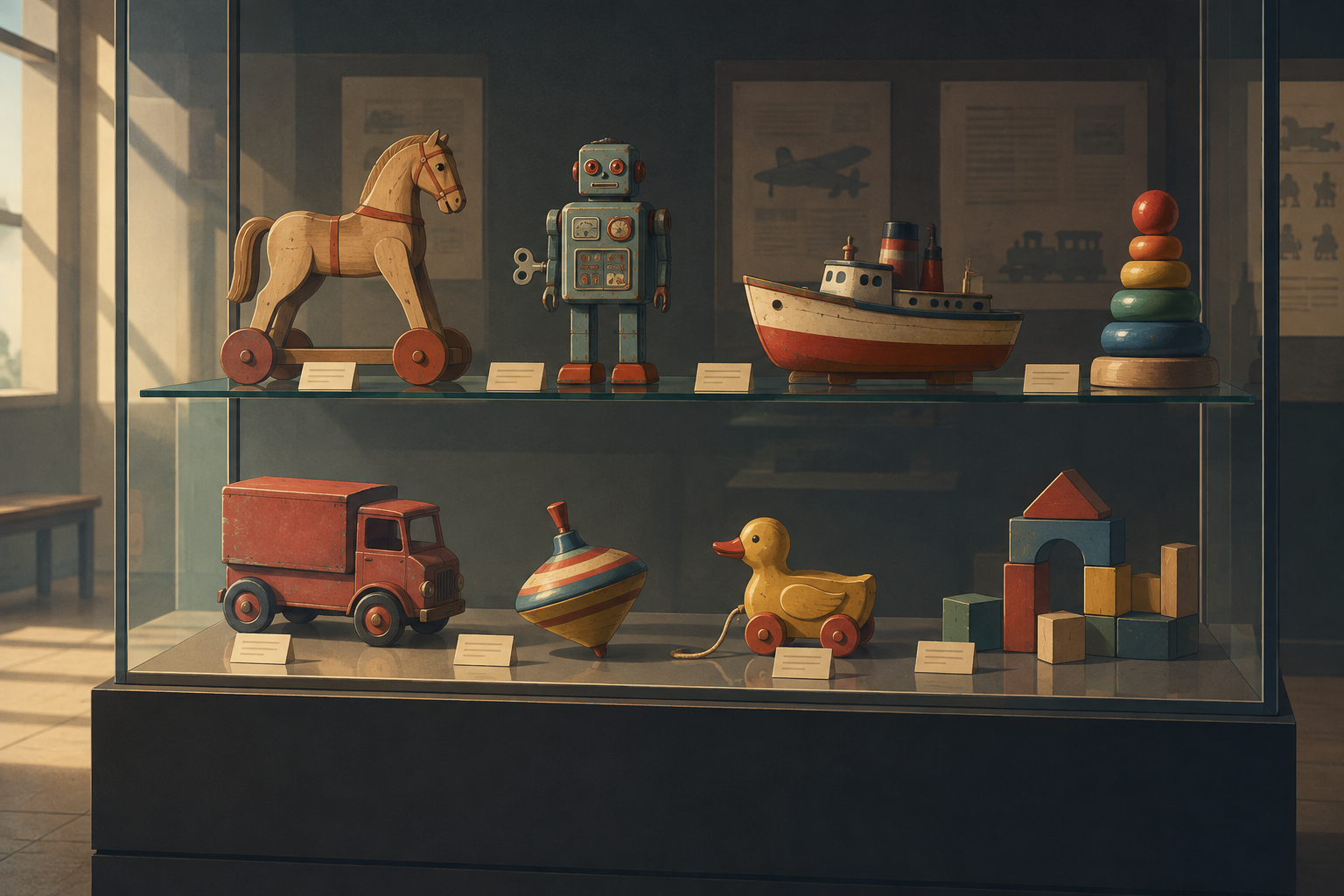
The academic study of the Museu del Joguet de Catalunya describes holdings of tens of thousands of toys, trading cards, comics, illustrated stories, nativity figures, toy theatres, and music boxes, placing them within childhood’s material culture and popular culture. Its approach cautions against purely decorative display. A case selects, groups, and separates objects; it therefore constructs a narrative as well.
Recording provenance, materials, condition, inscriptions, repairs, and links to other objects reduces the risk that a toy becomes a sentimental emblem without context. It also makes absences visible. Collections depend on what was kept, who could buy, which families donated, and what institutions deemed worth preserving. A rich collection is not the same as a complete representation of a society.
Conservation and careful interpretation
Conservation does not mean returning an item to an assumed original state. In many toys, wear, a home repair, or an inscription may be part of its biography. Deciding what to stabilize, clean, or leave visible requires documented judgment. The available sources emphasize conservation, research, and dissemination, but they do not authorize claims about specific treatments for specific objects.
The most productive reading joins intimate and historical scales. A toy may speak of a gift, factory, shop, craft, educational ideal, or heritage policy. It does not speak for itself, nor can it replace the testimony of people who played with it. Its strength lies in this incompleteness: it invites comparison with archives, photographs, catalogues, and memories, while making clear where evidence ends.
Conclusion
A toy collection becomes historically meaningful when it preserves objects and contexts together. The institutions cited here show different paths: relating pieces to social change, documenting craft traditions, preserving palace settings, or recovering industrial heritage. None allows absolute generalizations about “childhood.” Together, however, they make it possible to understand the toy as a material document: a specific, situated, partial object that opens wider questions about culture, work, education, and memory.
- Decade
- 1950s
- Region
- Global
- Level
- Enthusiast
- Entities
- Museum, Museo del Traje
Sources and references
- Pieza del mes de abril de 2024: Los juguetes en la historia de la infancia. La colección de juegos y juguetes en el Museo Pedagógico Colombiano. – MUSEO PEDAGÓGICO COLOMBIANOmuseopedagogico.pedagogica.edu.co · 2026-09-21
- Anti-juguetes o la «memoria lúdica» tras un cristal: Una ...dialnet.unirioja.es · 2026-09-21
- «Del juguete al cielo» | Condeduque Madridwww.condeduquemadrid.es · 2026-09-21
- Juguetes Reales - La Galería de las Colecciones Realeswww.galeriadelascoleccionesreales.es · 2026-09-21
- Pasado, Presente y Futuro - Museo del Juguetewww.museojuguete.com · 2026-09-21
- Juguetes - Museo del Traje | Ministerio de Culturawww.cultura.gob.es · 2026-09-21


