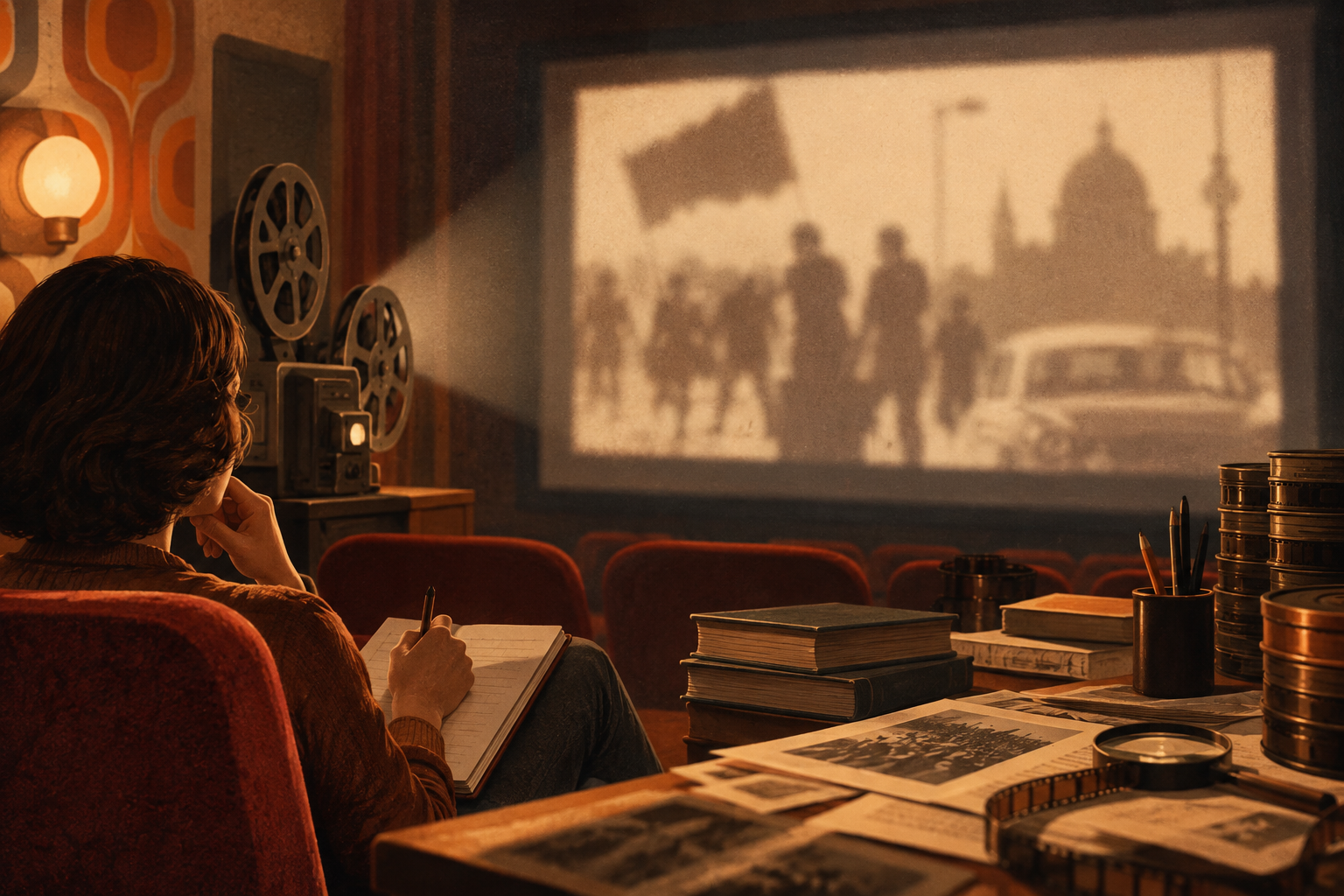
A film is not the past, but it belongs to it
A film set in another era often seems to offer a direct window onto the past. Costumes, sets, famous figures and recognizable events encourage that expectation. It is useful, but incomplete. Historical cinema uses material from the past while speaking from the time in which it was made. A film released in 1970 or 1971 can therefore matter not only for the period it depicts, but also for the questions, conventions and sensibilities of its makers and audiences.
Academic work on film and history calls for caution. A film can be a source for studying mentalities, representational habits and cultural uses of history; it does not become a transparent record that replaces archives or historical research. Careful viewing means considering what it tells, how it tells it, when it was produced and for whom.
Two times on one screen
The first time is that of the story. A film about war, monarchy, political conflict or social change organizes its subject: it chooses protagonists, arranges causes and consequences, simplifies processes and concentrates action. That is the work of cinematic storytelling. Even when it draws on documented events, it decides what remains outside the frame.
The second time is production. Script, staging, performance, editing, music and promotion were made under specific conditions. CineHistoria describes its approach as a contextual history of cinema: films may be read as reflections of a society’s mentality and as testimony to their own time. This should be treated as a set of questions, not an automatic guarantee. What present-day conflicts seem to enter the represented past? Which political or moral language does the film use? Who receives empathy, authority or silence?
The gap between these two times explains why period films remain historically useful even when individual details are debatable. Their historical value may lie less in the accuracy of every costume or line than in the public memory they construct.
The 1970s: history, politics and representation
The decade is a useful case because cinema visibly addressed political and historical subjects. Academic materials mention Patton (Franklin J. Schaffner, 1970) and Nicholas and Alexandra (Franklin J. Schaffner, 1971) among works connected with major contemporary events. Their inclusion does not establish one interpretation or complete accuracy. More modestly, it makes them relevant starting points for discussing how cinema turns historical processes into characters, scenes and dramatic conflict.
A teaching source on history and film also links Costa-Gavras with Z (1968), The Confession (1970) and State of Siege (1973). This grouping highlights a key distinction. Some films recreate a distant past; others intervene in conflicts close to their release. In both cases, the screen is not outside history. It participates in the circulation of ideas, feelings and interpretations.
There is no need to reduce such films to political theses. Analysis becomes more precise when it separates what can be verified—title, credited authorship, year and general subject—from interpretation: the effect of a scene, the memory privileged by editing, or a possible reading by viewers. Those are argued hypotheses, not facts a technical credit can settle.
Look beyond the plot
Historical viewing begins with plot but should not end there. Mise-en-scène distributes visual power: who occupies the centre of the frame, from what angle a character is filmed, how long a face is held, and whether spaces feel open or oppressive. Costume and décor do more than establish period; they produce distance, authenticity or theatricality.
Editing interprets too. By joining glances, speeches, crowds and reactions, a film creates causal and emotional links. Music can cast an episode as triumph, grief, threat or irony. None of these devices is neutral, yet none compels a single conclusion. Comparing sequences, describing them precisely and avoiding undocumented claims about intention are sounder practices than merely retelling the plot.
This approach shows why literal fidelity is not the only criterion. Discussion of historical cinema includes plausibility: internal narrative coherence is not the same as factual accuracy. A film may be persuasive while compressing chronology, merging people or inventing dialogue. Recognizing that difference avoids two opposite mistakes: accepting everything as truth or dismissing every film because it is fiction.
How to check without turning viewing into an exam
A practical method is to make a short record before and after viewing. Before: note the title, year, credited makers, represented period and your own questions. Afterwards: separate observations from historical claims. “The film shows” describes the work; “this happened this way” requires additional evidence.
Then compare three levels. First, historiography: studies, archives or research on the represented event. Second, film history: production information, reception and the work’s place in its makers’ careers. Third, context: cultural and political debates around release. The academic and educational sources supplied for this dossier are useful for this methodological framework; on their own they do not confirm every detail of every film.
This discipline does not diminish pleasure. It reveals the creative work that produces an impression of truth. It also clarifies disagreement: one viewer may value dramatic force while another questions the selection of facts, and both may be discussing different aspects of the same work.
Legacy and the limit of the cinematic gaze
Cinema remains a privileged tool for approaching how societies imagine their past. RTVE, introducing a book by Javier Mateo Hidalgo, relays a broad account of milestones that includes sound, documentary, the musical, colour, montage and continuing challenges to narrative formulas. The list reminds us that film history does not move along a single technical track. It also changes through styles, institutions, audiences and arguments about which stories deserve to be told.
Its visual force nevertheless requires clear limits. A film alone cannot demonstrate what an entire society thought. Nor is it legitimate to assign undocumented intentions to creators or use drama as a substitute for research. The evidence supplied here supports a general framework about film and history and names several works; it does not support exhaustive conclusions about their reception, production processes or scene-by-scene accuracy.
Conclusion: look in two directions
The productive question before a historical film is not only “Is it true?” It is also “What version of the past does it construct?” and “What does that construction reveal about the film’s own time?” The 1970s provide especially suggestive ground for practising this double view, between historical recreation and political cinema.
This does not instantly turn a viewer into a specialist. It offers a method: observe form, separate fact from representation, compare sources and recognize that every film is at once a narrative, a cultural object and a trace of an era. That combination lets us enjoy fiction without demanding what it cannot provide, while using it as a critical doorway into history.
- Decade
- 1970s
- Region
- Global
- Level
- Enthusiast
- Entities
- La confesión
Sources and references
- 102 Grandes acontecimientos históricos contemporáneos en el cinee-archivo.uc3m.es · 2026-09-19
- El Cine como fuente de la Historia - DADUNdadun.unav.edu · 2026-09-19
- Historia y Cineclio.rediris.es · 2026-09-19
- Acerca de – cinehistoriacinehistoria.com · 2026-09-19
- La historia del cine a través de algunos de sus grandes hitoswww.rtve.es · 2026-09-19


