The magazine as a point of entry
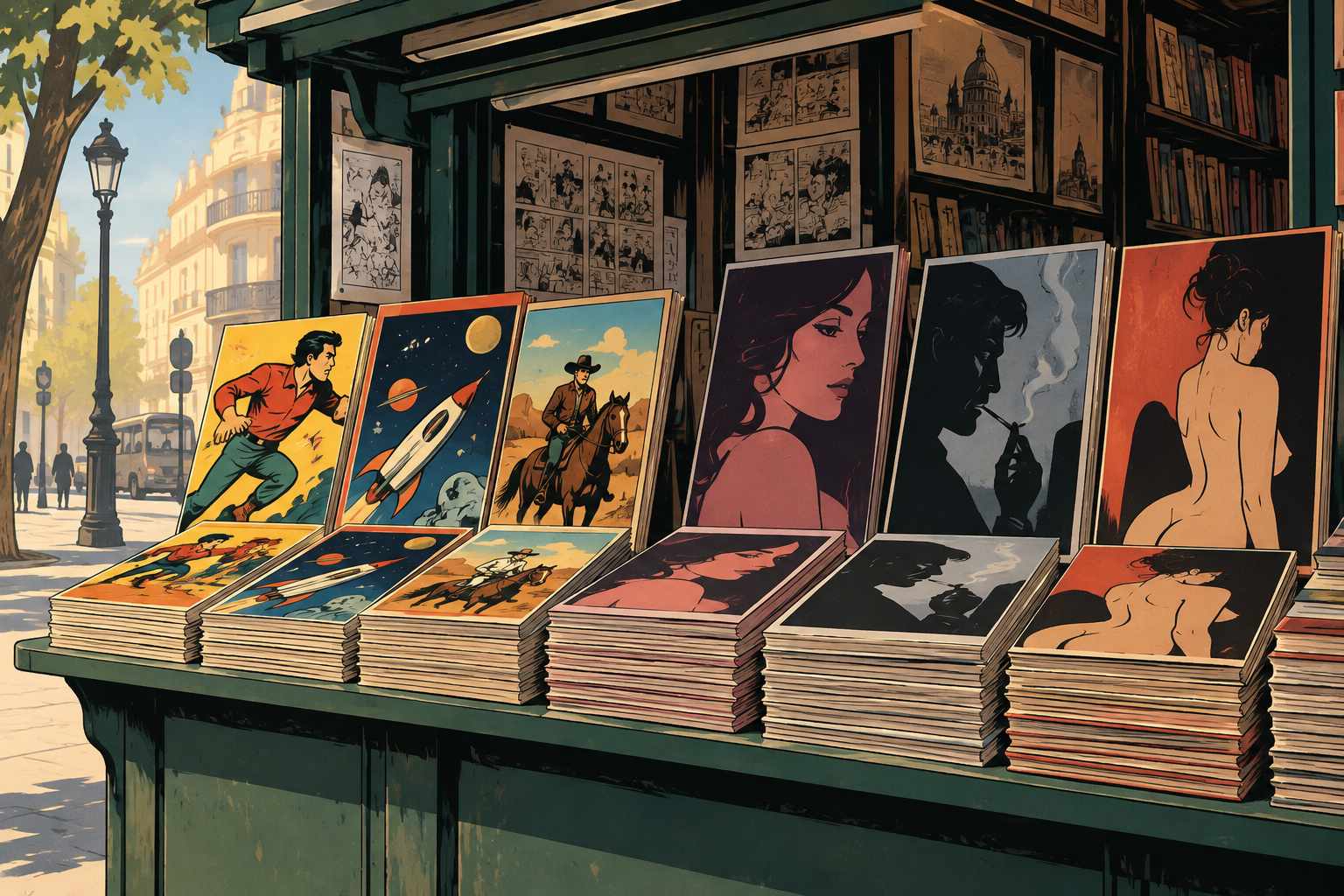
In Spain, the newsstand was for a long time a familiar place to find comics. A magazine was more than a container for several stories: as a periodical, it could bring together series, artists and different tones, reaching readers who did not visit specialist bookshops. This position began to change when direct sales expanded in the early 1970s and specialist bookshops became more prominent. That transition did not mean the newsstand disappeared at once; rather, it ceased to be the only point of reference for comics distribution.
The adult magazines of the following decades offer a specific way to observe that change. A report published by El Periódico de España says that thirty adult-comic titles appeared at Spanish newsstands between 1981 and 1990. The same article counts around twenty titles available in 1981, the year of the first Barcelona International Comic Fair. These are figures reported by that article, not an independently verified census here; even so, they describe a period of considerable publishing visibility.
A format that brought voices together
The magazine had a cultural advantage as well as a commercial one: within the same issue, it could place work by artists at different stages of their careers. Antoni Guiral, quoted in the El Periódico de España report, notes that the format gave young artists visibility by placing them alongside more established names. This describes a possibility of the medium, not proof that every title followed the same editorial policy.
A periodical also offered a different framework from a self-contained album. It could publish material in instalments or bring together varied work, although the sources available here do not detail the practices of each magazine or allow us to reconstruct their contents issue by issue. We should therefore distinguish the format’s potential from a uniform description of all magazines of the period.
These publications make more sense within the broader history of Spanish print culture. El Correo’s account of the exhibition Historietas del Tebeo. 1917-1977 describes a display organized around publications and original drawings, combining a chronological and a thematic approach. The report also recalls prior censorship and restrictive legislation under the dictatorship. That context matters to the longer history of Spanish comics, but it does not justify attributing an identical experience of censorship to every adult magazine of the 1980s.
Newsstands and specialization
The arrival of more titles at newsstands in the early 1980s suggests that magazines could still attract readers and make different projects visible. The figure alone does not tell us who read each title, how long each publication lasted or what print runs it achieved; the consulted material does not establish those details. What can be stated is narrower: the newspaper report records a wide offer of adult titles during the decade and connects their presence with the context of the Barcelona fair.
At the same time, the development of specialist channels changed how readers found comics. The general reference source on comics places the expansion of direct sales and specialist bookshops in the early 1970s, alongside a move away from reliance on newsstands. As a broad reference rather than a study of each market, it is useful orientation, not a complete explanation of decisions made by Spanish publishers and readers.
The coexistence of channels matters because each shapes the encounter with a work differently. A newsstand puts periodicals in an everyday buying environment; a specialist shop makes it easier to seek out particular titles and formats. Treating the change as a straightforward replacement would overlook the possibility that both circuits coexisted and that the market changed gradually.
The contraction of the 1990s
The El Periódico de España report characterizes the 1990s as a period of sharp contraction for adult comics and lists possible factors: the consolidation of albums, declining magazine quality, exhaustion of the earlier boom, and the arrival of the comic book as a vehicle for series. These are explanations attributed to voices cited by that article, not causes demonstrated by a comparative study presented here.
That distinction matters. A decline in the number or visibility of magazines does not prove that their readers, artists or forms of experimentation disappeared. It may instead indicate that audiences and the industry began to organize around other formats. The supplied sources do not allow us to measure the relative weight of each factor or to chart the transformation title by title.
Beyond the life of an individual title
A magazine can leave a legacy beyond its publication run. Jot Down Cómics’ article on the past and present of comic magazines approaches the format through its industrial history, while the El Periódico de España report emphasizes its role as a platform for emerging artists. Research on comics in museums, meanwhile, shows how publications and original drawings can feature in historical and exhibition narratives. This does not mean every title has entered a museum collection; it means that magazines can become objects of cultural memory.
The exhibition described by El Correo offers an example of periodicals supporting a historical account: titles, drawings and characters appear in a route combining chronology and themes. CuCo’s academic work on comic exhibitions broadens the discussion, although the information available here is not sufficient to set out its full argument.
What we know—and what remains to be checked
The evidence supports a broad outline: the newsstand was a central channel; direct sales and specialist bookshops gained ground from the early 1970s; adult magazines had a substantial presence at Spanish newsstands in the 1980s; and the format contracted in the 1990s as other publishing models gained importance. The sources also document a potential role for magazines as a showcase for younger artists.
They do not, however, provide complete title lists, print runs, prices, sales figures, publication schedules or reader profiles. Nor do they justify reducing the decline to one cause or claiming that all magazines shared an aesthetic, content or strategy. A fuller history would require complete runs, publisher archives, newspaper libraries and research focused on individual titles.
The significance of Spanish adult magazines lies in their newsstand presence and in their role during a period of changing distribution channels and formats. Their trajectory is not simply a story of boom and disappearance: it offers a view of how comics were published, encountered by readers and left traces that can be recovered and studied.
- Decade
- 1980s
- Region
- Spain
- Level
- Enthusiast
- Entities
- Museum
Sources and references
- El año del cómic y los museos - Jot Down Cultural Magazinewww.jotdown.es · 2026-09-23
- Cien años de historietas | El Correowww.elcorreo.com · 2026-09-23
- Historieta - Wikipedia, la enciclopedia librees.wikipedia.org · 2026-09-23
- Las exposiciones de cómics. Historia y contexto global | CuCo, Cuadernos de cómicerevistas.publicaciones.uah.es · 2026-09-23
- Pasado y presente de las revistas de cómic – Jot Down Cómicscomics.jotdown.es · 2026-09-23
- Mujeres del cómic en la España de los 70 y 80 - Revista de Arte - Logopressrevistadearte.com · 2026-09-23


