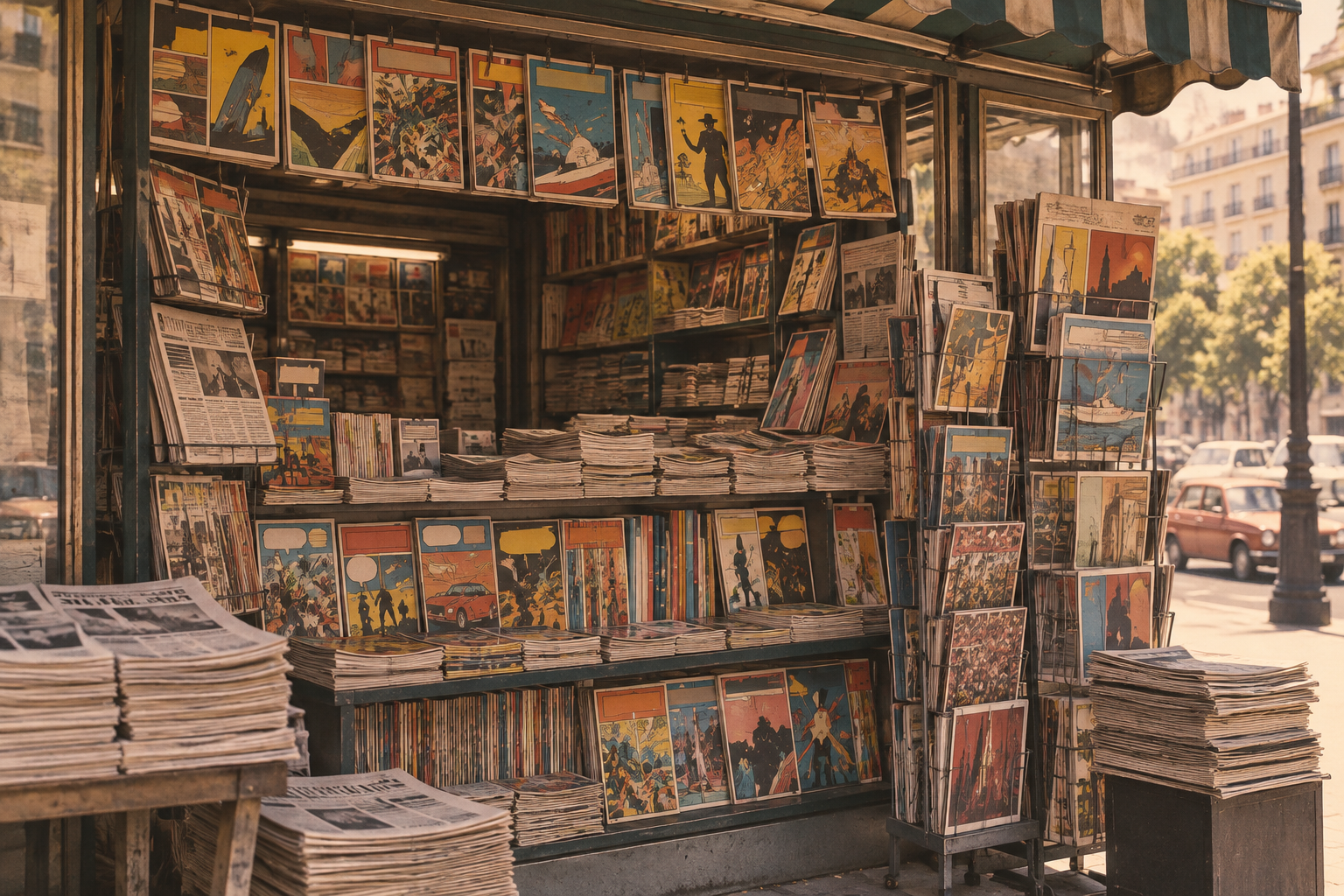
The magazine as a place of reading
For much of the twentieth century, comics magazines were among the most common publishing formats. They were not merely containers: periodicity, mixed line-ups, physical size, and newsstand availability created a collective reading habit. A general definition of the comics magazine as a periodical that gathers comics is useful, but it does not fully capture the material experience of finding it among newspapers and other periodicals.
In Spain, magazines have a history that predates the years discussed here. Jot Down recalls early titles such as Monos and identifies a significant postwar expansion. This article does not claim to reconstruct that entire history. It focuses on the change documented for the 1970s through the 1990s: adult-oriented magazines expanded, served as editorial platforms, and then sharply contracted.
From the newsstand to the specialist shop
The newsstand was a usual channel for comics, though not the only one. The supplied historical overview says that specialist bookshops began to gain ground with the development of the direct market in the early 1970s. This describes a gradual shift, not an immediate or uniform replacement.
Distribution matters because it shapes visibility. At a newsstand, comics share everyday retail space with newspapers and magazines; a specialist shop addresses a more intentional search for the medium. The evidence does not quantify the weight of each Spanish channel in a given year. It does support the conclusion that alternative channels developed alongside changes in format and consumption.
The boom in adult titles
Press evidence identifies 1981-1990 as a period of intense editorial density. El Periódico de España reports that thirty adult-comics titles reached Spanish newsstands during those years, joining titles launched in the second half of the 1970s. It also reports that about twenty adult comics magazines were available in 1981, the year of the first Barcelona International Comics Fair.
These figures show breadth of offer, not sales, print runs, profitability, or readership. They do, however, document many concurrent magazines at the point of sale. This gave readers a field of choice: serialized work, varied graphic approaches, and different authors in one recurring object.
The same report quotes curator Antoni Guiral on a specific strength of the magazine format: young artists could gain exposure beside established names. That is an attributed assessment, not a universal rule. Yet it identifies a key possibility of anthology publishing: shared pages can work as both showcase and context.
A format, not a genre
Magazine publishing should not be confused with one kind of comic. It could contain humour, adventure, satire, serial fiction, and distinct graphic approaches. General sources note the emergence of satirical and adult-oriented publications in the 1970s, alongside a broader adolescent and adult readership. That is useful context, but it cannot define every Spanish title.
Magazines also differed from albums. One stressed recurrence and variety; the other could support a self-contained work or a collected edition. Neither form is inherently superior. Comics could first run in instalments in magazines and later be collected in books or albums. As a result, the history of a work and the history of its first publication may differ.
The contraction of the 1990s
The journalistic source describes a dramatic decline in adult comics magazines during the 1990s. In Guiral’s retrospective explanation, relevant factors included the consolidation of albums, declining magazine quality, the exhaustion of the boom, and the arrival of the comic-book format as a vehicle for series. These are proposed factors, not a statistical proof or a single final explanation.
The point is not necessarily that interest in comics vanished. Rather, the relationship among formats, channels, and readers changed. A general overview adds that many anthology magazines have disappeared in the current context, while albums and the internet have become original publication formats for many comics. That later observation does not alone explain the 1990s, but it places the shift within a longer reconfiguration.
What remains of the newsstand
Nostalgia can hide both diversity and fragility. The thirty titles counted for 1981-1990 had very different lifespans; abundance did not ensure permanence. Albums should not be treated as absolute opponents either: they opened other possibilities for reading, collecting, and circulation.
The magazine’s legacy is therefore not a uniform golden age. It is a cultural infrastructure: visible comics in everyday space, recurring reading, and—according to the cited curator—a route by which emerging creators could appear beside established ones. The move from the newsstand toward other formats and circuits was not simply disappearance. It changed the conditions for making, finding, and reading comics.
- Decade
- 1980s
- Region
- Spain
- Level
- Enthusiast
- Entities
- No linked entities
Sources and references
- Historieta - Wikipedia, la enciclopedia librees.wikipedia.org · 2026-09-19
- Historia visual del cómic, la novela gráfica, el manga y los tebeos – Alberto Albarránwww.albertoalbarran.com · 2026-09-19
- Del quiosco al museo: el viaje del cómic en los últimos 40 añoswww.epe.es · 2026-09-19
- Pasado y presente de las revistas de cómic – Jot Down Cómicscomics.jotdown.es · 2026-09-19
- Revista de historietas - Wikipedia, la enciclopedia librees.wikipedia.org · 2026-09-19


