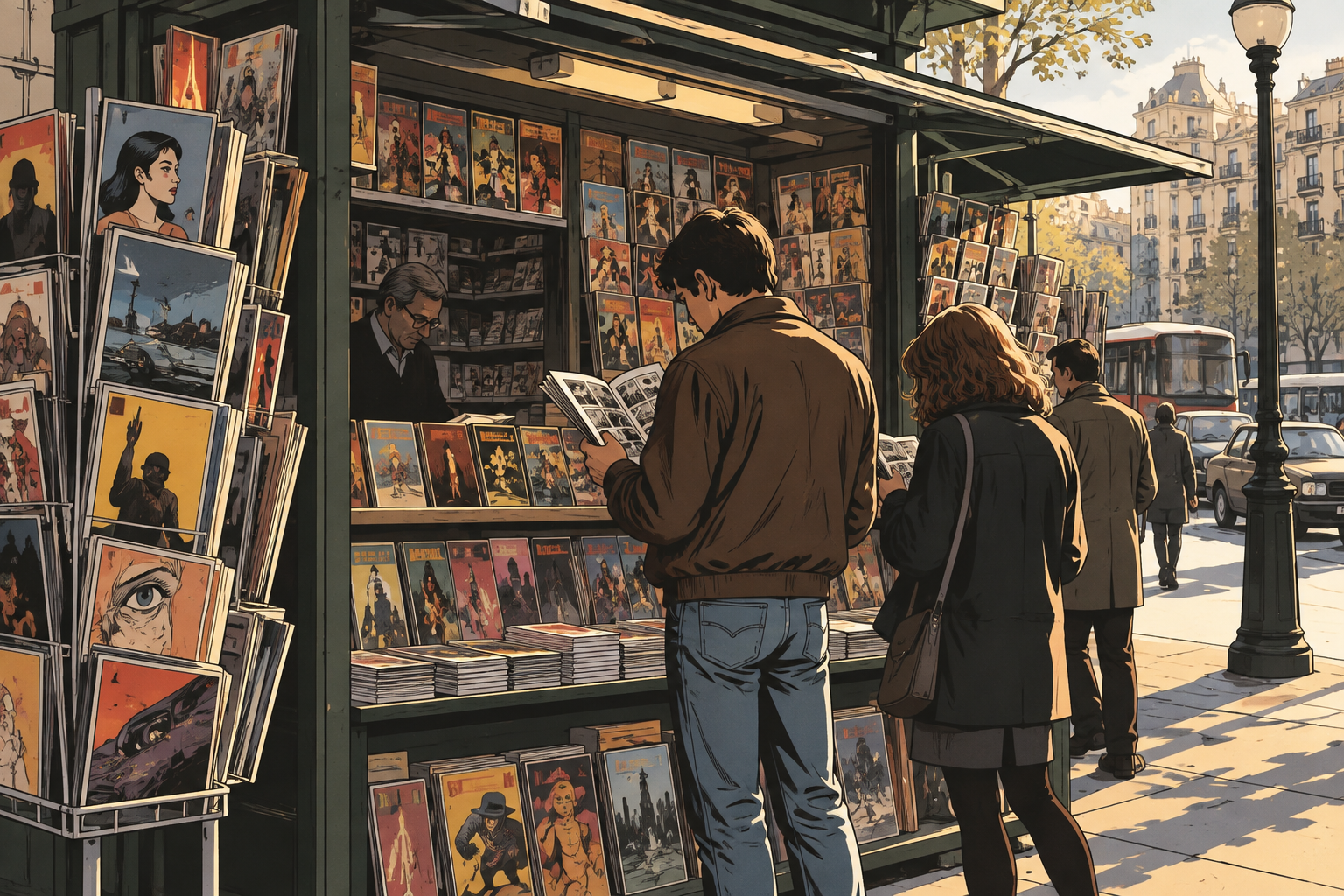
A Way of Reaching Readers
The history of comics magazines cannot be reduced to a list of titles. Periodical publishing organized a particular relationship between creators, publishers, readers, and outlets: comics reached the newsstand alongside newspapers and other publications, returned with a new installment, and allowed readers to discover artists without necessarily waiting for a book. An overview of comics magazines notes that, for much of the twentieth century, this was the most common publication format. In Spain, the story can be traced back to early titles such as Monos, but the evidence available here identifies the postwar boom in magazines as a later industrial milestone.
That long tradition should not be confused with the specific phenomenon of adult comics. “Adult” does not mean a single genre, a fixed level of quality, or a uniform audience. It is used here as a practical label for an editorial space in which work aimed beyond childhood circulated. The supplied evidence describes an especially visible expansion from the second half of the 1970s through the 1980s; it also shows that the cycle did not last indefinitely.
An Expanding Market
The available press reporting offers a useful numerical reference: between 1981 and 1990, thirty adult-comics titles reached Spanish newsstands, some long-lived and others short-lived, adding to titles that had appeared during the second half of the 1970s. The same source says that in 1981—the year of the first Salón Internacional del Cómic de Barcelona—roughly twenty adult comics were available at newsstands.
Those figures do not, by themselves, establish print runs, sales, profitability, or readership; none of those is documented in the supplied evidence. They do indicate editorial density and variety within an everyday distribution channel. The newsstand was a meeting point for novelty, continuity, and chance: a magazine might be sought for its editorial line, a particular creator, or the surprise of its contents. That final point is an interpretation of the format, not a quantified fact.
Different Tones and Models
The sources portray magazines that appeared chiefly in the 1970s and 1980s as a diverse group. They mention fantasy, experimental, underground, erotic, satirical, horror, and women’s titles. Examples named in the evidence include CIMOC, dated 1984 in a popular timeline, as well as Rambla, Cairo, Madriz, El Víbora, Totem, Kiss, El Jueves, El Papus, Creepy, and Esther.
This list should not become a closed genealogy or a claim that all these publications had the same audience, frequency, or editorial strategy. What can be verified is that they are used as examples of a scene with varied styles. That variety explains why “adult comics magazine” is too limited a label when treated as though it described one aesthetic. The format could contain sharply different registers; the reader’s experience depended on each title and each issue.
Magazines as an Access Space
A comment attributed to curator Antoni Guiral summarizes an important cultural role: the magazine format gives visibility to young artists who publish alongside already established figures. This is neither a universal rule nor a career guarantee, but it is a plausible explanation for the importance assigned to such publications. Sharing pages, contents lists, and distribution circuits could make new work visible in an environment where readers also encountered known names.
Its periodical nature matters as well. Unlike a self-contained volume, a magazine organizes successive readings and an expectation of return. This describes a basic property of periodical publishing; it does not reconstruct the habits of every Spanish reader. A more exact material history would require complete runs, distribution figures, publishing contracts, and corroborated testimony—materials absent from the evidence received.
Retreat in the 1990s
The press source describes the 1990s as a period of “extinction” for adult comics magazines and attributes the process to several factors: the consolidation of albums, declining magazine quality, exhaustion of the boom, and the arrival of the comic-book format as a vehicle for series. That list needs cautious reading. It is a journalistic attribution based on Antoni Guiral’s account, not an exhaustive causal demonstration or a title-by-title chronology.
Even so, the contrast between formats is central. If albums gained ground, the relationship between serialization, periodic purchasing, and the newsstand changed. A general source adds that, today, most anthology magazines have disappeared and that albums or the internet are the original publication format for many comics. This does not mean magazines ceased to exist altogether; it points instead to a loss of centrality compared with earlier periods.
What the Cycle Leaves Behind
The movement “from newsstand to museum,” in the phrase used by a cultural source, should not be read as a simple replacement: preserving, exhibiting, or studying comics does not reproduce the weekly circulation of a magazine. It does show institutional revaluation of the medium. In France, for instance, the Louvre is said to have created its own bande dessinée collection in 2005. This is a French case, not direct evidence about Spanish publishing, and it mainly places the story within a broader shift in cultural consideration.
On the evidence available here, the legacy of Spanish adult-comics magazines lies in concentrating a broad offer during a specific period and in serving as a platform for artists. Clear limits remain: the evidence does not establish which titles were most influential, who bought them, or when each title ended. The conclusion therefore has to remain restrained. From the late 1970s to the turn of the 1990s, the newsstand was a crucial setting for part of Spanish adult comics; afterward, the balance among formats shifted. Understanding that change requires attention both to the works and to the medium that made them findable.
- Decade
- 1980s
- Region
- Spain
- Level
- Enthusiast
- Entities
- No linked entities
Sources and references
- Historieta - Wikipedia, la enciclopedia librees.wikipedia.org · 2026-09-17
- Pasado y presente de las revistas de cómic – Jot Down Cómicscomics.jotdown.es · 2026-09-17
- Del quiosco al museo: el viaje del cómic en los últimos 40 añoswww.epe.es · 2026-09-17
- Revista de historietas - Wikipedia, la enciclopedia librees.wikipedia.org · 2026-09-17
- Timeline: Historia del cómic | Timetoastwww.timetoast.com · 2026-09-17


