A small object with a large logistics
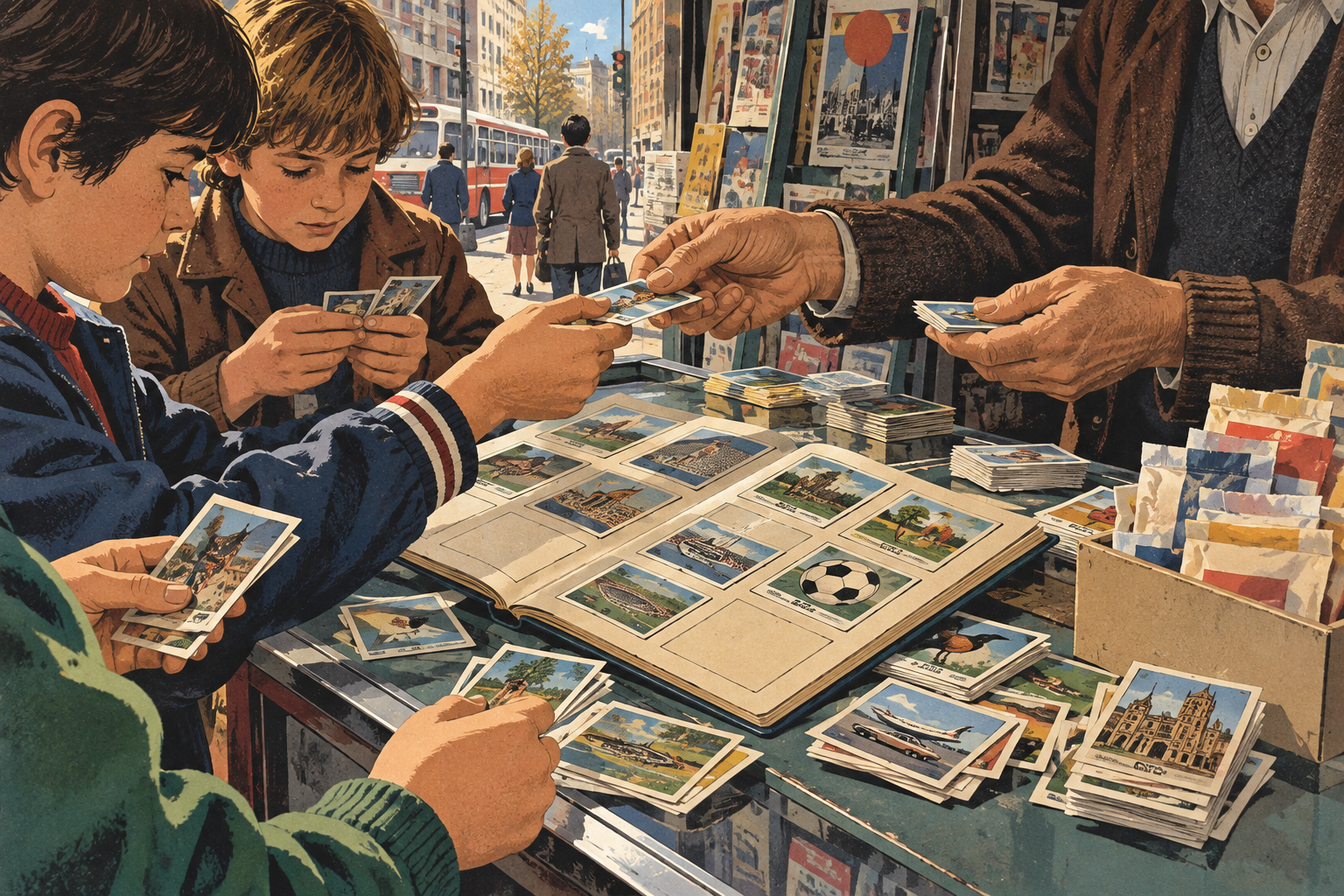
A sticker was never merely an image to paste. Its cultural force came from a whole system: a numbered series, a surface with gaps, sealed packets, duplicates, and people willing to trade. The album turned scattered pictures into a task with a visible finish; the packet introduced chance; duplicates required conversation. This is why memories of stickers often include the paper as much as the newsstand, schoolyard, or kitchen table.
The history should not be reduced to one firm or one founding date. The supplied evidence outlines a long, uneven trajectory: commercial prints attached to consumer goods, albums arriving in Spain through seaports at the end of the nineteenth century, stickers proliferating with brands in the 1920s, and post-war packets sold independently of the promoted product. It was a succession of formats and distribution channels rather than a straight line.
Before packets: printing, promotion, consumption
The Estadilla Sticker Album Museum identifies imported goods whose wrappers carried coloured figures among Spanish precedents. It also mentions matchbox phototypes and stickers associated with tobacco, stock-flavour tablets and chocolate brands in the 1920s. In this phase, the collectible image was tied to another purchase: it functioned as an incentive, gift, or advertising addition.
A source from the Museo del Juego places the appearance of chromolithography in 1837. This does not prove a uniform development for every publisher, but it helps explain how small colour prints could circulate widely before the familiar packet market existed.
The album changes the image
An album is not simply a folder. Its numbered spaces define what counts as a collection and make absence visible. A sticker matters inside a set, not only as an isolated illustration. A partly filled album therefore records purchases, successful trades, and missing pieces.
The post-war independent sale of packets, described by the Estadilla museum, changed the ritual. Children need not obtain a print only through food or household purchases. The outlet became as important as the item: a newsstand could bring together newspapers, sweets, comics, and packets. Collecting became a sequence of small purchases and a familiar pause—open, check, sort.
Duplicates: the flaw that makes sociability
Duplication is the least glamorous and most decisive part of the system. Without duplicates there is no need to trade; without trading, the album is far more solitary. “I need it,” “I have it,” and “I’ll swap it” join inventory and conversation.
In 2009, Cinco Días reported Panini’s view that stickers had social effects videogames did not directly provide. That is a company position, not a universal measurement. Yet it fits the object’s structure: completing a set requires negotiating the uncertainty created by packets. The same report described online orders of up to 40 stickers to finish a collection. The web did not eliminate the physical album; it offered another way to solve gaps.
Football, television, shared repertoires
Football gave stickers a particular regularity: squads, competitions, and seasons produce renewable lists. ABC dates the earliest LaLiga albums to the 1940s and 1950s and says Colecciones Este and Panini changed the field in the 1970s. Its account places Panini’s first LaLiga album, issued as CromoCrom, in 1979/80.
Press coverage also shows that collecting was not only about sport. Cinco Días listed Fútbol 82, Transformers, Los disfraces de Mortadelo, The Lion King, and Harry Potter and the Half-Blood Prince among Panini collections. The list does not establish the relative reach of each title, but it shows the format’s flexibility across football, television, comics, and cinema.
Preservation and its limits
Albums, loose stickers, and incomplete sets are useful but partial sources. A specialist dealer describes material from the late nineteenth century to the 1980s and 1990s, including matchbox phototypes and chocolate and tobacco prints. According to Pixartprinting, Modena’s Museo della Figurina opened in 2006 from Giuseppe Panini’s donated collection and holds more than 500,000 small prints from the nineteenth century onward. Such holdings allow stickers to be seen as graphic heritage rather than nostalgia alone.
The supplied evidence does not support estimates of print runs, sales, true rarity, or historical prices for a particular collection. Nor does it make every schoolyard exchange identical. What can be documented is a medium structured by printing, serialisation, purchase, and completion.
Conclusion
Stickers endure because they embody an incomplete promise. The album orders; the packet disrupts; the duplicate creates a relationship. From promotional inserts in consumer goods to newsstand series and online missing-sticker orders, channels changed without removing that tension. Even an unfinished album preserves its trace: a small history of images, commerce, and everyday negotiation.
- Decade
- 1970s
- Region
- Spain
- Level
- Enthusiast
- Entities
- Museum
Sources and references
- Una historia de cromos | Pixartprintingwww.pixartprinting.es · 2026-09-20
- Museo del Álbum de Cromos de la Villa de Estadillaturismosomontano.es · 2026-09-20
- Los cromos resisten el auge de las videoconsolas | Empresas | Cinco Díascincodias.elpais.com · 2026-09-20
- Cromos Y Albumes Antiguos | El Coleccionista Eclécticowww.elcoleccionistaeclectico.com · 2026-09-20
- Cromos imposibles, 'repes' y demás mitos sobre la colección de LaLigawww.abc.es · 2026-09-20
- COLECCIÓN DE JUEGOS INFANTILES: LOS CROMOSmuseodeljuego.org · 2026-09-20


