A decade that does not fit one uniform
Discussing 1970s fashion calls for an initial caution: the available sources describe broad features, not an identical wardrobe for every country, social group or person. Fashion can be understood as a changing collective taste concerning garments and accessories; it also includes clothing production and accessories. That definition helps avoid a common nostalgic trap: mistaking repeatedly circulated images for the whole experience of dressing in a decade.
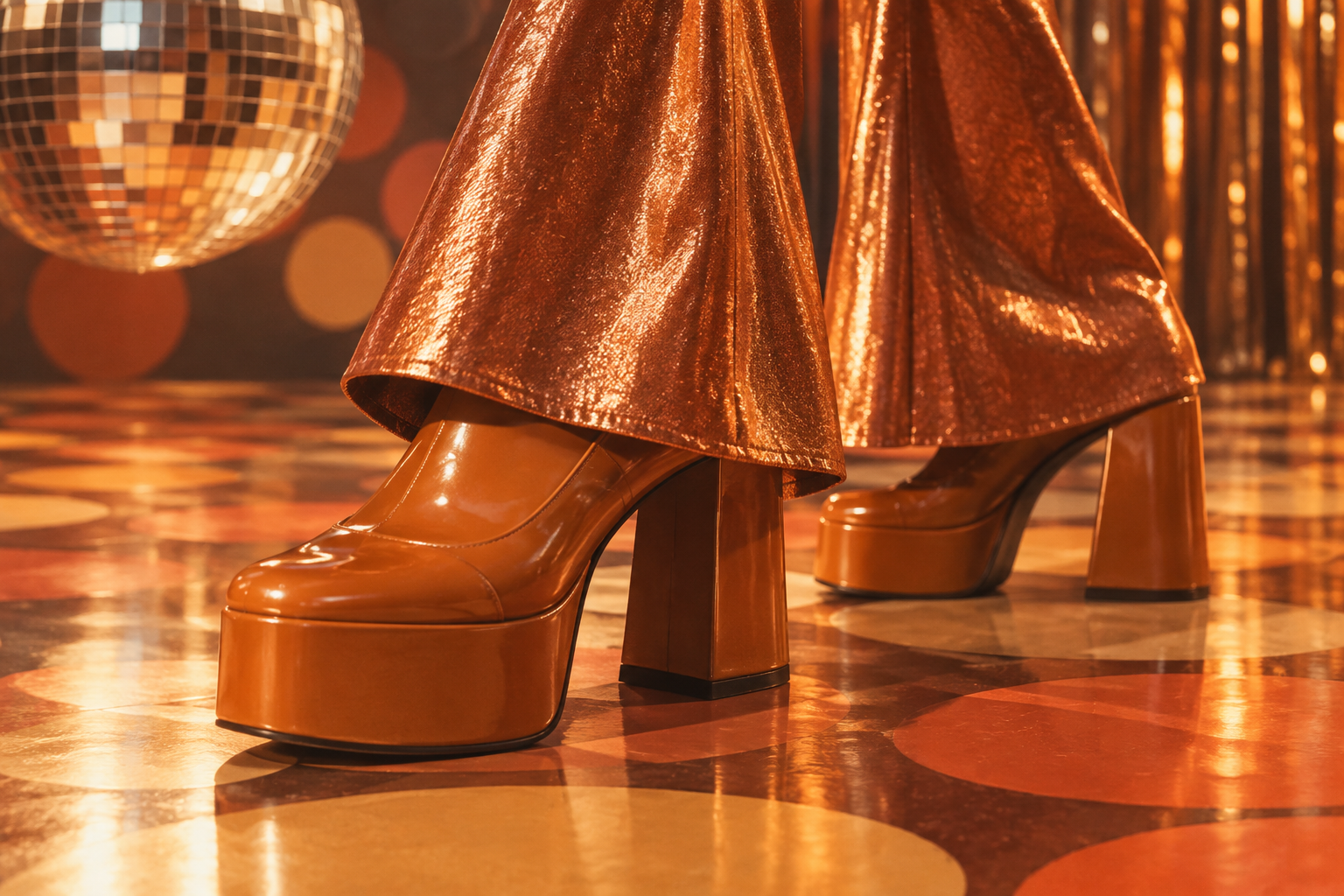
The evidence consulted identifies the 1970s with the disco era and highlights two specific elements: synthetic fabrics, including Lycra, and platform shoes. At the same time, it places the 1970s and 1980s under the signs of experimentation and diversity. These are useful starting points, but not permission to assign a precise brand, social meaning or biography to every period-looking garment.
Disco: a cultural reference, not compulsory dress
The association between the 1970s and disco is explicit in the material reviewed. Within that framework, synthetic fabrics and platforms stand out. Editorially, this matters because it allows clothing to be viewed alongside the spaces and practices that made it visible: dancing, nightlife, music and public display.
Yet “disco fashion” should not become a total synonym for “1970s fashion.” Diversity itself requires us to read it as one reference among several. A platform shoe may evoke an aesthetic repertoire associated in the sources with the dance floor; it does not prove that its wearer belonged to a particular scene or that their entire wardrobe followed it.
Materials and silhouette: what can be stated
The mention of Lycra and other synthetic fabrics makes materiality a sound focus. This is not only about colour or ornament: fabric changes drape, fit and the perceived form of a garment. Platforms, meanwhile, visibly alter height and silhouette. Together, these elements offer a concrete way to describe an aesthetic without inventing manufacturers, prices, everyday uses or measured popularity.
This material approach also shows that accessories are not incidental additions. The definitions gathered expressly include accessories within fashion. Platform footwear is therefore a suitable object through which to examine how an apparently secondary item helps construct a recognisable appearance.
Experimentation, diversity and cultural movements
Another source characterises the 1970s and 1980s through experimentation and diversity, linking cultural movements such as hippie culture and punk to clothing and tendencies including bohemian style and an androgynous look. This wording discourages a neat sequence of replacements: references may coexist, combine or circulate unevenly.
The evidence also states that hip-hop, emerging in African American and Latino communities during the 1970s, had a significant impact on urban fashion. That point matters because it moves attention beyond catwalks or parties toward communities and cultural movements. The supplied material does not, however, document particular garments, finer dates or commercial paths; those questions should remain open rather than be filled with clichés.
How to look at 1970s images and objects
Responsible reading begins by describing what is visible: material, shoe height, proportions, combinations and documented context of use. Observation should then be separated from interpretation. Saying that the sources associate platforms with disco fashion differs from claiming that a particular image depicts nightlife or a defined identity.
Museums provide a further useful reminder. Spain’s Museo del Traje presents collections of historical dress, fashion and accessories, while an exhibition by the Community of Madrid addressed the evolution of Madrid fashion from the post-war period to the 1970s through photographs and institutional objects. Preservation and display do not make one piece a complete summary of an era, but they do show that fashion can be investigated as material and social heritage.
Legacy and the verifiable limit
One source notes that fashion reuses influences from the past, a point compatible with current interest in the 1970s. Still, calling a present-day trend a “return” requires evidence in each case. What can be verified here is more modest and more useful: the 1970s are described as associated with disco, synthetics such as Lycra, platforms, experimentation and diversity; the decade also saw the emergence of hip-hop, with a significant effect on urban fashion.
The best conclusion is not a period costume. It is a method: treat garments and accessories as material objects, place them beside documented cultural references, and retain uncertainty where evidence is absent. The dance floor can be an entrance to the 1970s, but never the decade’s only room.
- Decade
- 1970s
- Region
- Global
- Level
- Introduction
- Entities
- Museo del Traje
Sources and references
- Historia de la moda - Wikipedia, la enciclopedia librees.wikipedia.org · 2026-09-22
- Así fue... Exposición: En Madrid. Una historia de la moda, 1940-1970 | Comunidad de Madridwww.comunidad.madrid · 2026-09-22
- Historia de la moda: del origen a la actualidad | CEACwww.ceac.es · 2026-09-22
- Moda e indumentaria - Museo del Traje | Ministerio de Culturawww.cultura.gob.es · 2026-09-22
- Todo sobre la historia de la moda y su evoluciónaudaces.com · 2026-09-22
- Historia de la moda: origen y evolución a lo largo del tiempo - Diario Librewww.diariolibre.com · 2026-09-22


