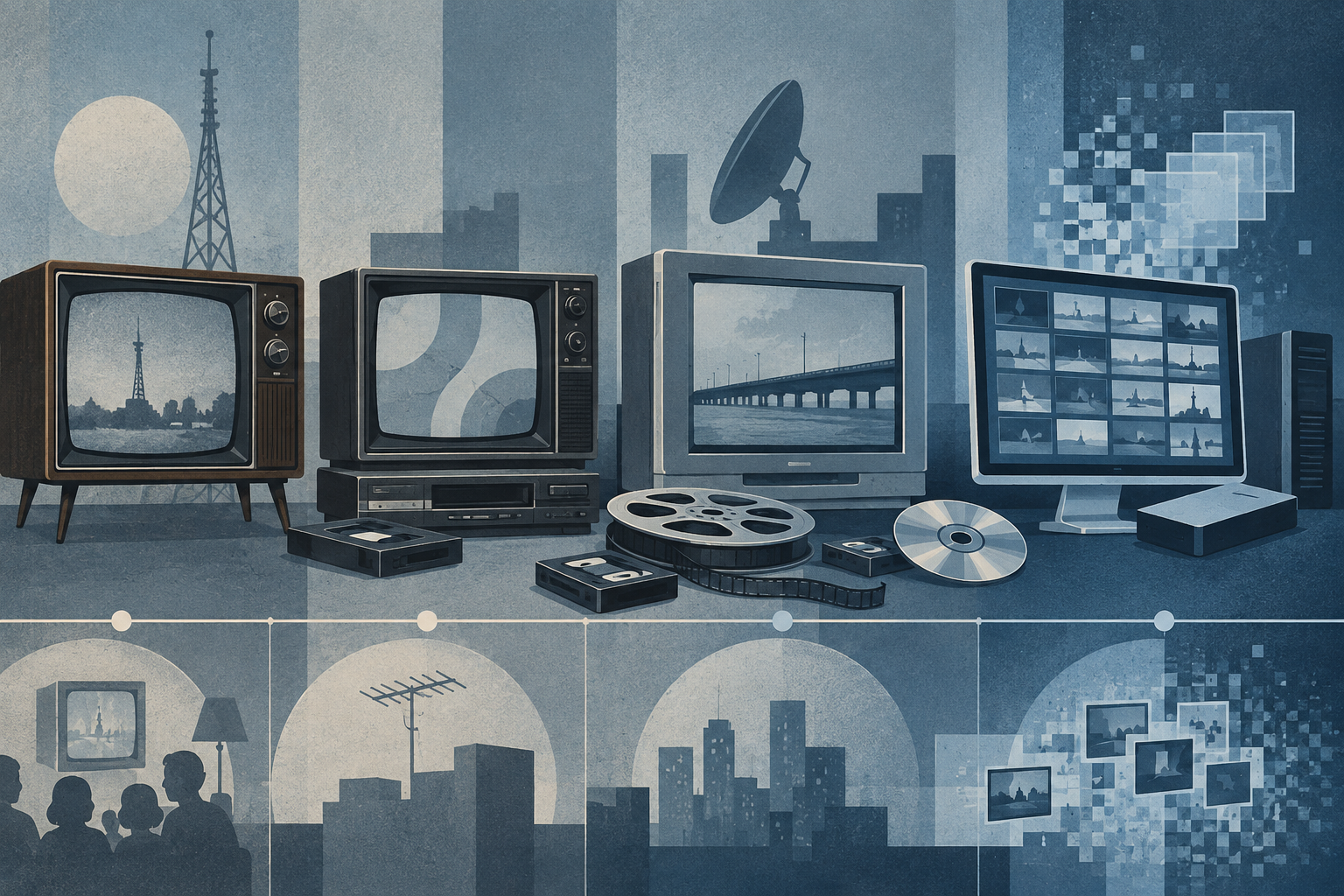
A period that does not fit a single story
From 1970 to 2009, Spanish television underwent far-reaching cultural and technical changes. The sources assembled for this article support that broad conclusion, but they do not justify an exhaustive timeline of channels, ratings, premieres or corporate decisions. That limit matters: responsible history does not fill gaps with shared memories.
El Mundo presents forty years of television in Spain through the 1970s, 1980s, 1990s and 2000s. This structure is useful because it stresses that the medium was not static: its relationship with daily life, consumption and viewers’ expectations changed. Academic work from the University of Seville places the historical study of Spanish television within the wider span of 1956-2006. Together, those perspectives make 1970-2009 a period of transition rather than a uniform block.
1970: television, memory and political context
The available sources present the 1970s as inseparable from Spain’s political and social context. RTVE’s audiovisual archive has been studied academically, and the supplied material mentions programmes connected with television representations of Francoism, including broadcasts from 1970 and 1971. This does not describe all programming, but it does confirm that television and political power belong in the same field of analysis.
Television also preserved entertainment formats that now provide routes into the past. RTVE identifies Galas del sábado as a variety programme broadcast from 1968 to 1970, directed by Fernando García de la Vega and presented by Joaquín Prat and Laura Valenzuela. Its archival presence shows that television history is not only the history of news or technology. Genres, credits, presenters and later access to broadcasts are audiovisual heritage too.
From the 1970s to the 1980s: a domestic experience
El Mundo describes the four decades as television that changed everyday life. That claim should be treated as an interpretive frame, not a precise measurement of social effects. Still, it is reasonable to see the television set as a domestic and collective focal point: its importance lies in both what it broadcast and the routines formed around the screen.
The available evidence does not establish which set was dominant in every home or assign a single date to each technological change. It does state that the arrival of colour was regarded by the ETSIT Museum at the Universitat Politècnica de València as a major milestone because it made television images closer to reality. Colour was not merely technical; it altered the appearance of sets, costumes, advertising and broadcasts, as well as viewers’ visual expectations.
The 1990s: more layers for interpreting the medium
University documentation on Spanish television includes research on its origins and development, with a section on digital satellite television in the international context from 1994 to 2003. The existence of that scholarly field confirms that, in the 1990s, television could no longer be understood solely through traditional terrestrial broadcasting. It was increasingly tied to infrastructures, distribution systems and digital technologies.
A rigorous timeline must nevertheless avoid turning that academic heading into an unsupported list of launches, operators or access conditions. The supplied sources do not provide those specifics. What can be verified is narrower, and valuable: digital satellite television forms part of the historical framework studied for 1994-2003.
The 2000s: from broadcast programme to accessible object
The clearest change visible from the present is the way television’s past can be approached. RTVE Play describes its Historical Archive as a place for programmes, series, films, podcasts and news, and offers access to the Televisión Española archive through streaming. That present-day availability should not be projected back onto 2009. Yet it changes retrospective research: material once tied to a particular broadcast can be watched again, identified and compared.
The general account of technological evolution in the evidence also describes a shift from videotape machines to computer video servers, and from physical archives to hard drives and data tapes. It highlights metadata and layered storage. Preserving television, then, is not only about keeping images; it requires describing, locating and retrieving them.
The archive does not replace context
Access to a programme does not automatically explain it. A clip may preserve image and sound while losing its schedule, reception, production circumstances or surrounding continuity. Audiovisual archives therefore need historical scholarship, press sources and institutional documentation. Research on half a century of Spanish television and RTVE’s accessible holdings are complementary: one supplies historiographical perspective, the other brings material and programme descriptions closer.
The supplied sources cannot certify what survives for every year from 1970 to 2009, which versions remain available, or which preservation processes were applied to each item. That absence does not invalidate the account; it honestly defines its scope.
Conclusion: television as changing heritage
This timeline can be read as a movement from television closely bound to domestic experience and historical context toward an ecosystem where digitisation and archival access matter more visibly. Colour is a recognised technical milestone; academic research demonstrates the breadth of the historical field; and RTVE Play shows how television heritage can circulate again.
The lesson is not that every television past is available or every memory verifiable. It is that television should be considered material culture, programming, technology and archive at once. That approach keeps curiosity alive without mistaking it for certainty.
- Decade
- 1970s
- Region
- Other regions
- Level
- Advanced restoration
- Entities
- No linked entities
Sources and references
- Historia y evolución de 40 años de televisión en España | EL MUNDOlab.elmundo.es · 2026-09-17
- medio siglo de televisión en españa (1956-2006).idus.us.es · 2026-09-17
- Televisión – Museo ETSITmuseotelecomvlc.webs.upv.es · 2026-09-17
- El archivo audiovisual de RTVE. Programas emitidos entre ...revistas.ucm.es · 2026-09-17
- Archivo Histórico - Programa de adquisiciones en RTVE Playrtve.es · 2026-09-17
- Archivo de Televisión Española | Ver en RTVE Playwww.rtve.es · 2026-09-17


