A change that is not immediately visible
Restoration is often associated with a visible result: a recovered painting, a reopened gallery, or a building welcoming visitors again. Yet the institutional sources available for this period point to another, less spectacular and more lasting change: the move toward a practice that needs to leave a record of its decisions.
The National Library of Spain places the 1960s and 1970s in a period when documentary practice in museums was virtually non-existent. This does not mean that restorers or interventions did not exist, but it does impose a limit: some earlier work may be difficult to reconstruct when reports, images, or technical records are missing.
The Prado and a specific collaboration
The Museo Nacional del Prado records a precise collaboration in 1970 and 1971. For the opening of the Casón del Buen Retiro, Amalia de Escauriaza, a restorer from the Restoration Institute, worked on a substantial number of nineteenth-century paintings.
The value of this information lies in its specificity. It does not describe a complete trend for every Spanish museum, but it shows that cooperation between the Prado and specialist Institute staff formed part of collection work at that time. It also reminds us that a museum opening could involve prior work on the objects to be displayed.
Training and professional awareness
The National Archaeological Museum presents a conservation-restoration route created with Madrid’s Higher School of Conservation and Restoration of Cultural Property to mark the fiftieth anniversary of the school’s creation, dated 1969–2019. The very existence of this institutional route links collection history to specialist training.
It is important not to infer more than the source states. The available material does not detail curricula or procedures for each decade. It does, however, allow 1969 to be treated as a reference point for a fifty-year trajectory of teaching and professional reflection in the field.
Documenting in order to understand intervention
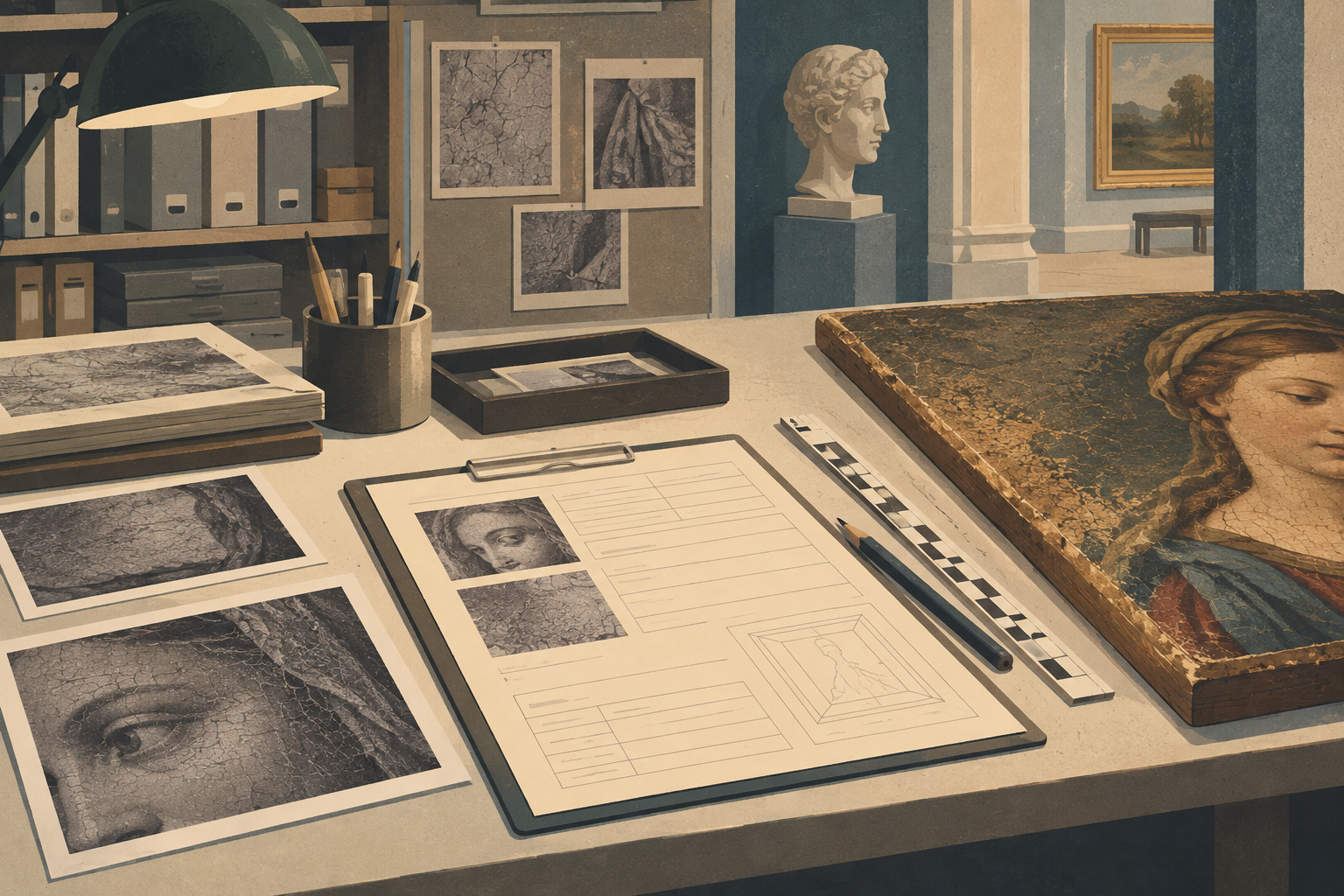
The National Library explains that newer working guidelines aim to address the lack of documentation from earlier periods. It also describes a documentary corpus made up of written records, photographs, and other materials. This perspective changes the meaning of restoration itself: the outcome is not only a stabilised object or recovered room, but also a body of evidence that helps explain what was done and in what context.
Documentation serves both retrospective and future purposes. It can help study earlier decisions, while providing a starting point for later research or intervention. The source does not prescribe a single method, but it does present documentation as part of contemporary methodology.
Museo Cerralbo: recovering the atmosphere as well
The Museo Cerralbo’s space-recovery project, begun in 2002, expands the scale of the question. Spain’s Ministry of Culture describes the setting as a historical-artistic value worth recovering because it reflects collecting interests, social uses, and ways of life of part of nineteenth-century society.
The project drew on historical documentation and on recovery, conservation, and restoration tasks coordinated among historians, restorers, and professionals from several trades. Its work included galleries completed in 2006, the Great Portal in 2007, and spaces including the Armoury, Drawing Corridor, and Bathroom Room, completed at the end of 2009.
What can—and cannot—be claimed
These sources do not support a total history of restoration from 1970 to 2009. They are examples from Spanish institutions and cover different scales: nineteenth-century paintings, training and museum interpretation, documentation, and the recovery of historic interiors.
Read together, however, they show a verifiable transformation: intervention no longer means only acting materially upon an item. It also entails recording, research, coordinated knowledge, and attention to the setting in which an object gains meaning. That documentary legacy may be restoration’s least visible element, and one of its most useful for the future.
- Decade
- 1970s
- Region
- Spain
- Level
- Enthusiast
- Entities
- Museo Cerralbo, Museum
Sources and references
- Historia de la restauración de arte en España | Arte Restauraciónarte-restauracion.es · 2026-09-21
- Restauración en el Museo del Prado. - Museo Nacional del Pradowww.museodelprado.es · 2026-09-21
- Recuperación de espacios - Museo Cerralbo | Ministerio de Culturawww.cultura.gob.es · 2026-09-21
- Historia de la conservación-restauración (en el MAN) - | Ministerio de Culturawww.man.es · 2026-09-21
- Documentando la restauración… pasado, presente y futuro | Biblioteca Nacional de Españawww.bne.es · 2026-09-21


