A professional change visible in records
Museum restoration is not limited to acting on a work of art or an object. It also involves deciding what is preserved, what information is recorded, and how the result is presented to the public. The available material on Spanish institutions points to an important transformation between 1970 and 2009: intervention ceased to appear merely as an isolated event and became part, at least in some projects, of a framework involving research, conservation, professional coordination and museum interpretation.
This should not be turned into a straightforward story of progress. Spain’s National Library notes that documentary practice in museums was practically non-existent during the 1960s and 1970s. That gap matters because it limits what can now be known about earlier treatments. A restoration without an adequate record may have altered an object, yet it makes its decisions, materials and scope difficult to reconstruct. The issue is not simply administrative; it shapes historical interpretation.
The Prado and institutional collaboration
The Museo del Prado records that technicians from the Restoration Institute worked with the museum, after having previously collaborated through the Ministry of Public Instruction. Around the opening of the Casón del Buen Retiro, restorer Amalia de Escauriaza treated a considerable number of nineteenth-century paintings in 1970 and 1971.
The information is specific, but it does not justify generalising methods or outcomes across all those paintings. It does, however, establish a relevant point: restoration was undertaken through collaboration between institutions and specialists. Read alongside the National Library’s account of limited documentation in those decades, this case calls for a distinction between the existence of specialised work and the uneven extent to which that work was recorded for later study.
Documentation is not an afterthought
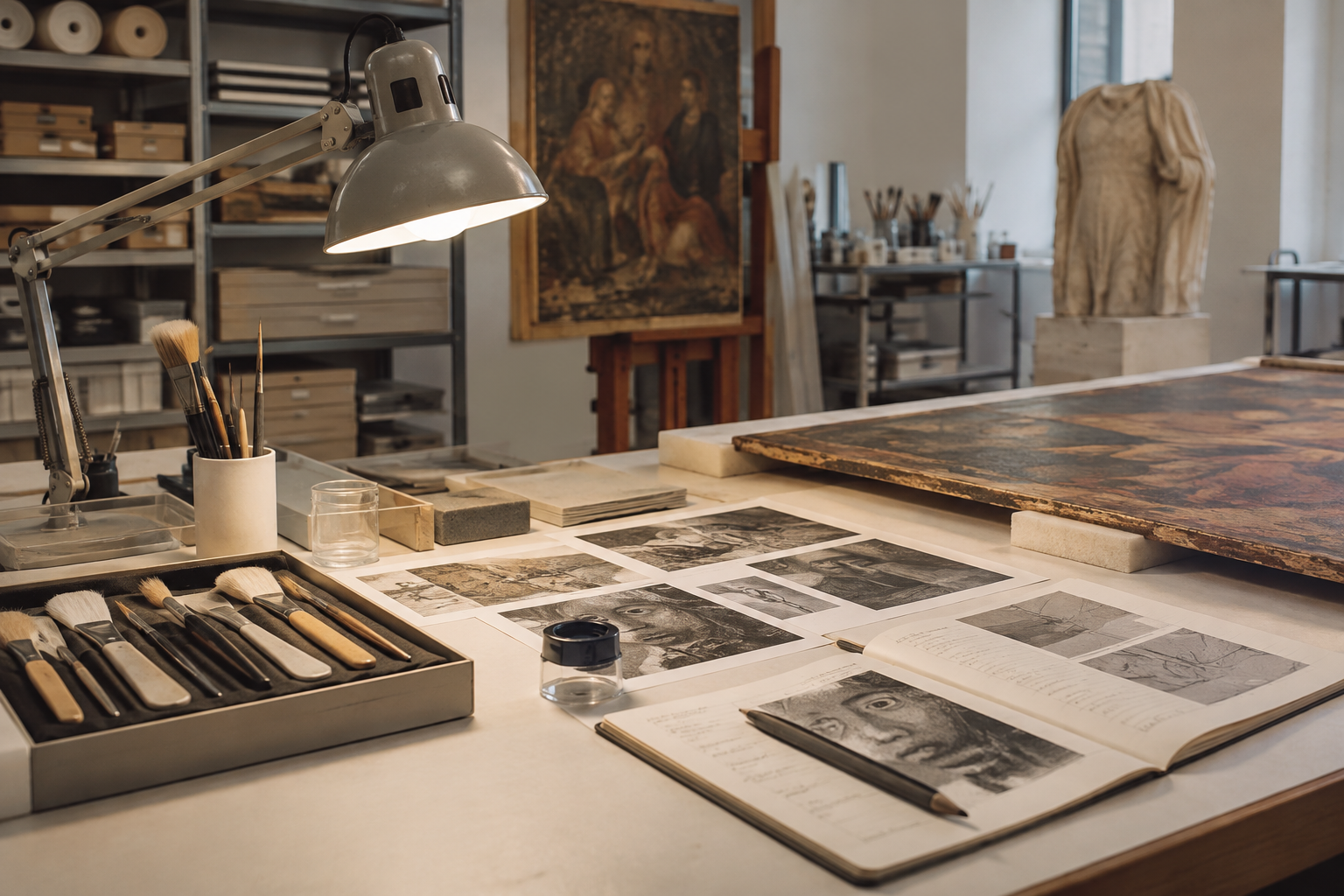
The National Library’s reflection traces a path from the documentary scarcity of the 1960s and 1970s to working methods intended to address, as far as possible, that absence. It refers to a body of written and photographic materials, among other records. This changes the emphasis: restoring cannot be understood only as physically altering a piece.
Documentation creates a memory of treatment. It can connect an object’s condition with decisions made, preserve process images and support later reassessment. It cannot remove the uncertainty surrounding older work, but it offers a way not to reproduce it. Much of this labour remains unseen by visitors; for a museum, it is a condition for continuity of knowledge.
Recovering a house, not only its objects
The Museo Cerralbo’s project for recovering its spaces reveals a different scale of restoration. Spain’s Ministry of Culture explains that, from 2002, it addressed interiors considered historical and artistic values: evidence of collecting, taste, social practices and ways of life among part of nineteenth-century society. This matters because the subject was not an isolated item, but the relationship among architecture, decoration, furnishings and visitor route.
The project required historical documentation and coordination among historians, restorers and practitioners of many trades. It also unfolded in phases: library work took place in 2002; gallery work in 2006; and work in the Grand Entrance, Office and other spaces between 2007 and 2009. Earlier structural works, completed in 1993, had addressed matters including floors, roofs, electrical installation and air conditioning. The sequence shows that preserving a historic museum requires balancing its building, collections and public use.
Training, critical reading and limits
The National Archaeological Museum’s conservation-restoration route was created with Madrid’s Higher School of Conservation and Restoration of Cultural Heritage for the school’s 1969–2019 fiftieth anniversary. This confirms the importance of specialised training within the sector’s recent history. It also offers a methodological warning: the history of restoration has to be examined through particular collections, not merely through general principles.
The available sources do not provide a complete register of techniques, budgets, files or criteria used in every intervention from 1970 to 2009. They do not show that every Spanish museum worked in the same way either. What can be verified is narrower but meaningful: technical collaboration at the Prado; recognition of museum documentation as a necessity in response to earlier gaps; and projects such as Cerralbo joining material recovery, research and museum display.
A legacy of method
The key legacy of the period is neither a single technique nor one celebrated restoration. It is a broader understanding of institutional responsibility. A painting, piece of furniture, sheet of paper, room and building raise different questions, but share one demand: present decisions must remain understandable to those who will care for them later.
From Amalia de Escauriaza’s work around 1970–71 to Cerralbo’s phases at the end of the 2000s, there is evidence of a move towards more interdisciplinary projects and greater awareness of documentary trace. This is not an absolute conclusion about the entire country, but a reading grounded in published institutional cases. That is precisely its value: it restores restoration to its proper place between material care, research and the making of public memory.
- Decade
- 1970s
- Region
- Spain
- Level
- Enthusiast
- Entities
- Museo Cerralbo, Museum
Sources and references
- Historia de la restauración de arte en España | Arte Restauraciónarte-restauracion.es · 2026-09-22
- Restauración en el Museo del Prado. - Museo Nacional del Pradowww.museodelprado.es · 2026-09-22
- Recuperación de espacios - Museo Cerralbo | Ministerio de Culturawww.cultura.gob.es · 2026-09-22
- Historia de la conservación-restauración (en el MAN) - | Ministerio de Culturawww.man.es · 2026-09-22
- Documentando la restauración… pasado, presente y futuro | Biblioteca Nacional de Españawww.bne.es · 2026-09-22


