Restoration also means leaving a record
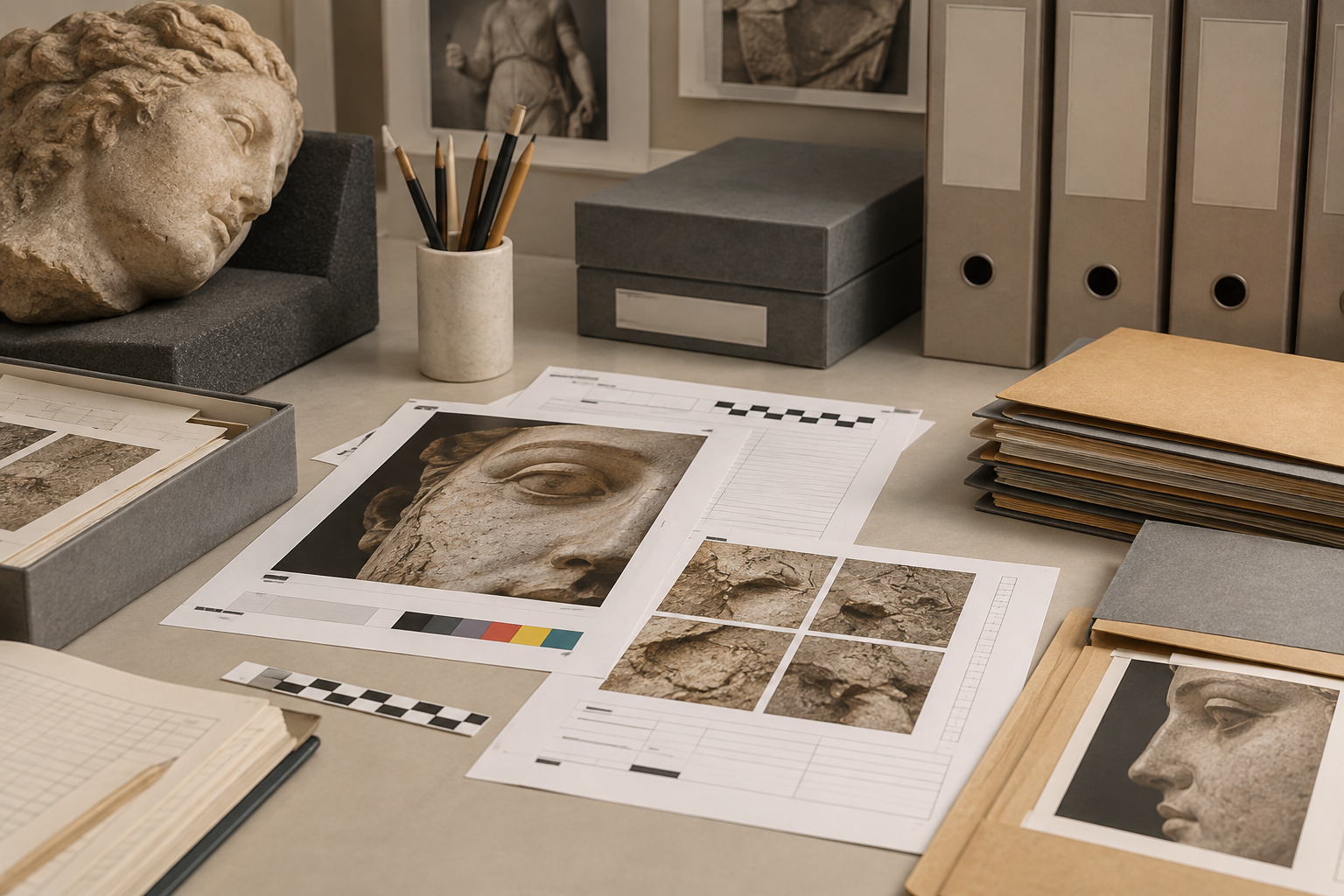
A restoration does not necessarily end when an object returns to a gallery, a display case or storage. For a museum, the process also produces a second, less visible work: the record that makes it possible to know what was observed, what was done and on what grounds each decision was made. That trace matters when an object is studied again, lent, found to have changed materially, or requires further treatment.
The available information from Spanish institutions provides a careful framework for this question between 1969 and 2009. It does not describe a uniform evolution for every museum, nor does it justify claiming that one date immediately replaced one working method with another. It does bring together several indications: the creation in 1969 of Madrid’s Escuela Superior de Conservación y Restauración de Bienes Culturales; the collaboration of restoration institute staff with the Prado in the early 1970s; the identification of museum documentation as practically non-existent in the 1960s and 1970s; and, in the 2000s, projects presenting historical research, conservation, restoration and museographic renewal as connected tasks.
1969 as an institutional reference, not an absolute border
The National Archaeological Museum states that its conservation-restoration route was created with Madrid’s Escuela Superior de Conservación y Restauración de Bienes Culturales for the fiftieth anniversary of the school’s creation, dated 1969–2019. This places a clear institutional reference within the period. A training institution alone does not summarize the practices of every professional, but it shows that conservation-restoration was taught and discussed in a specialized setting.
An overly automatic reading should be avoided. A school does not make every intervention identical, nor does it prove how every case was filed. Its relevance lies in marking a professional environment through which methods, vocabulary and criteria could circulate. It also invites us to treat restoration as both an intellectual and material discipline: examining an object, treating it and recording what was done are separate, though connected, problems.
The Prado and work dated 1970 and 1971
The Museo Nacional del Prado encyclopedia documents a specific case. In preparation for the opening of the Casón del Buen Retiro, restorer Amalia de Escauriaza worked on a considerable number of nineteenth-century paintings in 1970 and 1971. The same entry says that technicians from the Instituto de Restauración began to collaborate with the Prado, after earlier collaborations by technicians from the Ministry of Public Instruction.
The value of this testimony lies in its limited precision. It supports stating that this collaboration existed and that Escauriaza treated works in those two years. From the available text, however, it does not support reconstructing techniques, materials, the exact number of paintings, the outcome of each treatment or the contents of her reports. The distinction matters: responsible writing does not fill archival gaps with plausible but undocumented procedures.
Even so, the case illustrates a central issue. Restoration in a major museum is not merely an isolated action on a painting; it is embedded in the opening of spaces, institutional responsibilities and professional collaboration. When that work is identified by an institution, its traceability increases, even if readers do not have every technical document before them.
Documentary absence as historical evidence
Spain’s National Library presents restoration documentation as a historical problem. Its text describes the 1960s and 1970s as decades in which documentation in museums was practically non-existent, contrasting that condition with later methodologies. It also notes that a museum’s documentary corpus can include written records, photographs and other materials.
This observation changes the question. Where a record is incomplete, it is not always possible to say with certainty what was done to an object decades ago. Missing information is not an invitation to guess; it is a condition affecting research, assessment of condition and present-day decisions. It also explains why photographs, working notes and reports matter: they are not decorative additions to treatment, but tools that make it intelligible over time.
Calling documentation “practically non-existent” does not mean that there were never papers, photographs or professional memory. The National Library’s wording should retain its scope: it identifies a broad shortfall and a methodological contrast, not an absolute absence demonstrated for every museum and every restorer.
The Cerralbo Museum: recovering spaces as well as objects
The Cerralbo Museum’s space-recovery project shows how, from 2002, restoration could form part of a wider operation. The museum explains that it regarded the historic-artistic environment as worthy of recovery because it reflected collecting, taste, social uses and ways of life. It also states that the project required historical documentation and the coordination of historians, restorers and professionals from numerous trades.
Its published chronology is particularly useful. After architectural works completed in 1993, the project addressed museographic renewal. Work on the three galleries was completed in 2006; in 2007 the Gran Portal was finished and work began in the Study and Library. The Library had already received work in 2002 on wall paper and the shelving of the upper floor. In 2008, work took place in the Armoury, the Drawing Corridor and the Bathroom Room, completed at the end of 2009.
Here, restoring does not simply mean making an object look brighter. The project’s own approach joins architecture, installation, atmosphere, research and public circulation. The lesson is useful for any reading of historic interiors: a room can simultaneously be an architectural container, an ensemble of objects and a museographic argument.
What can be verified—and what must remain open
These sources support a bounded account: there is an institutional reference point in 1969; the Prado records Amalia de Escauriaza’s work in 1970 and 1971; the National Library identifies a documentary deficit in the 1960s and 1970s; and Cerralbo provides a specific chronology of recovery work in the 2000s. They also show that institutions do not reduce restoration to a single technical gesture.
They do not, however, support a complete national chronology, a single standard for Spain, or a comparative assessment of the treatments mentioned. Nor do they allow the Prado or Cerralbo projects to be turned automatically into models for other museums. Institutional pages serve here as anchors, not as substitutes for intervention files, treatment reports or full technical studies.
Conclusion: material memory needs written memory
Between 1969 and 2009, restoration appears in these sources as a field in which the object and its record became increasingly connected. Specialized training, inter-institutional collaboration, awareness of older documentary gaps and comprehensive recovery projects point to the same need: conserving is not only acting on matter, but making the history of that action readable.
This conclusion does not erase uncertainty. It proposes a way to work with it. When documentation is missing, the limit should be stated. When it exists, it should be treated as part of the process’s heritage. The record then ceases to be merely archival: it becomes essential for future generations to understand, debate and, if needed, intervene with greater knowledge.
- Decade
- 1970s
- Region
- Spain
- Level
- Enthusiast
- Entities
- Museo Cerralbo, Museum
Sources and references
- Historia de la restauración de arte en España | Arte Restauraciónarte-restauracion.es · 2026-09-20
- Restauración en el Museo del Prado. - Museo Nacional del Pradowww.museodelprado.es · 2026-09-20
- Recuperación de espacios - Museo Cerralbo | Ministerio de Culturawww.cultura.gob.es · 2026-09-20
- Historia de la conservación-restauración (en el MAN) - | Ministerio de Culturawww.man.es · 2026-09-20
- Documentando la restauración… pasado, presente y futuro | Biblioteca Nacional de Españawww.bne.es · 2026-09-20


