A medium that exceeds the domestic set
The history of Spanish television cannot be reduced to the television set that occupied a place in the home. It is also a history of produced and transmitted images, of habits tied to scheduling, and, over time, of material that can be searched for again. The evidence assembled places the historical study of the medium within a broad frame, from 1956 to 2006, while a journalistic review proposes the 1970s, 1980s, 1990s, and 2000s as distinct decades. That arc helps organise the subject, although it cannot replace a complete chronology.
A methodological caution is necessary from the outset. The available documents do not allow every channel to be listed, audiences to be reconstructed, or the experiences of all households to be described equally. Nor do they justify a single national narrative as though access and use had been identical. They do, however, make it possible to identify three inseparable dimensions: television as cultural practice, the technical evolution of the image, and the later preservation of broadcasts.
The 1970s and the idea of a shared experience
El Mundo’s review describes 1970s television as something that changed life and remained in memory. That wording is not a universal measurement, but it points to a relevant cultural question: the screen could organise common content and common schedules. In an experience based on broadcast transmission, the time of viewing was part of the programme itself. Television was not merely a work or a piece of information; it was also its appearance at a particular time.
Speaking of shared memory nevertheless requires precision. It does not mean that everyone watched the same thing, or that every programme carried the same meaning for different audiences. It means that television offers a starting point for studying conversations, recollections, and repertoires of images associated with an era. Its cultural importance lies both in what it showed and in the possibility that broadcasts became embedded in everyday life.
The arrival of colour as material change
The ETSIT Museum at the Universitat Politècnica de València identifies the arrival of colour as a major milestone in television’s development because it offered images closer to reality. The statement matters because it shifts attention from content to the material condition of experience. Altering the image also alters the viewer’s relationship with the screen: colour is not a decorative detail, but a change in how the world is visually presented.
That milestone should not be turned into a total explanation. Colour alone does not establish which content was watched most, who could access it, or what effects it had on social life. It does, however, support the view that television history includes changes in the medium’s sensory language. Production, transmission, reception, and memory are connected to the quality and appearance of the images available.
Decades as a way to read prolonged change
The separation of the 1970s, 1980s, 1990s, and 2000s in the journalistic review is a tool for reading history, not an absolute set of boundaries. It helps avoid the idea of an unchanging television over forty years and recalls that the medium underwent successive transformations. The historiographical frame of 1956 to 2006 reinforces the need to think in long processes, in which each period must be situated before conclusions are drawn.
The supplied evidence does not allow a definitive list of innovations, dominant genres, or shifts in viewing to be assigned to each decade. The value of this periodisation is more restrained: it makes questions possible. What endured from habits linked to broadcast schedules? How did technical changes affect perception? How does the current availability of archives alter the relationship with programmes that once seemed ephemeral? These questions connect the history of the medium to its documentary present.
From broadcast flow to searchable archive
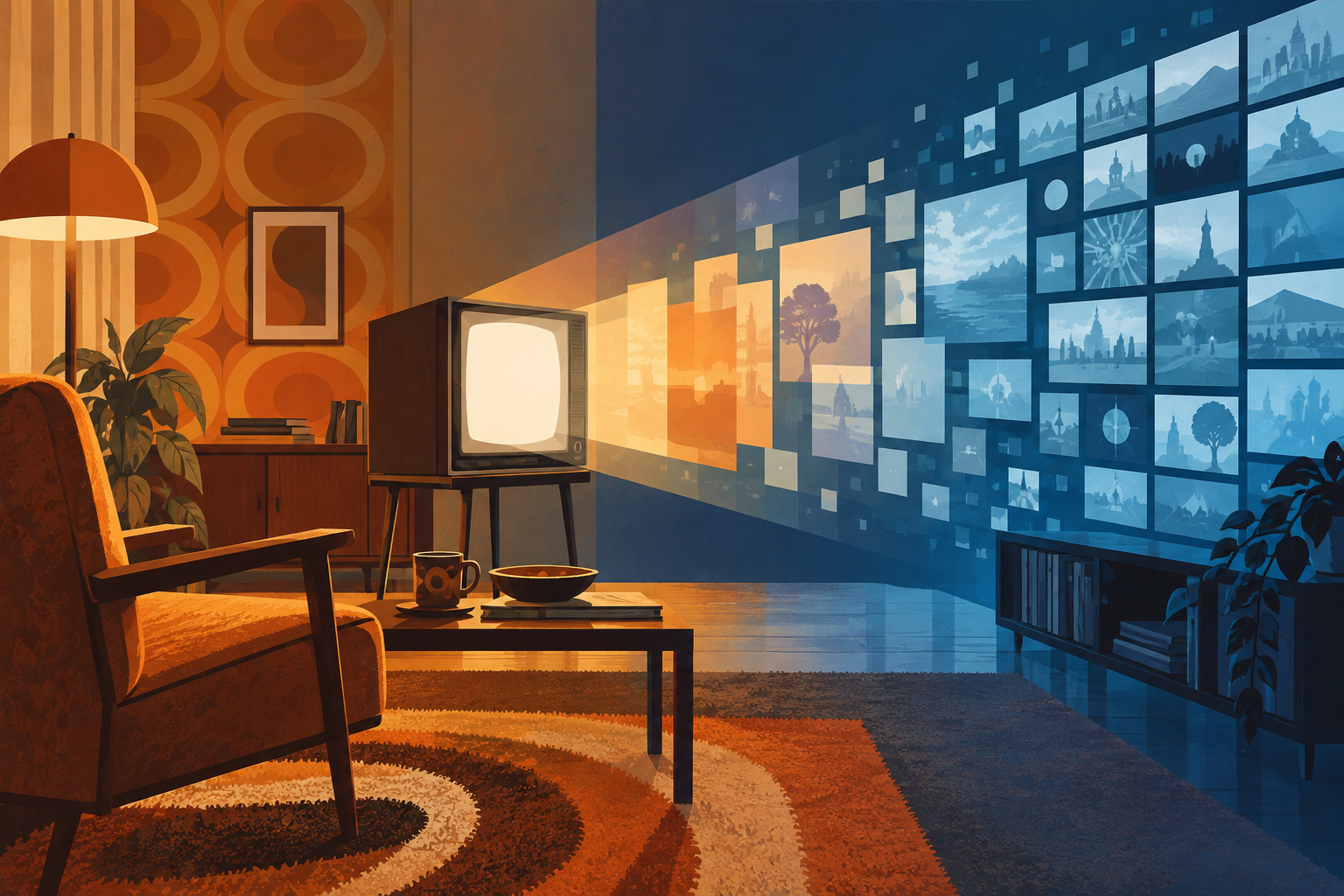
RTVE presents its Historical Archive on RTVE Play as a free-access space for programmes, series, films, podcasts, and news. Its television archive organised by decades also announces the streaming availability of older content. This change concretely modifies the cultural status of broadcasting: material designed to circulate in a temporal flow can be located and played again.
Research on RTVE’s audiovisual archive further shows that programmes broadcast in 1970 and 1971 can form part of corpora for historical analysis. That possibility matters because it turns television into a source that can be revisited, compared, and contextualised. An archive is not equivalent to the whole past. It preserves particular material and presents it through choices of selection, description, and access. Even so, it provides a decisive documentary basis alongside memory, which without such traces would depend on recollection alone.
Legacy, limits, and a verifiable conclusion
The legacy visible in this evidence is not confined to individual titles or nostalgia for the screen. It lies in television’s consolidation as a cultural and documentary object: a medium whose images took part in everyday life and whose broadcasts can be examined again when they have been preserved. The coexistence of university research, a technical museum, and an institutional archive shows that its history requires attention to technology, practices, and documents at once.
The limits matter just as much. No exhaustive chronology can be established here; neither audiences quantified, all distribution models explained, nor the reception of each generation reconstructed. The firm conclusion is narrower: between the 1970s and the 2000s, Spanish television can be studied as a medium undergoing technical and cultural transformation, and as heritage whose digital consultation changes the way past images and broadcasts can be revisited.
- Decade
- 1970s
- Region
- Spain
- Level
- Introduction
- Entities
- No linked entities
Sources and references
- Historia y evolución de 40 años de televisión en España | EL MUNDOlab.elmundo.es · 2026-09-18
- medio siglo de televisión en españa (1956-2006).idus.us.es · 2026-09-18
- Televisión – Museo ETSITmuseotelecomvlc.webs.upv.es · 2026-09-18
- El archivo audiovisual de RTVE. Programas emitidos entre ...revistas.ucm.es · 2026-09-18
- Archivo Histórico - Programa de adquisiciones en RTVE Playrtve.es · 2026-09-18
- Archivo de Televisión Española | Ver en RTVE Playrtve.es · 2026-09-18


