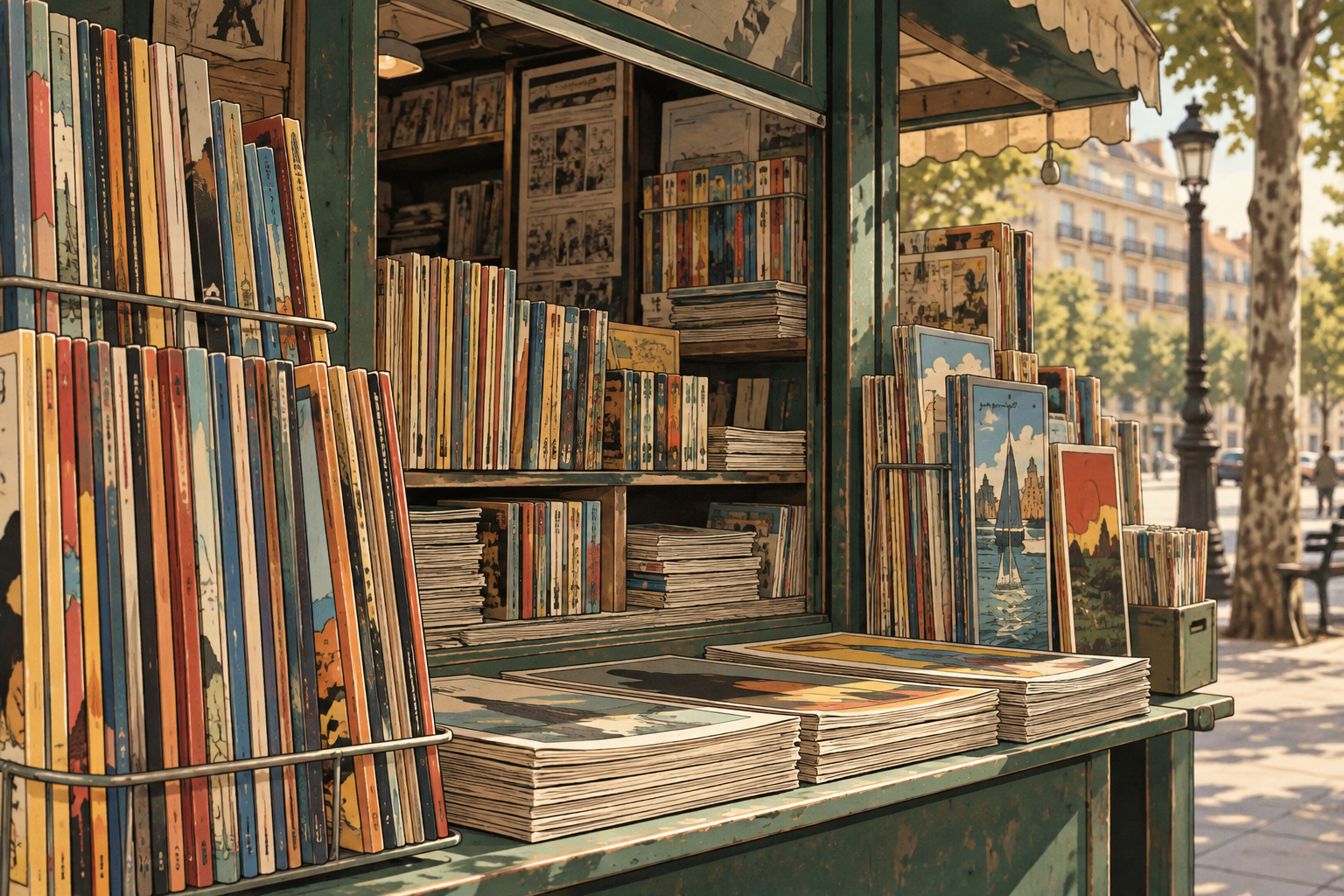
An editorial object, not mere packaging
For much of the twentieth century, the comics magazine was one of the most common ways of publishing comics. The definition matters: it is not simply an album, nor any illustrated book, but a periodical that gathers comics. Its periodicity shaped the relationship between readers, works, and retail outlets. An issue did not arrive as a self-contained volume, but as part of a rhythm: a new number, a new selection, and often the continuation of something previously read.
Nostalgia should not flatten that history. The format was not identical across countries, publishers, or decades. Nor did every magazine contain comics alone. Recent research on Spanish publishing stresses the need to distinguish commercial comics from other publications that include comics. That caution is useful: “the comics magazine” names a family of editorial objects, not a uniform item.
Serialization as a reading practice
Alberto Albarrán’s historical overview recalls a decisive practice: at certain times, a comic could appear in chapters in magazines and later be collected in an album or graphic novel. That sequence changes the experience. Serialized reading introduces waiting, recap, and memory of the previous issue; a collection permits continuous reading and changes the work’s material rhythm.
One should not assume that every collection was conceived as a book from the beginning, or that every magazine installment became a volume. The source explicitly warns that dates may refer to a character’s first appearance, a series, or a later collection. For cataloguers, collectors, and historians, the lesson is clear: identify what event a date records before treating it as the origin date of a work.
The newsstand and varied audiences
Specialist magazines were also defined by their coexistence with other printed matter. Jot Down Cómics cites the academic definition of a magazine as a periodical with text and images on several subjects, or on one in particular. In comics, that condition could bring together series, creators, genres, and varied material under one masthead.
In Spain, the Calahorra Library chronology places comics among products appearing practically from the start of the twentieth century. It mentions Chiquilín, issued in Madrid in 1924 as advertising support for Federico Bonet, and Pinocho, published in Madrid by Saturnino Calleja in 1925. These are specific examples of comics intersecting with advertising, children’s publishing, and the arrival of American comics for Spanish readers. They do not describe the whole market, but they rule out a single industrial model.
Transformation, not automatic disappearance
Jot Down’s contemporary assessment is that the magazine format has occupied a very small place in recent decades. For 2019 it notes the arrival of Alta Tensión and Planeta Manga, alongside the conclusion of La Resistencia with its tenth issue. These cases demonstrate activity, not a continuation of the format’s former centrality.
The available evidence does not support reducing the change to one cause. It does document two shifts that broaden the frame. Albums and other collections occupy publishing space. Albarrán also distinguishes webcomics—created for online distribution and reading, with devices such as scrolling—from downloadable digital comics intended for offline reading. Both models alter the relationship among periodicity, medium, and access.
Comics as heritage and a living medium
Market change does not erase the historical value of magazines. The Museu del Còmic i la Il·lustració says its holdings include satirical press, weeklies, children’s press, adventure booklets, magazines, graphic novels, and original art. That list places magazines within a broad documentary ecosystem: they matter for their stories, but also for design, advertising, periodicity, and signs of use.
The supplied popular and academic material converges on a general point: comics have been understood both as mass-culture products and as artistic and cultural expression. This prevents an artificial separation between popular objects and their later preservation. A magazine may have been inexpensive, periodic, and intended for rapid circulation; those qualities are precisely why it can now reveal reading habits and distribution networks.
Conclusion: read the format before mythologizing it
The comics magazine is not a minor stage to be measured only by what was later collected in book form. It is a publishing mode with its own rules: serialization, mixed contents, recurrence, and a place in press-distribution circuits. The available sources support the view that its weight has declined and that comics have adapted to albums and digital media; they do not support a single cause or a universal date of decline.
An old magazine therefore asks two questions. What does its content tell us? And what does the issue itself say as a periodical object? The second question returns us to the newsstand, to waiting between installments, and to a medium whose history was also written on ephemeral paper.
- Decade
- 1970s
- Region
- Spain
- Level
- Enthusiast
- Entities
- No linked entities
Sources and references
- Historia visual del cómic, la novela gráfica, el manga y los tebeos – Alberto Albarránwww.albertoalbarran.com · 2026-09-21
- Manuel Barrero (2022): "La industria del cómic en España en 2020 y 2021", Documento en Tebeosferarevista.tebeosfera.com · 2026-09-21
- Pasado y presente de las revistas de cómic – Jot Down Cómicscomics.jotdown.es · 2026-09-21
- Inicio - Museu del Comic i la ilustraciónmuseudelcomic.org · 2026-09-21
- Historia del cómic | Biblioteca de Calahorracalahorra.biblioteca.larioja.org · 2026-09-21


