A small object with a material history
A sticker cannot be understood merely as a printed image. Its history joins printing, commerce, children’s leisure and very specific forms of social interaction. The available evidence places the first known albums in Spain at the end of the nineteenth century: they arrived through seaports attached to overseas goods such as dates, cocoa and vanilla. The tourism source from Estadilla also mentions images from matchboxes and the presence of stickers in tobacco brands, stock-cube tablets and chocolates during the 1920s.
This trajectory cautions against an overly simple idea: the album did not necessarily begin as an autonomous product. It was first a commercial incentive and a detachable object from other consumer goods. Collecting turned an ephemeral detail of packaging into a continuing series. The appeal lay not only in each illustration, but in the possibility of completing a set.
From printing to popular circulation
The sources highlight chromolithography in 1837 as an important change for colour-image production. The Museo del Juego names it directly in its documentation on stickers, while other texts in the evidence connect it with lower costs. Yet one technique alone cannot explain later expansion. For a sticker to become a popular practice, distribution networks, commercial formats and people willing to keep it were also needed.
In Spain, the institutional account of Estadilla’s sticker-album museum marks an important transition: after stickers attached to everyday goods, packets that children could buy directly appeared in the post-war period. That changed the relationship with the object. It no longer depended solely on buying chocolate, tobacco or another product; the packet became a purchase unit devoted to the collection. Album, packet, duplicate and missing sticker could then operate as one system.
The album turns images into a goal
An album sets a task. Its numbered spaces organise a series and make progress and absence visible at once. A single sticker may be attractive; placed on a page, it gains a position in a visual narrative, a classification or a themed template. Completion is therefore not incidental: it is the rule that gives meaning to buying, arranging and trading.
Collections could address nature, history, art, cinema, television or sport. The evidence does not allow an exhaustive catalogue or a complete chronology of Spanish publishers. It does show that football came to occupy a central place in album culture. ABC says stickers circulated in Spain in the 1920s with chocolate bars and later came to be sold in packets and gathered in albums. The newspaper also identifies football as the general theme that decisively boosted the sector’s popularity.
Panini and football on an international scale
Within this process, Panini is unavoidable, although the account should remain within what is documented. Pixartprinting says the company launched its first footballer album in 1961 and its first international World Cup album in 1970. El Trastero de Palacio likewise identifies 1961 for a collection based on the Italian championship and describes 1970 as a commercial breakthrough linked to the Mexico World Cup.
For Spain, ABC places Panini’s first approach in the 1974 Germany World Cup album. According to that source, its settled arrival came in the late 1970s: first with motorcycle collections and, in the 1979/80 season, through CromoCrom and a first LaLiga album. These facts help locate editorial expansion, but they do not make one brand the sole explanation of the phenomenon. Sticker traditions predated that arrival, and many subjects, formats and local practices existed.
Duplicates, missing pieces and negotiation
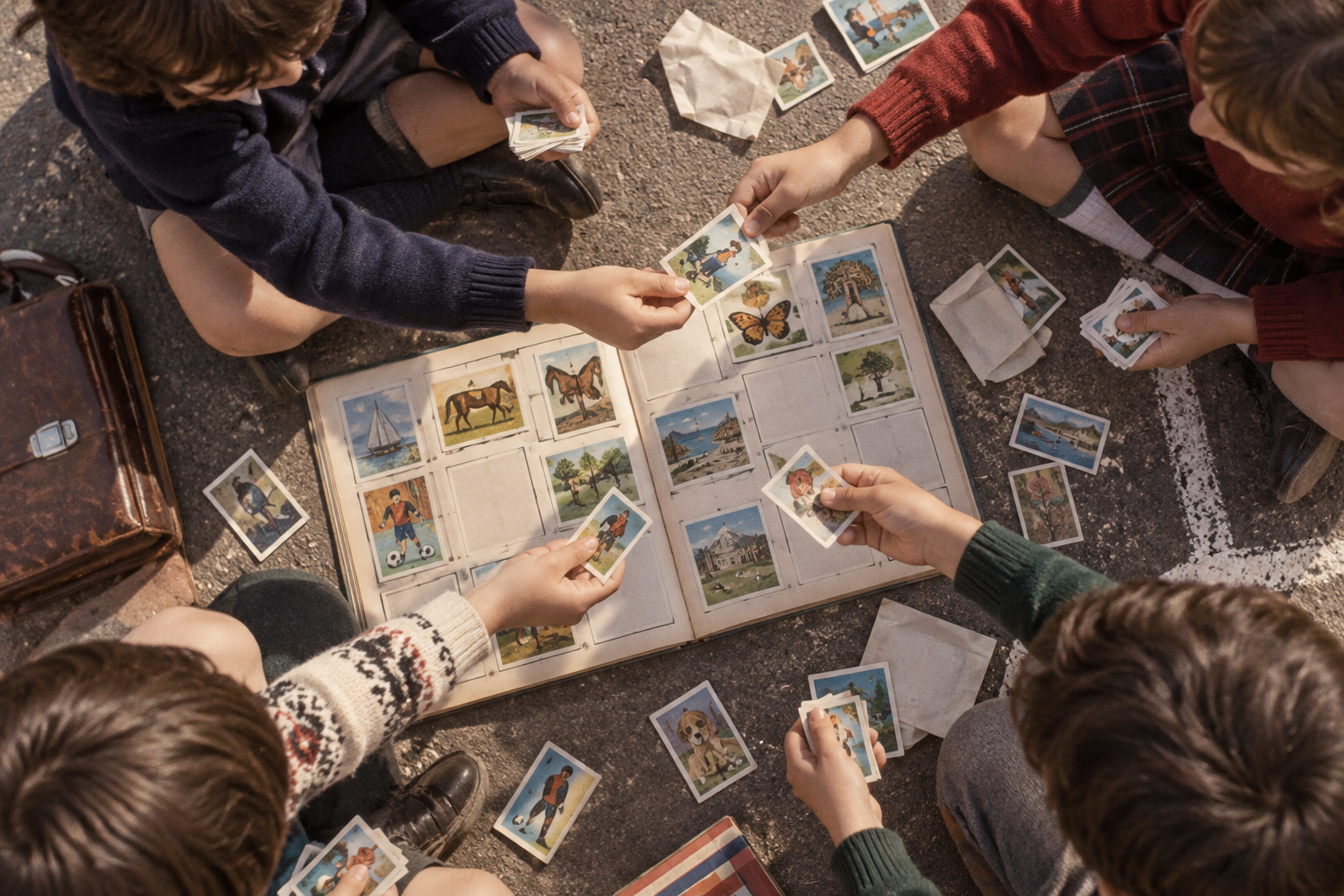
The most visible part of a filled album often hides its social component. A packet introduces uncertainty: it may contain a new image or a duplicate. A duplicate is not necessarily waste; it becomes trading material. Nostalgic accounts in the consulted blogs describe exchanges during school breaks, after school, in markets or at Madrid’s Rastro. They also recall glue in albums predating self-adhesive stickers and playground expressions such as “síle, nole”.
Those accounts are useful for approaching lived experience, not for measuring how common it was throughout Spain. They are situated memories written after the events. Even with that limit, they clarify a decisive quality: the album was often a means of conversation, assessment and negotiation among peers. A missing-sticker list, a pile of duplicates and the condition of the paper mattered as much as the printed image.
Heritage without treating nostalgia as proof
Institutions devoted to these items show that stickers can also be read as graphic heritage. Pixartprinting reports that Modena’s Museo della Figurina opened in 2006 and holds more than 500,000 small prints, while also addressing materials and techniques. In Spain, Turismo Somontano presents Estadilla’s museum as a chronological public exhibition, though it says that, for organisational, structural and space reasons, it shows very few collectibles after 1980.
A museum does not automatically turn every memory into historical fact, but it creates conditions for viewing pieces as documents: what was printed, how a series was organised, which subjects were considered appealing and what traces use leaves. An incomplete album can be as revealing as a finished one because it preserves the logic of wanting to complete it.
What endures
Between 1970 and 2009, subjects, finishes and sales channels changed, but the basic principle remained recognisable: a fragmented series invites people to gather pieces and compare what they have with what they lack. Its cultural force comes from the combination of editorial design, distributional chance and sociability.
The supplied evidence does not allow sales figures, prices or a uniform generational experience to be asserted. It does support the view that Spanish stickers moved from association with consumer products to circulation in packets bought specifically for the purpose, and that the football album became an especially visible reference point. More than a paper collection, the sticker was—and remains—a small infrastructure for completing, trading and remembering.
- Decade
- 1970s
- Region
- Spain
- Level
- Enthusiast
- Entities
- Museum
Sources and references
- Una historia de cromos | Pixartprintingwww.pixartprinting.es · 2026-09-20
- El mundo de los cromos, una historia de ayer y hoy | El trastero de Palacioeltrasterodepalacio.wordpress.com · 2026-09-20
- Museo del Álbum de Cromos de la Villa de Estadillaturismosomontano.es · 2026-09-20
- Cromos imposibles, 'repes' y demás mitos sobre la colección de LaLigawww.abc.es · 2026-09-20
- Álbumes de cromos y colecciones de los años 70 y 80 » Aquella Maravillosa Infanciaaquellamaravillosainfancia.com · 2026-09-20
- COLECCIÓN DE JUEGOS INFANTILES: LOS CROMOSmuseodeljuego.org · 2026-09-20


