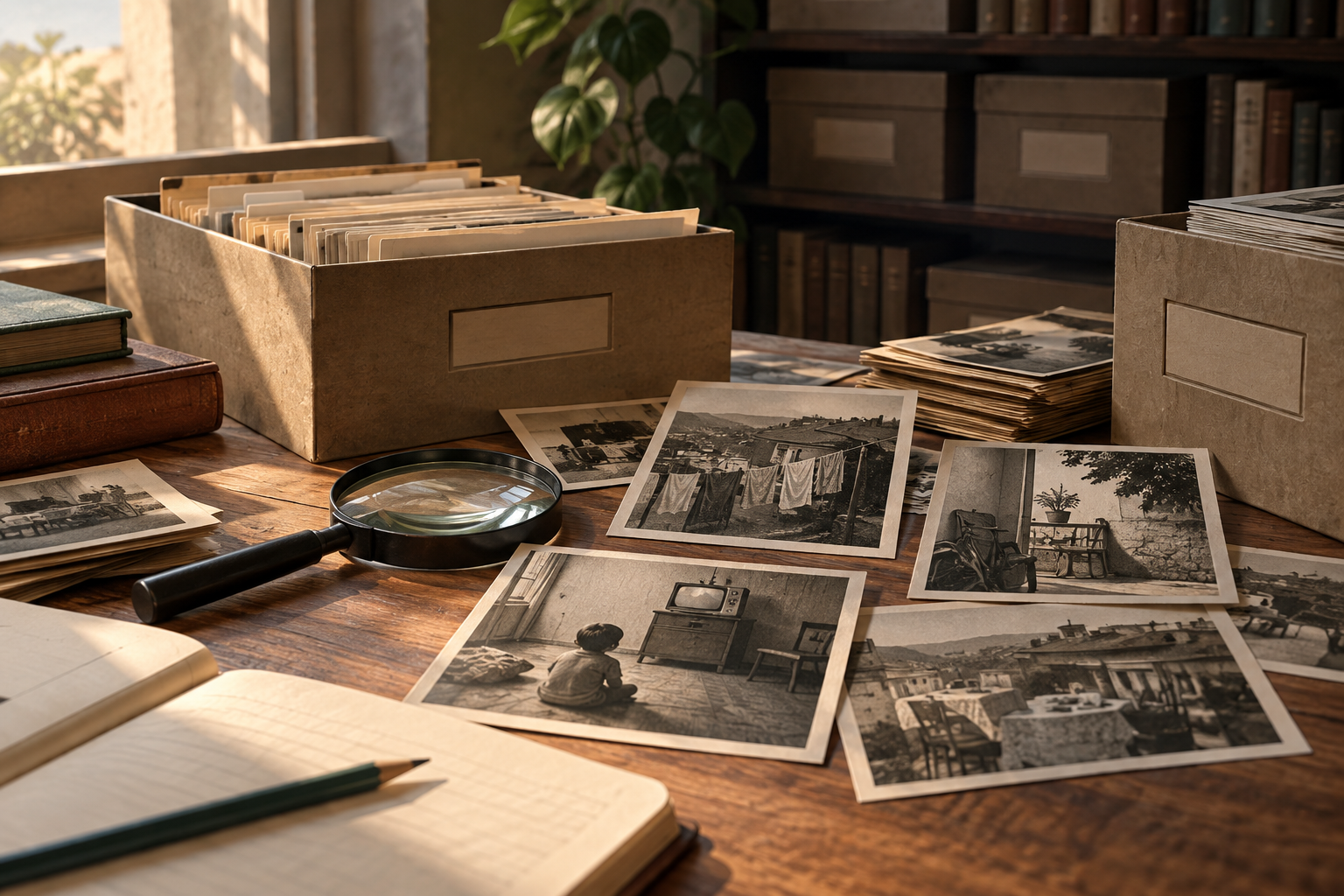
The problem is not finding memories, but testing them
Everyday life can seem easy to approach: a home, a magazine, a photograph, or a family custom may immediately feel familiar. That proximity is also an editorial risk. A domestic scene does not automatically represent a generation, a city, or a social class. Researching 1970-2009 means treating memories as a starting point, not as proof.
The history of everyday life addresses areas often left aside by political history: domestic and urban spaces, family, work, leisure, food, clothing, and celebrations. The University of Zaragoza’s course description lists these fields and connects them with mentalities and culture. Everyday life is therefore not one object, but a set of practices and cultural frameworks.
Ask a small question
A sound investigation begins with a limited question. Rather than asking how “people” lived in the 1970s, ask what sources can reveal a specific practice in a particular place and time span. Which periodicals are recorded for a year? What kinds of images does a photo archive preserve? What subject does an academic study address?
Available evidence can support questions without answering everything. Spain’s state-archive library catalogue records issues of Historia y Vida for 1970 and for 2000-2009. This documents catalogue availability, not content, circulation, reception, or influence. The distinction prevents claims the record cannot sustain.
Use catalogues and archives as access maps
Catalogues map access. The ministerial record for Historia y Vida helps locate holdings; conclusions require consulting individual issues and recording date, genre, authorship, images, advertising, and stated audience.
Photo archives leave a different kind of trace. The Censo-Guía describes a collection of roughly one million images, including photographs, reproductions, and slides, with everyday life and ethnography among its subjects. It also says that part of the holdings was incorporated into the Fototeca Nacional in the late 1970s. This identifies a repository and thematic breadth; it does not establish which homes, groups, or routines appear without consulting the items.
Read images as situated documents
A photograph may show objects, clothing, architecture, spatial arrangements, and gestures, while concealing much else. Caption, date, authorship, provenance, commission, and relation to other images shape its meaning. An institutional photograph, a family snapshot, and a press image were not made for the same purpose.
The National Library of Spain encourages comparisons between historical and current advertising while considering the messages, cultural patterns, models, and stereotypes it conveys. Its stated period does not itself cover 1970-2009, but its method remains useful: advertising is not a neutral inventory of real life. It selects audiences, desires, and norms.
Link domestic and social scales
Specialist bibliography prevents isolated readings of a kitchen table or family image. Fondo de Cultura Económica presents its Historia de la vida cotidiana en México series as a collective effort to understand everyday life across periods. The cited volume includes a chapter on women and domestic violence in a town in the Toluca Valley, 1970-1990.
That reference supports two choices. Recent decades can be studied through specific social problems, not only through objects and fashion. And research on violence, family, or inequality must not turn one case, chapter, or locality into an automatic national portrait. UNAM’s academic resource on everyday life and popular culture from 1940 to 1970 can serve as chronological background, not direct evidence for later decades.
Record uncertainty
Every research note should separate four fields: verifiable fact, exact source, scope, and unanswered question. “The catalogue records these issues” is a fact. “The magazine defined Spain’s everyday memory” is an interpretation requiring other sources. “The photo archive holds material on everyday life” is supported by the institutional description. “The collection represents the entire population evenly” is not.
Conclusion
Researching everyday life from 1970 to 2009 is not about collecting recognisable objects. It means matching a precise question to documents with known provenance, reading each source by its function, and stating its limits. Catalogues, photo archives, educational resources, and academic studies provide a starting route; responsible conclusions come only after consulting and comparing the materials. Nostalgia may motivate research, but it should not determine its result.
- Decade
- 1970s
- Region
- Other regions
- Level
- Advanced restoration
- Entities
- No linked entities
Sources and references
- Censo-Guía de Archivos de España e Iberoaméricacensoarchivos.mcu.es · 2026-09-17
- Catálogo Colectivo de la Red de Bibliotecas de los Archivos Estatales > Historia y Vidawww.mcu.es · 2026-09-17
- Vida cotidiana 1940-1970 Humberto Domínguez Chávez La cultura popularportalacademico.cch.unam.mx · 2026-09-17
- La vida cotidiana | BNEscolarbnescolar.bne.es · 2026-09-17
- Historia de la vida cotidiana - Repositorio Institucional de Documentoszaguan.unizar.es · 2026-09-17
- Historia de la vida cotidiana en México. Tomo V. Volumen 1www.fcede.es · 2026-09-17


