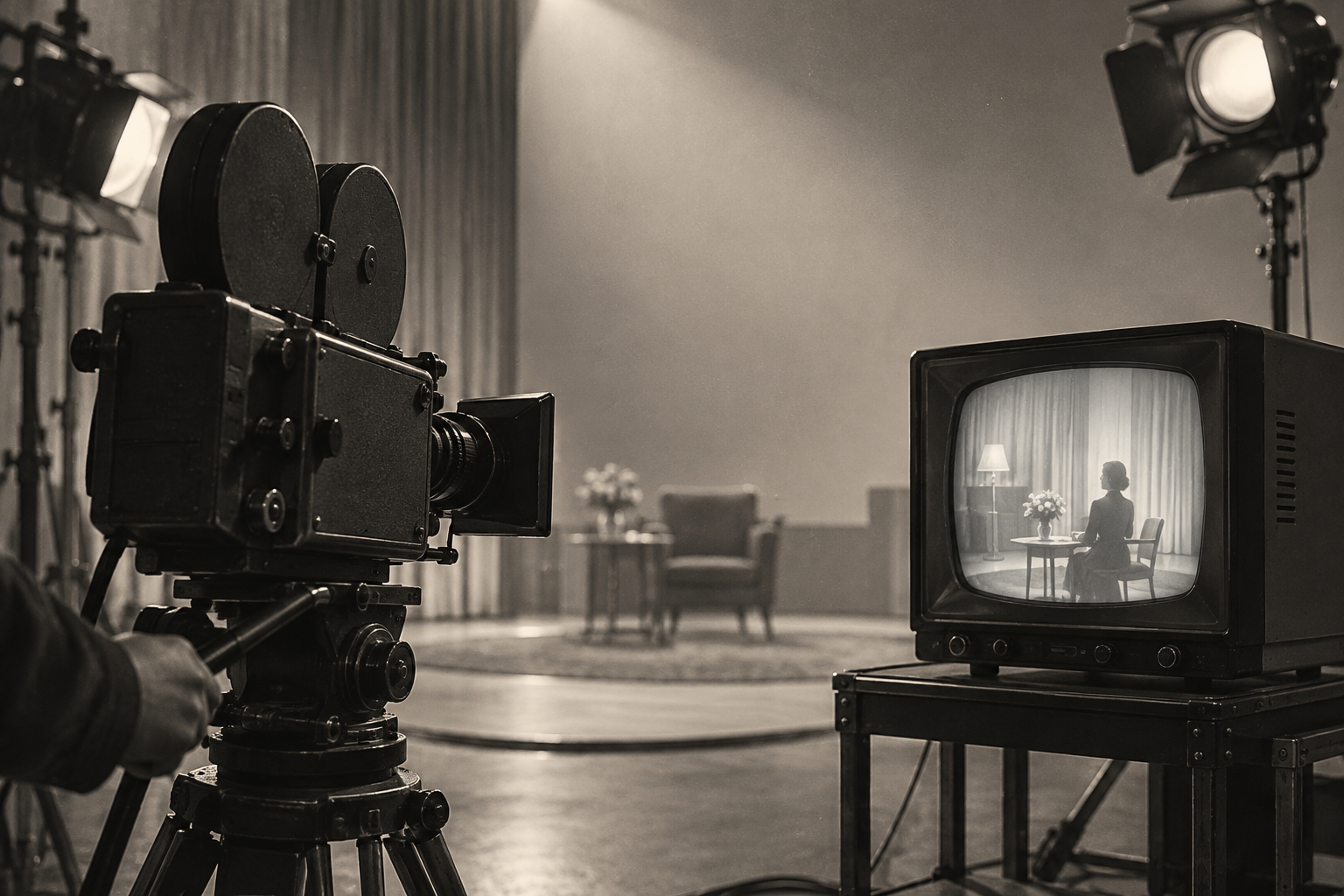
Television before a record button
Television is defined as a system for transmitting and receiving moving images and sound at a distance. Signals may travel by radio waves or specialised networks, while the television set is the receiver. That definition explains the medium, but not a key question for its early history: what happened once a broadcast ended? The Polytechnic University of Madrid’s Museum of Telecommunications states that, from the beginning of regular broadcasts in the mid-1940s until 1956, the only available means of recording television programmes was a motion-picture camera followed by film processing.
This was not a minor technical inconvenience. It places early television memory outside an instant, reusable capture process. Recording a broadcast meant turning a television image into film, processing that film, and only then having a copy that could be consulted or broadcast later. An early television archive must therefore also be understood through the materials and timings of cinema.
Mid-1940s: regular broadcasting and the need to retain
The starting point is not the abstract invention of television, but the arrival of regular broadcasting. The UPM source places that beginning in the mid-1940s. It explicitly identifies two reasons for filming: delayed broadcasts and programme archives.
Both uses reveal a practical pressure. Delay means that material made or transmitted at one time had to be viewed at another; archiving means that some programmes were worth retaining after transmission. Neither point proves that every broadcast was recorded or that a complete archive existed. The source supplies no totals, selection criteria, copy counts, quality assessment, or survival rate. Those gaps should not be filled with an assumption of comprehensive preservation.
The documented process: camera, then processing
The available sequence is short but clear: a motion-picture camera was used, and the resulting film was then processed. The order matters. A television broadcast did not immediately become a convenient playback medium. Film required a subsequent processing stage before serving the delayed-broadcast or archival functions named by the source.
That mediation separates the live television event from its surviving document. The transmission belonged to television’s flow; its record passed through cinematic material and labour. On the supplied evidence, it is not possible to establish camera configurations, film gauges, speeds, synchronisation methods, or national standards. Nor is it justified to attach the method to a particular product. What is documented is the operating principle: filming and processing.
1948: Spanish trials as context, not proof of method
RTVE records that, after the Spanish Civil War, the Dutch company Phillips carried out television trials at the 1948 Trade Fair. This is a useful Spanish reference for post-war television experimentation. Yet the short evidence does not state that these trials were recorded by the procedure described by UPM. The claims must remain separate: one source establishes the trials; the other describes the available recording medium for the broader period.
That caution prevents an overly linear account of technical development. Public trials, home reception, regular programming, and broadcast preservation are connected dimensions, but they are not interchangeable. A museum may display them together without treating temporal proximity as demonstrated technical linkage.
1951: making sets is not recording programmes
Pesquisa FAPESP reports that Semp, founded in São Paulo in 1942, was the first company to manufacture a television set in Brazil, in 1951. The point is useful because it shows that 1950s television included receiver manufacturing in Latin America. But a receiver is where a signal arrives; it must not be confused with the process used to preserve programming.
The distinction is valuable in collecting as well. A period television set can illustrate the experience of reception, while a motion-picture camera and film evoke the problem of preserving a broadcast or moving it through time. Television’s material history cannot be contained by one display case or one object.
1956: the explicit evidential boundary
UPM identifies 1956 as the end of the interval in which the motion-picture camera and subsequent film processing were the only available means of recording television programmes. The date anchors this timeline, but the supplied evidence does not identify a machine, company, country, demonstration, or specific broadcast at that point. It also does not explain which technology replaced or supplemented the process.
Accordingly, 1956 is presented here as a documentary boundary rather than a complete story of transition. Assigning an exact international adoption date or describing a later system’s specifications would go beyond the supplied sources.
What this meant for television culture
Even with limited technical detail, the cultural consequence is clear. Delayed transmission changed the relationship between programme and schedule; archiving created a route by which a broadcast might be more than a vanished moment. National Geographic describes television’s later growth as a mass medium, with formats such as sitcoms and the swift arrival of advertisers. That overview does not prove recording practice, but it helps explain why retaining programmes mattered.
PuroMarketing’s description of Reina por un día as a major Spanish success of 1964 belongs to a later stage and does not demonstrate recording technology either. It only reminds us that as programming and advertising expanded, programmes acquired increasing cultural and commercial weight.
Conclusion: a chronology of materials and limits
From the mid-1940s to 1956, the supplied evidence describes television recording as dependent on filming the programme and processing the film. This requires us to picture a medium whose memory was not automatic: camera, photographic stock, and processing all intervened. It also requires editorial precision. We know the stated uses—delay and archive—and the stated time frame. We do not know from these sources how every broadcaster applied the method or which individual works survived.
That mixture of certainty and restraint is the value of this timeline. Rather than claiming a total genealogy of television recording, it identifies a foundational material condition of early television and clearly separates documented facts from connections that require further research.
- Decade
- 1950s
- Region
- Other regions
- Level
- Advanced restoration
- Entities
- No linked entities
Sources and references
- Historias de las Telecomunicaciones – Museo de Telecomunicacionesblogs.upm.es · 2026-09-17
- Hace 100 años, unas "imágenes borrosas" cambiaron el mundo: así fue el nacimiento de la televisiónhistoria.nationalgeographic.com.es · 2026-09-17
- Cuando la televisión llegó a España: así eran los primeros anuncioswww.puromarketing.com · 2026-09-17
- Televisión – Museo ETSITmuseotelecomvlc.webs.upv.es · 2026-09-17
- Los inicios de la televisión en Españawww.rtve.es · 2026-09-17
- TV 100 años: de las válvulas al televisor inteligente : Revista Pesquisa Fapesprevistapesquisa.fapesp.br · 2026-09-17


